Lift Programming

I would like to share the programming style I used for USAWA meets.

With the number of meets and lifts in the USAWA, programming efficiency is key not to over train while still competing competitively in several lifts.

The simple strategy I used was;

Combine the “main” weight of one lift to be the “warmup” weight of another.

For example, if you are training for a split jerk, push press the lighter warmup weights. While you are doing warmup weights for push press, strict press them.

Obviously if your form needs work, you need the reps but if your skill and strength are adequate, squeeze in an extra lift or two.

My deadlift strategy for the longest time is to use thumbless until grip starts to fail, then double over, and finally alternate grip.  It allowed me to train 3 styles of deadlift without one impacting another.  Train for 3 types of lift without any programming changes off the bat.

Once the weights are programmed, the goal is to hit the prescribed reps for each deadlift type but if the grip starts to fail, the barbell is floored, and the next grip is taken to finish out the reps and the workout carries on.

When training for meets, specific changes are made. This could be adding a lift or replacing a lift plus equipment changes e.g. Fulton deadlifts. Also singles for the meet lift will be added.

If finger deadlifts are on the horizon, they would be added first, becoming the warmup to the thumbless deadlift.

If there’s a Peoples deadlift, the no thumb deadlift may be removed to save strength and to start at a higher poundage. The Peoples deadlift would continue after the alternate grip deadlift.

If you are going for a thumbless record, this is going to be pushed  followed by a few extra singles before the full grip deadlift. You’ll then perform the rest of the deadlifts in the series to “keep the wheel greased” but you won’t push them.

I used my PR’s from 2020 for the example below. Using the 531 method by Jim Wendler, I took 90% of these PR’s to calculate an individual workout for each.
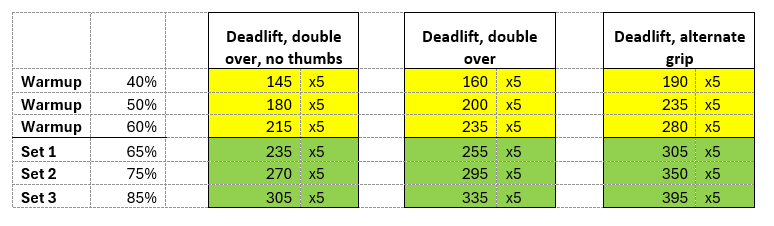
So instead of 3 workouts with 3 separate warm-ups, they will be combined into one workout;
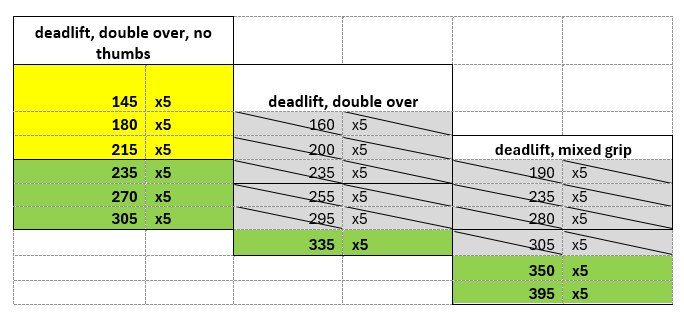
The greyed out poundage is made redundant by the previous lift. You’ll need to decide where one lift ends, and another begins based on the poundages. Since “no thumbs” ends at 305, the closest weight to that (and lower) will be ignored, thus “double over” will start on its last set of 335. Then “mixed grip” will finish its last two sets. If you feel you need more work on x lift, just repeat the last lift weight with the new lift. E.g. after “no thumbs” 305×5, do “double over” 305×5, then 335×5.

Meet manipulation example 1

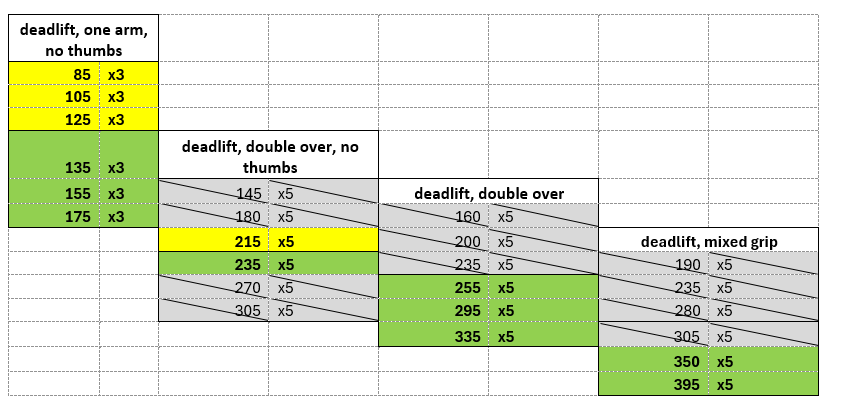
Say the next meet has a no thumb one arm deadlift, since they are the lightest, they are placed at the start and will replace part of the “no thumbs” warmup. Since both hands will be trained, I drop the reps to 3 and do each arm per set. Also since these are “no thumb” you may want to only do a few sets of “double over, no thumb” and jump early to “double over” as to not stress the thumbless grip.
Meet manipulation example 2

Maybe there’s a meet with the “peoples deadlift” and a Postal the following week with “double overhand”. Since “Peoples” is a heavy lift, you may want to strip down the sets, so “no thumbs” is reduce to a couple of warmup sets to still get some training in, then the lift is switched to “double overhand” for the rest of the warmup and main lift. Some singles are added to train strength before a set of “mixed grip” as a filler to warm up for the “peoples deadlift”.

While these all use the same bar, there is no reason dumbbell lifts like one hand/two hand, Fulton, Inch etc can be used early as well as a Fulton barbell lifts.

The same process can be used as a dumbbell workout, regular > to fulton > to inch.

There are many USAWA lifts that can be “cheated” into another lift’s progression. Even just combining two that fit well will make a difference.

Hope this was helpful to anyone struggling to program many lifts into their routine.

USAWA Business

Please send Secretary correspondence to Sanjiv Gupta (sanjiv_gupta@hotmail.com) until further notice. This will include meet sanction forms, meet results, membership applications, etc.

The Executive Board intends to keep USAWA running with minimal disruptions. Several members and special assignment directors have been pitching in to keep content on the website and social media platforms.

Travis Lift

Any bar may be used in this lift, which may include the Heavy Lift Bar. The bar is supported on stands or a rack at waist height. The lifter assumes a position with the bar in front of the lifter. The feet must be parallel and in line with the torso. Width of feet placement is optional. The feet must not move during the lift, but the heels and toes may rise. The lifter is allowed to grip the bar with any grip, and may also have a specially adapted belt attached directly to the bar or connected by a chain. The lifter may perform the lift without the use of this belt. The lift begins at the lifter’s discretion. The lifter is allowed one test lift to check the balance of the weight and to make adjustments to the chain length or height of the support stands. The lifter will stand and lift the weight or bar clear of the stands or rack. The shoulders and torso do not have to be upright upon the finish of the lift. The legs must straighten, but the knees do not need to be locked. Once the weight is motionless, and the plates on both ends of the bar are off the supports at the same time, an official will give a command to end the lift.

I have been interested in the Travis Lift for over a year. I reached out on the USAWA Forum and had several responses. Most of the responses were words of warning. Being physically attached to weights from 900-2000 pounds that could travel 3 feet before coming to rest on the ground can obviously end badly.

Reviewing the records list, brave souls have taken this on three different times: Ambridge RD 1990 (1), Dino Gym Challenge 2006 (15), and Florida RD 2015 (2)

  • Women’s Records:
    • Kirstie Griffis – 520 (Dino Gym Challenge 2006)
    • Misty Fritz – 520 (Dino Gym Challenge 2006)
    • Mary McConnaughey – 740 (Dino Gym Challenge 2006)
  • Men’s Records:
    • Theo Prior – 705 (2015 Florida RD)
    • Kent Longbine – 880 (Dino Gym Challenge 2006)
    • Derek Prior – 585 (2015 Florida RD)
    • Layne Burnett – 1200 (Dino Gym Challenge 2006)
    • David Suttle – 1200 (Dino Gym Challenge 2006)
    • Rick Newton – 1200 (Dino Gym Challenge 2006)
    • Joe Garcia – 2000 (Dino Gym Challenge 2006)
    • Dean Ross – 1200 (Dino Gym Challenge 2006)
    • Howard Prechtel – 1815 (RD Ambridge 1990)
    • Rudy Bletscher – 740 (Dino Gym Challenge 2006)
    • Tim Pinkerton – 1200 (Dino Gym Challenge 2006)
    • Kurt Pholman – 1000 (Dino Gym Challenge 2006)
    • Bret Carter – 1600 (Dino Gym Challenge 2006)
    • Eric Todd – 2000 (Dino Gym Challenge 2006)
    • Josh Hettinger – 1200 (Dino Gym Challenge 2006)

Taking this lift on requires (1) an attachment to a belt (2) a platform or pins to pull from and (3) enough plates to test a 1RM.

I fashioned an attachment from leather that I had left over from another project.  I was planning on running chain from the belt attachment to a normal Olympic barbell.

For the platform, my blocks were not tall enough, so I set up a barbell on the safety stops of my squat rack.  This seemed a little sketchy.  If the weights got heavy enough or I missed a lift badly enough, the whole squat rack could just tip over.

The weights are an obvious frustration also.  With a crew of lifters, setting up a heavy lift is not so bad.  At home, it is much harder to get all of the plates out and put them away than it is to perform the lift.

I worked my way up from 135 and spent every 90-pound increment fiddling with the connection to the belt.  Whenever I thought I had it right and added more weight, the belt attachment felt too long.  When the attachment is too long, you have to hold tighter with your hands.  I eventually topped at 525 pounds.

525 pounds is not heavy.  Many athletes my size can deadlift that without issue.  For me, my grip is probably done somewhere around 400 pounds and the belt attachment bought me another 125 pounds.

What lifts have you been trying lately?  Consider submitting an article for the USAWA website!

2025 One Ton Challenge Results

The first One Ton Challenge Meet was the brain child of Jeff Wenzel. These lifts were meant to be challenging, while at the same time allow lifters to post some big numbers. Preferably, the lifts are those named after someone. The meet was a success drawing in 20 lifters from five different gyms and two nations. On the women’s side, we had seven lifters, five in the competition and two for records. Allison Lupo was thrilled to win her first outright title in a contested meet. She had a great day as she rolled up a total of 925 lb, and was the only female over 1000 points with age and weight. She wasn’t the only female lifter with big numbers as Mary McConnaughey posted 900 lbs in four events and Lisa Gore lifted 855 lb on a bum knee to take 3rd place. Janet Thompson was the second place finisher.

On the men’s side we actually had two lifters make it to one ton! Both Jeff Wenzel (2357 lb) and Abe Smith (2335 lb) went the extra mile posting totals of more than one Metric Ton (2205 lb). Only 22 lb separated the two, or a hair under 1%! After age and weight were accounted for, Abe Smith came out on top. The battle for 3rd was also interesting as Travis Luther lifted 1910 lb, while Riley Wenzel came in at 1810 lb. For both that is more than 90% of a ton! But once age and weight were accounted for, they literally flipped spots. Tony Lupo gave it a good try getting just over 82% of a ton.

Some big individual lifts were made as Lisa Gore (300 lb People’s DL), Allison Lupo (275 lb People’s DL), and Mary McConnaughey (275 lb People’s DL) all set records in this event. Janet Thompson set a new standard with 200 lb in the Kennedy DL, and Alix McGregor at 79 years young did an Anderson Squat of 120 lb. On the Men’s side perhaps the most impressive lifts were from Jeff Wenzel (700 lb Anderson Squat), Abe Smith (600 lb Anderson Squat), with Travis Luther posting a 575 lb Kennedy DL, and Riley Wenzel was not too far behind at 495 lb. Sanjiv Gupta also posted a record 380 lb in the Kennedy, and relative newcomer Jerome Licini hoisted 360 lb in the same lift. Everett Todd at the tender age of 12, also got a big number on the Kennedy at 265 lb. Eric Todd lifted an impressive 300 lb in the Anderson Press. Tony Lupo’s big lift was 475 in the People’s DL.

2025 IAWA Andy Goddard Memorial Postal Results

The final results with records noted are available for the 2025 IAWA Andy Goddard Memorial World Postal. Thanks to Chris Bass and Paul Barette for preparing these. The USAWA fared quite well thanks to the four clubs that participated. The four were Iron Throne, High Country Vigour, Frank’s Barbell Club, and Clark’s Gym. All in all the USAWA had by my count 25 new world records, three teams (Clark’s 1, Clark’s 2, and Franks Barbell Club) were part of the top 10 teams, and Frank’s Barbell Club and Clark’s Gym finished 5th and 2nd, respectively. The USAWA also claimed four of the 10 best lifters by age class (Dan Jones 40+, Jeff Wenzel 50+, Tony Lupo 55+, and Dave Deforest 65+) as well as eight (Jeff Wenzel, Dave DeForest, Riley Wenzel, Travis Luther, Tony Lupo, Dan Jones, Wade Marchand, and Kim VanWagner) of the top 20 individual lifters! Well done USAWA!

1 13 14 15 16 17 537