USAWA Deadlift Rules
Does the body need to be upright? Can Sumo stance be used?
I have been involved with All-Round Weightlifting for four years and have officiated in 48 USAWA competitions, but the rules of the deadlift variations always require careful study of the rulebook. I think a careful study of the rulebook is essential for every athlete, but especially those who choose to support the organization by officiating.
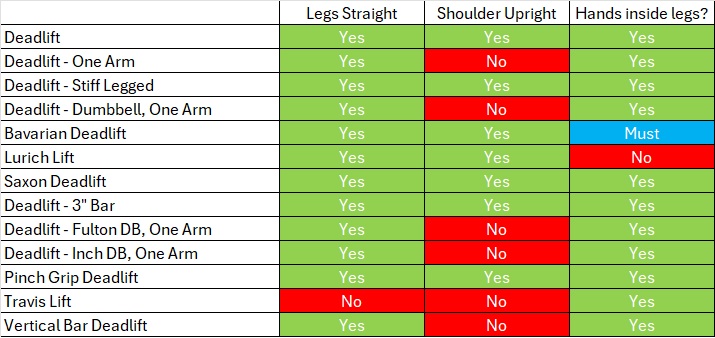
The question that most often comes up is does the body need to be upright? The second question that comes up is hand position and whether the hands can be inside the legs?
My understanding of the traditional deadlift is that the body needs to be fully erect (knees locked, hips open, shoulder erect). However, with one arm deadlifts, the shoulders do not need to be pulled erect. This was likely due to limb length variation which may not allow the shoulders to be erect without interference with the groin if the bar were being straddled.
My understanding of the traditional deadlift is that the arms should be outside the legs. However, arms inside the legs is often more comfortable for athletes based on limb length variation. Given this variation and the opportunity for a very wide stance, the rule book typically states that the bar needs to be above the knees when the lift is completed.
As follows are the references in the rulebook.
- The Rules of the Basic Movements – Deadlift (XII.A) states that legs are straight, shoulders erect and bar motionless. It also mentions that any hand spacing may be used.
- Deadlift – One Arm (B13) Bar must be raised to a point where both ends of the bar are above the knees, but the shoulders do not need to be pulled erect or the body straight as long as the legs are straight.
- Deadlift – Stiff Legged (B16) This is the first mention that arms are allowed to be inside the legs.
- Deadlift – Dumbbell, One Arm (E13) refers back to Deadlift – One Arm (legs straight, shoulders not erect)
- Bavarian Deadlift (H4) – lifter has to use Sumo stance
- Lurich Lift (H12) – Sumo stance is not allowed
- Saxon Deadlift (H14) – Rules of Deadlift (legs straight, shoulders erect)
- Deadlift – 3” Bar (I4) – Rules of Deadlift (legs straight, shoulders erect)
- Deadlift – Fulton Dumbbell One Arm (I7) refers back to Deadlift – Dumbbell, One Arm refers back to Deadlift One – Arm (legs straight, shoulder not erect)
- Deadlift – Inch Dumbbell One Arm (I8) refers back to Deadlift – Dumbbell, One Arm refers back to Deadlift One – Arm (legs straight, shoulder not erect)
- Pinch Grip Deadlift (I15) legs straight and body erect
- Travis Lift (I24) shoulders and torso do not need to be upright
- Vertical Bar Deadlift – 1 Bar, 1”, One Hand (I26) legs straight and knees locked, but shoulders and body do not need to be erect. Lifting hand must be above mid-thigh.
Did this article miss anything or are corrections required?
Do you have an idea for a USAWA website article? Consider submitting some content for the website.