Tag Archives: Larry Traub

Making Weight for Competition (Part 2 – water loss)

by Larry Traub
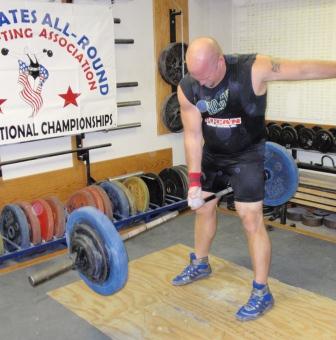
Chad Ullom performing the Thumbless Grip One Arm Deadlift at the 2012 USAWA Grip Championships. Chad weighed in at 238# for the Grip Champs, and then weighed in at 248# the next day for the Dino Gym Record Day. He utilized water loss to make this 10 pound difference in weighins a day apart. (photo and caption courtesy of webmaster)

In the first article I talked about my high school wrestling days and how my extreme dieting made my life miserable and certainly made me less of a wrestler.  I do remember however the fall of my senior year I decided I would start a month or so before wrestling season and start gradually decreasing my weight through diet and a running program. I remember hanging in there a weeks or so, losing a couple of pounds and thinking; ‘This is stupid, I can lose 5 pounds in a couple of hours in the wrestling room with my rubber suit on, I’ll just enjoy the time between now and the start of the season and worry about it later’. In retrospect, I was on the right track, but I abandoned my plan because I didn’t distinguish between fat loss and water loss.

I believe it is possible to use moderate dehydration to your advantage in making a weight class for an athletic activity.  However, it can be tricky and the percentage of body weight that you choose to lose should be determined by several factors.  The method I have used in power lifting competitions many times is to dehydrate approximately 5% of my bodyweight over a 3 day period.  If I am going to compete at 198, I want to reduce my bodyweight to 208, using the fat loss method described in the previous article. I would then lose the last 10 lbs by dehydration and hopefully compete at a bodyweight around 208 or possibly even more.  Let’s say I have a Saturday morning weigh in. I would basically eliminate liquid from my diet after my noon meal on Wed. My projected bodyweights would look something like this:

  • Wed morning – 208
  • Wed night – 208
  • Thu morning – 206
  • Thu night – 203
  • Fri morning – 201.5
  • Fri night –199
  • Sat morning – 198

Notice that the rate of loss decreases over the dehydration period because, as you dehydrate, it will be more difficult to lose additional fluid.  In order to accomplish this, you should be eliminating fluids, as well as eating DRY food.  You must remember your goal is to lose water weight, not muscle, and, at this point, no fat loss, so you must continue to eat well.  If you have been following the fat loss program you really want to take in your normal calorie intake plus at least an extra 500 calories per day. This would put you around your BMR and should keep you from losing anything but water weight.  Actually, I don’t count calories during the dehydration period but I become concerned about getting enough calories. I’m actually reversing the rule of thumb that I used in the fat loss phase. I am trying to get a maximum number of calories from a minimum amount of food. I am still concerned about taking in an appropriate amount of protein and other nutrients, but if I’ve been craving pecan pie, I will go for it.  Just don’t plan on enjoying it as much as you would if you were washing it down with a glass of milk.   In the later stages of the process, I suspect you will have little desire to eat and you may decide you would rather have 6 ounces of water instead of the dry meal in front of you. Stay with the plan or at the very least treat yourself to six ounces of ice cream where you will get substantial calories while enjoying something with moisture in it.

Over the years, I have tried a number of different things. Once, I determined that if I spent some time in the sauna, I could then drink a glass of water at bedtime and eliminate going to bed thirsty.  The glass of water tasted good going down but provided little or no relief for my thirst so I decided it wasn’t really worth it.  Sucking on hard candy seemed to conquer the thirst issue as well as any other thing I tried.  You should also be aware that the morning of the competition you will feel like you would be lucky to squat a 45 pound bar, but as you rehydrate your energy levels will return.  I actually learned to like the dehydration process, somewhat. Normally, a few days before a competition I would start obsessing over my projected lifts and start to get anxious about the contest.  However, when you are dehydrating the process becomes your entire focus.  All you care about is making weight and drinking that first bottle of water. I really feel I’m more relaxed and confident going into the competition because I have spent time concentrating on the dehydration phase instead of the competition itself.   So, you endured 3 days of hell (actually the first day and a half aren’t too bad) in order to give yourself an edge. Let’s make sure you take advantage of it.  Several times I’ve been able to weigh myself shortly before my final deadlift and I would usually weigh around 210. At this point my bodyweight is closer to the 220 lb class than the one I am competing in. This is quite an advantage and I have planned well and worked hard to make it happen!

I start my rehydration as soon as I get off the scale. I usually have a bottle of water, a bottle of pedialyte, and a banana set aside. The water will go down easy, so I quickly consume that and the banana. Then I would force the pedialyte down on the way back to my motel room. The pedialyte was suggested to me years ago by my friend, Dave Glasgow who was an R.N. This nasty stuff was developed for infants who are dehydrated and it works better than sports drinks because it doesn’t contain sugar, which is a diuretic.  By the time I walk back to my hotel room, I hope to be a few pounds heavier and I will sit down, continue to hydrate, and eat a little. I focus on carbohydrates with some sugar for energy. One of my favorites is a whole wheat bread with honey. I will switch to sports drinks but it would probably be to your advantage to get the reduced calorie types that are now available which will help you avoid an excess of sugar. I focus on hydrating and eating without getting bloated and uncomfortable.   Knowing how much time you have before you lift is crucial. Typically I could figure I had close to two hours before my first squat but If I got lucky and I was in the second flight, I might have an additional hour and I would eat and drink a little more,  knowing that I had a little more time to absorb and digest.  I do not intend to be fully rehydrated by the time I squat, but I should be at least 6 or 7 pounds heavier. By the time I bench I will probably be pretty much fully hydrated (around 208) and, if I execute my plan well, I should be overhydrated for deadlift. It is possible to overhydrate because your body compensates for its period of having insufficient water by holding on to all that it can. (I’ve discovered several times that providing a sample for the drug test can become a lengthy process.)  Now, in order to gain 12 pounds I must consume at least 12 pounds over the course of the competition. I accomplish this by having a sports drink or water with me at all times. I will basically sip my way back to being fully hydrated being careful not to make myself uncomfortable in the process. I will also eat small meals throughout the day. Bread and honey, fresh fruits, small sandwiches; one of my favorites is to buy a small unfrosted angel food cake and periodically grab a chunk of that.  Again, don’t make yourself bloated or uncomfortable.  If I finished my last squat and I know I have an hour before I have to start warming up for bench I will eat and drink a little more, but basically you need to listen to your body. 

Of course, the model I’m using here is a full day contest with competition starting two hours after weigh in. Adjustments should be made for different competitions. If it was a bench press meet where the lifting would be completed within 3 hours of weigh in I would probably dehydrate around 3% instead of 5%. If there was a night before weigh in I might push it up to 6% and try and lose the last pound or so in a sauna right before the weigh in.  I imagine the process of dehydration is not extremely healthy; however, I usually competed only once or twice a year, so I don’t have any great concerns about that. If you are going to compete more often, then you should think twice about how much you should dehydrate.  If I could go back to my wrestling days, where I had to make weight a couple times a week, I think that maybe losing about 1% of my bodyweight would be appropriate.  The bottom line is that the fat loss, as described in the first article, combined with dehydration and proper rehydration, may provide significant benefits to your totals. Good luck!!
Making Weight for Competition (Part 1 – fat loss)

by Larry Traub

Randy Smith performing the Cheat Curl at the 2011 USAWA National Championships. Randy maintains his competition bodyweight year-round by regular exercise and proper diet. (photo and caption courtesy of webmaster)

This is going to be a two part article.  First I will write about the process of slowly losing weight over the course of time to get you reasonably close to your competition weight. (Probably within 5%.)  The first article will be the fat loss article, which in my opinion would apply to anyone who would like to reduce the amount of fat on their body.  The second article will deal with water loss (dehydration) and it’s very important that you distinguish between the two.  It should also be noted that muscle loss is in no way desirable and is generally what happens to millions of people who just think in terms of “weight loss”.

Trivia question: What was Arnold’s first major movie?  ————– Wrong !  Before the documentary “Pumping Iron” Arnold was in a movie with Sally Fields and Jeff Bridges called “Stay Hungry”.  Prior to this movie I had spent what seemed a great deal of my life ‘staying hungry’ trying to make a competitive weight class, due to my involvement with high school and collegiate wrestling.  The great irony is that it wasn’t until I decided to try my hand at bodybuilding (Arnold’s sport) that I realized that staying hungry was counterproductive to what I was trying to accomplish.

Muscle is good.  I know I’m preaching to the choir given the readership of this site, but we know that muscle is so desirable that we are willing to do what we do to attain it.  The question is, what can we do to retain it during the weight loss process?  To make sure we retain all that valuable muscle we need to understand survival mode.  The cave man eats well when game is plentiful but never knows when things will change and he may have to go an extended time without food.  When he gets hungry his body anticipates a period of insufficient food and switches to survival mode.  First, it slows down the body’s metabolism.  Secondly, it makes muscle the preferred source of energy in order to preserve as much fat as it can, because the stored fat is what it needs to get through the period of little or no food.  If it sounds like staying hungry is a bad idea then you’re getting the picture.

Not only is staying hungry a bad idea, it is a battle you have little or no chance of winning.  Ghrelin, sometimes referred to as the hunger hormone, is there to make sure you lose this battle. The caveman has very little energy because his metabolism has been slowed to a crawl, he has depleted much of his muscle so his strength levels are way down and yet he has to go out there and do whatever it takes to hunt down and kill a wild animal or he will die.  Ghrelin becomes his friend.  It makes his hunger so intense that he is willing to do whatever it takes to feed himself.  If ghrelin can make a hungry caveman go kill a bear with a club then there’s a good chance that it will make the modern day hungry man get off the couch, get in his car, go to McDonald’s and supersize whatever combo appeals to him.

How do we avoid survival mode, retain muscle, and accomplish our weight loss needs?  We must avoid being hungry.  I feel certain that most everyone could eat as much or more as they do now and reduce calories sufficiently to achieve a slow steady weight loss.  A maximum of one pound per week is the rule of thumb that I think is ideal for weight loss.  Since there is 3500 calories in a pound of fat then a reduction of 500 calories per day is what we need.  You need to discover your basic metabolic rate (BMR) which is simply how many calories you would normally burn in a 24 hour period.  The old formula is 15 times your bodyweight but you can google BMR and get a more sophisticated formula. The number you come up with, regardless of your method, is based on averages and it’s probable that yours is significantly better because you (as a reader of this site) should have a greater percentage of muscular composition.  Finding out your true BMR is a matter of trial and error.  I would suggest you use the number from your formula, subtract 300 to 500 calories and carefully evaluate the results.  First, disregard the results of the first 2 weeks because there will be significant water loss due to the fact that you are changing the types of food you eat.  You should probably be weighing daily, first thing in the morning and pretty much disregarding the weekly highs and lows. If you are losing slower or faster than a pound a week then make small adjustment until you are consistently losing a pound a week.  At that point you’re BMR is 500 calories greater that your intake.

You can use this knowledge and an adjustment in the types of food you eat to avoid survival mode.  The basic concept is this.  Eat as much food as you possibly can in the process of taking in your prescribed calorie intake.  You need to know that fat and sugars provide the most concentrated amount of calories per gram so minimizing your intake of both will probably result in you taking in a lot more food than you ate before you reduced your calorie intake.  You will not be hungry, therefore no survival mode and your body will gladly use stored fat for energy and allow you to keep, or even build muscle during the process. And you will feel great.

As a clueless high school wrestler I was convinced that staying hungry was what I had to do.  For years my parents would tell the story that during wrestling season their electricity bill would go up because I would constantly open the refrigerator, stare into it for several minutes, and then eventually close it without taking anything out.  It was me against the ghrelins and I guess I defeated them for a few months each year.  The sad part was, even though I loved the sport I learned to dread wrestling season because of the misery of being hungry.

Contrast that with the dieting that I did years later in preparation for a bodybuilding contest.  I was eating practically no fat or sugar and I was counting every calorie by carrying around a little clicker.  I can remember many times where I was watching TV in the evening and thinking about going to bed.  I had eaten very well all day long and was not at all hungry.  I would look at my clicker and tell my wife, “geez, I still have to eat 300 more calories.” I can still remember the sympathy my wife would express when I made these announcements.  Fortunately she is not the type of person that is prone to using hand gestures.

I know that carrying around a clicker to count every calorie is probably a bigger leap than most are willing to take.  In more recent years I have had a more haphazard approach with similar results.  The last time I made 198 lbs for a powerlifting competition I determined how much fat loss was necessary.  I allowed one week for every pound I needed to lose and made adjustments in my diet without actually counting calories.  I watched my weight closely and made adjustments if I was losing too fast or too slow.  It’s been several years ago now, but for a period of 6 or 7 consecutive years I competed in the masters nationals held in early May.  After letting my weight climb during the holidays I would do the math and alter my diet shortly after the beginning of the year.  I can honestly say I started looking forward to this time of year.  I knew I could do it without any hunger and my energy level would actually improve.  I guess the word diet will always contain four letters but maybe when you learn how to defeat the ghrelins you won’t have to think of it as a four letter word.

NOTE:  I feel compelled to admit to plagiarism.  Dr. Bryant Stamford is the local fitness Guru in the Louisville Area and writes a fitness column for the local paper and does fitness segments on the radio.  He is also an accomplished author and a college professor.  I am a math teacher but for years I taught an elective PE class called strength and fitness.  I used many of Dr. Stamford’s articles in my class for all sorts of topics.  I did not really go back and pull any articles while I was writing this but I know that most of the ideas in this article are ingrained in my head because of the many times I discussed his articles in class.  Dr Stamford and I knew each other a lifetime ago when we served on an AAU committee together but since then he unknowingly become a mentor to me and I thought if I said some nice things about him then maybe I won’t hear from his lawyers.  I heard him say something on the radio several years ago that relates to this article and really stuck in my head.  When people realize who he is, they often want to tell him about their accomplishments.  Quite often someone will brag about losing a significant amount of weight in a short period of time. (I’ve lost 25 lbs in 6 weeks.)  Dr. Stamford says that he politely congratulates them but, what he really wants to say is, “Oh, I’m so sorry !”  Sorry because you’ve lost muscle.  Sorry because you’ve messed up your metabolism.  Sorry because eventually the ghrelins will win, you will gain it back and because of your muscle loss you will be fatter then before.

Chasing Squirrels and Bench Pressing

by Larry Traub

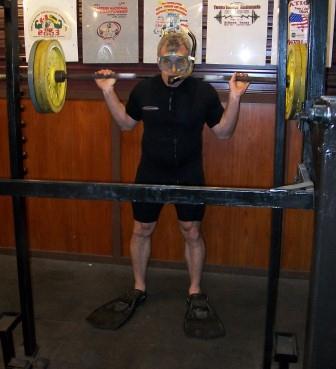
Larry Traub training the squat in his wet suit, getting ready to take the weights for a deep dive! (photo caption courtesy of the webmaster)

I ran into a childhood friend of mine a while back. We were standing outside a business, waiting for some things to be done and catching up on each other’s lives.  He had a small dog with him who kept wandering off, but returned when called.  He proceeded to tell me that the dog was old and in pretty bad shape. He told me the dog had some kind of degenerative condition with his hips, but then added, “He couldn’t be hurting too much because he chases squirrels around the yard like he was a young pup.” Now I don’t claim to be a ‘dog whisperer’ but I would bet the farm that his hips hurt like the devil when he was chasing those squirrels.  I just think that his addiction to chasing squirrels outweighed the pain that it caused him.

Lifting weights for a lot of us old timers can be a lot like that. Forty years of lifting and I have never had any serious injury of any type which I would like to attribute to good form and training hard without overtraining.  The glitch for me has been joint pain. The big one for me has been arthritis in my shoulders, but at different times my elbows, wrists and knees can get fired up also.

A few years ago I was adding on to the back of my garage to house my new weightroom and create more room for my toys. The process of building, which involved constantly climbing ladders and going through about 50 lbs. of 6”pole barn nails, proceeded to create pain in my elbows, knees, and wrists. During this process I discovered the power of neoprene. Neoprene sleeves seemed to keep the area warm as well as provide support, and that gave me some relief from the pain. I started considering how I could provide that relief for my shoulder and the only thing I could come up with was a wet suit.  I found out you could buy a “shorty” wet suit which was short sleeved and went to mid thigh. I figured I could get the desired effect for my shoulder, hips, and lower back and wear it under workout clothes without looking totally ridiculous.

So I walked into a local dive shop. (I have been to a couple of dives over the years, but this was my first trip to a dive shop.) I explained what I wanted and then I made the mistake of telling him why I wanted it.  When I explained how I wanted to minimize all the pain that I was having his response was, “Shouldn’t you just quit.”

Hell of a salesman!  I bought one off the internet.  As a matter of fact, I wore that one out and I’m on my second one.

Should I “just quit”?  It’s not going to happen. I’ve made some adjustments over the years but right now quitting is not an option. Since my strengths as a powerlifter have always been in my squat and deadlift, I have been able to minimize the actual bench pressing I do in my workout without a disastrous affect on my total, so it seems reasonable, to me, to keep competing.

I was bench pressing at my first annual Monster Garage meet last spring and there was a loud pop from my shoulder which has become quite normal when I bench press. One of the other lifters heard it from the back of the garage. He was a former high school lifter for me and after I completed the lift he asked, “Coach, does that hurt?”  Yeah, it hurt like the devil but right now my addiction to powerlifting outweighs the pain.

Rep Schemes

by Larry Traub

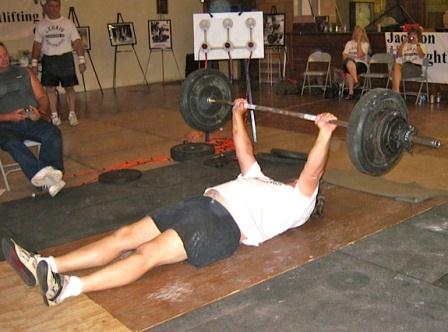
Dave Glasgow performing a Pullover and Push at the 2011 USAWA National Championships. Larry Traub is in the background to the left "looking on". (photo and caption by webmaster)

 The last two emails I received from Dave Glasgow who has been my lifting partner for the last 40 years, (even though we now live 800 miles apart) went like this.  The first one just encouraged me to start submitting some articles that could be used on the USAWA website.  The second one went exactly like this except for some expletives deleted.  (Only one, which is pretty good for Dave.)

“I was thinking last evening (yeah, laugh, ************). I am doing the 5/3/1 deal and it struck me. I know that you are a fan of the 7 rep system which got me wondering……

Take a weigh that you know you can’t get 7 reps with. Do however many sets it takes to get 7 reps. Example

Set 1… 2 reps, Set 2…2 reps, Set3 … 1rep, Set4…1 rep, Set5…1 rep.  OR

Set 1… 3 reps, Set 2…2 reps, Set3 … 2rep.   OR

Set 1… 4 reps, Set 2…3 reps.  OR

Set 1… 6 reps, Set 2…1 rep.  OR

You see where I am going. As you get stronger, the intensity increases but the volume ALWAYS remains the same. So I think you have a built in safety net of not actually doing the same workout twice.  When you can do one set of seven, that’s it for the day. You add weight the next workout and start over.

Thoughts??”

Well I did think about it and decided to use Dave’s idea as fodder for my article. First you need to realize how hard it is for Dave to take training advice from me.  So, even though he took a principal that I used and altered it beyond recognition before he considered using it, it is still a big step for him.  First, I’m not stuck on seven reps as being a magic number.  What I’m really doing is focusing on the development of the type 2B muscle fibers, which get maximum stimulation for growth when failure of an exercise is reached somewhere around the 7 to 10 rep range.  There are 3 types of fibers. First, the slow twitch type 1 muscle fibers which are stimulated by endurance activity and have no real ability for growth.  These have no real value for a weightlifter and too much endurance activity will result in the loss of our all important fast twitch fibers.   The second type is the type 2A fiber which is the fast twitch fiber that is geared  towards a little more endurance and is stimulated when failure of an exercise is reached somewhere in the 12 -20 rep range. This has some limited potential for growth.  It appears that it’s potential for growth is greatly increased with anabolic drugs so if you read articles about bodybuilders getting great results with high reps you need to consider the possibility of drugs being involved.  The last of course is the 2B muscle fibers which are the fibers that have maximum growth potential for the bodybuilders, and maximum potential for explosive movement which is probably a focus for most every athlete except the extreme endurance athlete.

I am first and foremost a powerlifter, so what I’ve done is taken the squat bench and deadlift and focused on 7 reps as my goal for a particular workout in those lifts. I am staying in the low end of the 7-10 rep range because these are the lifts I will compete in and I want to work with as heavy a weight as possible while stimulating the type 2B fibers.   For most of the other  “assistance” exercises in my workout I use a 10 rep goal because I am generally not concerned about my max on these.  This makes sense on another front also because it’s not really how many reps you do. It’s more about reaching failure in a certain amount of time.  I believe that doing a rep on squat, bench or deadlift will generally take longer than completing a rep on one of my assistance exercises.  For instance it seems reasonable that the time elapsed in doing a set of 7 in the squat might be the same or greater than doing a set of 10 on my hyperextension machine.

The late, great, West Virginia heavyweight , Luke Iams has often been quoted as saying, “Anything over 6 reps is bodybuilding.”  I might agree, but would have to ask, why is that a bad thing? Bodybuilding does not imply that you have to shave your body and get out the Speedos.  It just means that you are concerned with building muscle size which is directly proportional to strength.  My personal experiences with competitive bodybuilding some 30 years ago has made me conscious of training the whole body and maintaining a balanced physique while training at a bodyweight where I am fairly lean. I think this emphasis has aided me in my powerlifting.  It has also, absolutely, been a plus in my latest ventures in USAWA, where eventually every muscle in the body is tested and the bodyweight formula rewards a lean muscular body. 

Of course there is always the concern that the person who focuses on bodybuilding will become narcissistic and egotistical.  Was that a problem in my case?  I would have to say, no, I’m pretty sure those personality traits were probably firmly established before I ever oiled up and took the stage.  Actually, I can remember a time in college where several members of our lifting group were discussing bodybuilding.  I don’t remember details, but I’m guessing the conversation reflected a general disdain for the sport.  I was taken aback when a buddy spoke up and said, “You know, we’re all bodybuilders.”  This guy was on the football team and eventually became a pastor.  I’m sure he had no plans to ever compete as a bodybuilder.  He was just recognizing the fact that we were all enjoying how weightlifting changed the way we looked and the way we felt about ourselves. Maybe that’s OK.

So, what about the lower reps? What purpose does that serve?  Well, a powerlifter has to test his strength levels so he knows what attempts are feasible in a contest.  He also has to give his body, and maybe more importantly, his mind an opportunity to adapt to the heavyweights. But I really think that most of the benefit that lifters experience from doing lifts in the 1-5 rep range is neuromuscular. Training their brain and body to interact is a way that allows a strong signal can be sent to the muscles, so that every available muscle fiber can be recruited for one maximum explosion of power.  I usually switch to the lower reps 4 or 5 weeks away from a contest.  Would I get more benefit from spending more time with the lower reps in my lifting? Who knows, but I am convinced that some combination of the lower reps and the “bodybuilding” could benefit every lifter and probably most every athlete

What about Dave’s idea. Could it result in a nice mix of type 2B fiber development and neuromuscular activity?  Possibly so.  Lifting is definitely not an exact science, but there a lot of science involved.  A lot of different things have worked quite well for a lot of different people. I guess my feeling is this. If you have a better understanding of how all these different factors contribute to the big picture then you might have a little more success in designing the workout that gives you the results you are looking for.

ARE YOU REALLY WORKING HARD?

BY DAVE GLASGOW

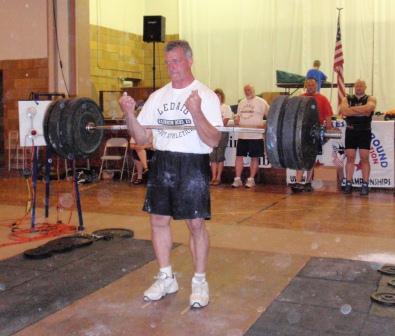
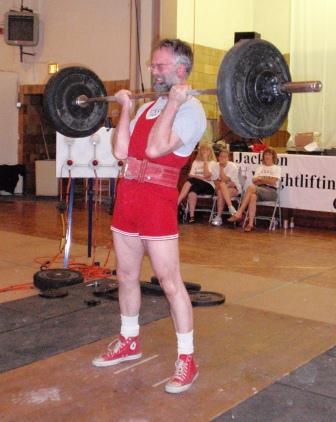
Larry Traub performing a 325 pound Zercher Lift at the 2011 USAWA National Championships in route to winning the Overall Best Lifter Award in Larry's first USAWA National Meet appearance. Obviously, Larry has worked out very hard in his life to achieve this accomplishment! (photo and caption courtesy of webmaster)

ASK ANYONE WHO TRAINS WITH WEIGHTS. ARE YOU WORKING HARD?? NINETY NINE OUT OF A HUNDRED WILL LOOK YOU RIGHT IN THE EYE AND SAY, “YES, I WORK HARD!!” HMMMM…ARE THEY REALLY??

A FEW YEARS AGO, THE WINFIELD POLICE DEPARTMENT SPONSERED MY BUDDY AND EARLIEST TRAINING PARTNER, LARRY TRAUB, TO COME AND SPEAK TO THE LOCAL HIGH SCHOOL ATHLETES ABOUT LIFTING AND HIS TRAINING PHYLOSOPY.  WITH NUMEROUS NATIONAL HIGH SCHOOL TEAM CHAMPIONSHIPS AND COUNTLESS NATIONAL CHAMPS TO HIS CREDIT, AS WELL AS HIS OWN RESUME’,  WE FELT HE HAD SOMETHING TO SAY!!  HE WAS SCHEDULED TO TALK FOLLOWING A MORNING WORKOUT BY THE HIGH SCHOOL FOOTBALL TEAM.  HE TOLD ME HE WANTED TO GO WORKOUT AT THE SAME TIME AS THE KIDS WERE HAVING THEIR WORKOUTS. LITTLE DID I KNOW THIS WAS REALLY A RECONISCONCE MISSION!!

FOLLOWING THEIR WORKOUT, HIS TALK BEGAN.  LARRY’S PHIOSOPHY CAME OUT AND HE CALLED FOR ONE OF THE LIFTERS OF THAT MORNING’S WORKOUT TO COME FORWARD.  AS I RECALL,  HE WAS ONE OF THE ‘STRONGEST’ OF THAT GROUP AND HAD BEEN SQUATING WITH WHAT I WOULD CALL A MODERATE WEIGHT, FOR FIVE REPS.  THIS SEEMED TO BE ABOUT ALL THE KID COULD HANDLE.  LARRY TOLD THE BOY THAT HE WAS WATCHING HIM SQUAT EARLIER AND, ALTHOUGH HE HAD JUST FINISHED HIS WORKOUT FOR THE DAY, HE (LARRY) WOULD LIKE HIM TO TRY SOMETHING FOR HIM.  LARRY LOADED THE BAR WITH THE VERY SAME WEIGHT THAT THE LAD WAS USING PRIOR AND SAID, “OKAY. I’LL BET YOU THAT, EVEN THOUGH YOU HAVE DONE YOUR WORKOUT, YOU CAN DO 10 REPS WITH THE SAME WEIGHT YOU WERE USING BEFORE!”  EVERYONE LAUGHED, THE BOY SEEMED SKEPTICAL BUT SAID HE WOULD GIVE IT A GO.  WITH EACH REP, THE LAD WAS ENCOURAGED TO “GET ONE MORE!”, AND EACH TIME, HE COMPLIDED! UNTIL HE HAD DONE 12 REPS!!

THERE WAS A LOT OF WHISPERING AND GIGGLING BUT THE POINT HAD BEEN MADE. “MAYBE WE NEED TO WORK JUST A LITTLE HARDER!”

I KNOW IN MY OWN CASE, I FIND MYSELF ON AUTO-PILOT, JUST GOING THROUGH THE MOTIONS A LOT OF THE TIME.  HOWEVER, THE POINT OF THE WHOLE TALK WAS THE NEED FOR INTENSITY!!  MOST ANY PROGRAM WILL BRING A CERTAIN AMOUNT OF SUCCESS.  BUT, YOU HAVE TO BRING THE INTENSITY IN ORDER TO GET THE FULL BENEFIT OF THE WORKOUT. SO, THE NEXT TIME YOU ARE TRAINING, ASK YOURSELF. “AM I REALLY WORKING HARD!!”  YOU MAY SURPRISE YOURSELF, IF YOU ARE HONEST, WITH THE ANSWER!!

1 2 3 4