Tag Archives: Al Myers

38 New USAWA Records at Club Challenge

by Al Myers
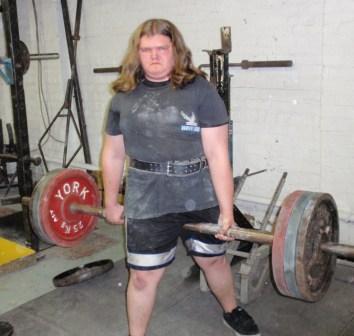
Kohl "the Young Samson" Hess set the most USAWA Records at the Club Challenge with seven.

An amazing 38 new USAWA Records were broken or set at the most recent Club Challenge in Ambridge.  The Kohl “Young Samson” Hess lead the way with 7 records.  Kohl has made great strength gains since I last seen him lift at Worlds in October, undoubtedly the result of hard work and good coaching from Denny Habecker. Kohl is only 15 – but weighing a solid 272 pounds he is built like a grown man.

A few more meets like this and this will be a RECORD YEAR for records. Records that impressed me the most were these:  Kohl Hess and his 407# Jefferson Lift with the Fulton Bar, John McKean and his 353# Jefferson Lift with the Fulton Bar (more than he did over 20 years ago at the 1988 Nationals with a regular bar), Ernie Beath and his HUGE 201 pound French Press (he had no problem touching his neck since Big Ernie’s neck goes to his ears), Chad Ullom doing 265# in the Reflex Clean and Push Press, Art “the Man of Steel” Montini benching 135# in the Andy Goddard Postal (and he INSISTED on keeping his feet up even though that is not required for this meet), and Scott Schmidt doing 358# on the 2″ 2 Bar Vertical Bar Deadlift (the TOPS of the meet and the bars were VERY slick!).

The RECORDS RACE between Art and Denny is heating up, with Art taking advantage of Denny’s absence at this meet due to illness. Art has increase his TOTAL NUMBER of USAWA records to 353, which is one more than Denny had after Worlds, but Denny still has the lead with 361 TOTAL RECORDS.

An interesting lift we did at this meet was the Reflex Clean and Push Press.  This lift was introduced many years ago by John Schubert (and is also known unofficially as the Schubert Clean and Push Press).  It is like a normal Clean and Push Press but the bar must not come to a stop after the clean, and must be immediately put over head with a push press.  This adds great difficulty to the lift as the lifter can not “collect himself” after the clean to prepare for the Push Press.  Also, since you can’t move your feet during a push press you must have your feet in good position after the clean. Scott Schmidt is a very experienced Olympic Lifter and great presser so this lift came very natural for him.  Scott had just competed at the Arnold in the Master’s Olympic Meet and didn’t even prepare for this lift, but still put up a big lift.  Check out this YouTube Video of Scott showing how to properly do the Reflex Clean and Push Press.
The Snaggin’ Curl

by Al Myers

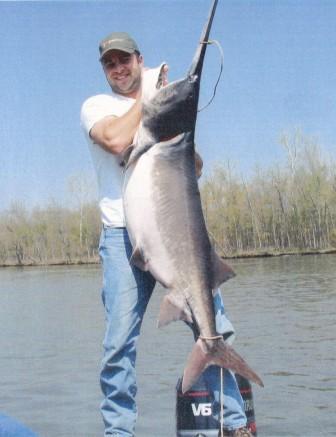
Dino Gym member Casey Barten put his weight training to good use in landing this 75 pound paddlefish.

Use an over the top grip

As promised yesterday, today I am going to present an exercise to you that will show that weight training virtually helps EVERYTHING. Most people would think fishing was a relaxing low effort sport – but that depends on the type of fishing you do! For the past several years Casey and I have taken part in snagging for paddlefish (also known asspoonbills) during the Missouri season. Paddlefish are one of America’s largest freshwater fish, and can grow to weights of over 100 pounds. Every spring, paddlefish will make their “spawning runs” and migrate into the upstream rivers from the reservoirs. However, there is one big problem with catching paddlefish – they are filter feeders and won’t bite on a baited hook! So we use a much more strenuous method of “catching them” – we snag them! (All of this is legal by the way). I was introduced to this unique way of catching fish by a good friend, outdoor enthusiast Kevin Yaeger, and I was immediately HOOKED (or you could say snagged)! It is by far the most physically draining type of fishing I have ever done. It is done like this – you allow the heavy pound and half sinker on the end of your line to touch bottom, at which time you give a hard pull on the rod, fighting the water resistance of the three big treble hooks on your line. If you don’t snag anything – you do it again and again at the rate of one pull every 5 seconds. The harder you work at it – the greater chances you will have success. Reeling in a 75 pound paddlefish is the easy part. It is the thousands of “pulls” you do before you snag the big paddlefish that wears you out.

Lift the kettlebell straight up

So what does this have to do with weight lifting?

Well, after the first year I went snaggin’ I was somewhat embarrassed by how I was “worn out” afterwards. I don’t train for endurance! Casey and I decided that prior to the next season we had to get ourselves in shape for snaggin’! This is what lead to the Snaggin’ Curl. Many years ago I was introduced to this exercise by armwrestler Jason Payne. He told me it was an exercise that the armwrestlers loved – and they called it the Cobra Curl. I’m always up to try something new so I gave it a try and found that it worked the EXACT same muscles that are required in pulling back on a fishing pole – thus Casey and I renamed it the Snaggin’ Curl!!

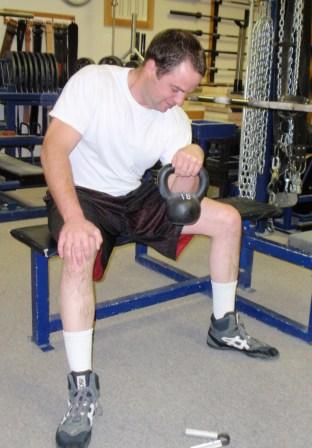
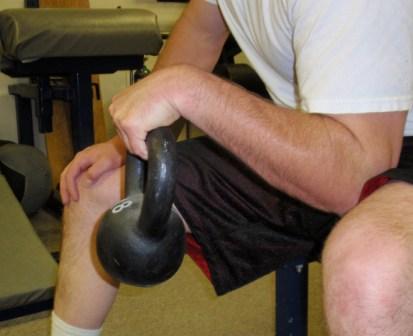
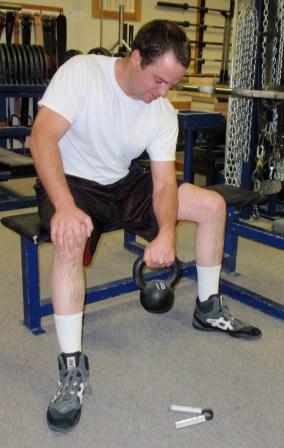
This exercise is very easy to do. You can use a dumbbell, but I prefer a kettlebell. Sit on a seat and place the kettlebell between your feet. Place your elbow of the lifting arm against your leg, and grab the handle of the kettlebell with an over the top grip. Lift the kettlebell straight up from the floor until the wrist is turned over and you can’t go any higher. At the top position hold the kettlebell for a slight pause, at which time you lower the kettlebell slow back to the floor and repeat the motion. I am not usually a high reps lifter but we will go up to 50 reps per set with this exercise – all in a slow and controlled motion. Do several sets. When finished your forearms are BLASTED! Rest a minute and then do them with your other arm – after all I rotate arms when snaggin’ and I don’t one to be my weak link.

The top position of the Snaggin' Curl (notice the flexed wrist)

Casey and I are now a month away from snaggin’. We are training the Snaggin’ Curl hard – hoping that our training will pay off and we will snag a BIG ONE this year!!

Block Bar Curls

by Al Myers

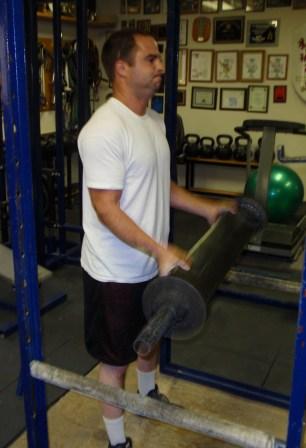
Dino Gym member Casey Barten performing a Block Bar Curl.

Would you like to try an exercise that works the grip, forearm muscles and the upper arm in one exercise?  Then try the Block Bar Curl!  This is a very simple exercise – but does require a piece of specialized equipment. I initially made this Block Bar for grip training, but the guys in the gym have found many other uses for it.  It has the same gripping dimensions as the IronMind Pinch Grip Block (3″ by 6″) and is painted with the same slick gloss paint finish.  The Block Bar is 36 inches long and weighs 45 pounds empty. I am really surprised no one has marketed a bar like this (at least I haven’t seen one). Really anyone could make one without even having shop skills. All it would take is two 2x6s nailed together, with a bolt on each end to bolt weight to.

It is very difficult to do curls with it, as all the arm muscles need to be contracting in unison to be able to execute the curl. You will find this exercise is great for developing wrist strength and stability.  Surprisingly, you will “feel” it in the biceps even with the much smaller amount of weight used versus a regular bar curl.  I think the reason for this is because of the added demands the Block Bar Curl places on the forearm muscles, and the forearm muscles must be in contraction at the same time as the upper arm muscles. This exercise has to be performed with good technique and under control or the grip on the block will be lost. The sets and reps we do with this Bar are pretty typical –  3 to 4 sets of 8-10 reps and adding weight with each set.

The Block Bar Curl  is a very practical exercise, and the strength it develops in the hands and arms will carry over to work applications.  Casey is a Veterinarian, and doing Large Animal Veterinary work requires strength in the hands and arms to perform some procedures. Much of his training is geared to increase the strength in his hands, arms and shoulders.   His training is not just about getting stronger, but about making his work easier!  You have to remember weight training can accomplish different things for different people.

Coming tomorrow

Casey’s favorite weight training exercise for fishing!

My Shot-Loaded Dumbbell

by Al Myers

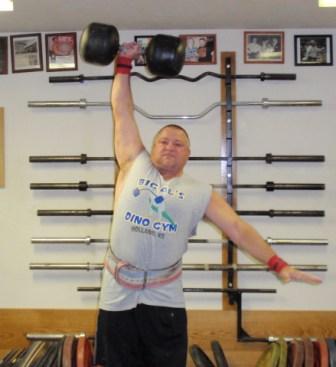
I'm performing a 130# One Arm Dumbbell Snatch with my shot loaded dumbbell.

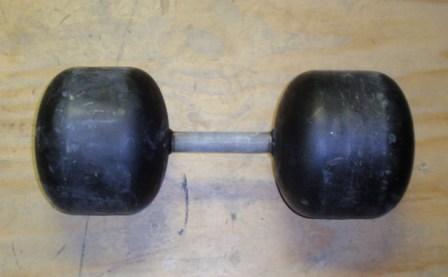
I have always been intrigued by shot loaded globe barbells and shot loaded dumbbells. These were very common training implements of the Old-Time Strongmen, and at one time every professional strongman or circus strongman had one they would use in their performances. Today shot loaded equipment is not very available commercially, so I decided I would just build my own shot loaded dumbbell. My design requirements were very simple: make a dumbbell that could be shot loaded to around 200 pounds full, very durable if dropped, and have a handle that would be optimum for lifting. I was very pleased how my project turned out, until I had to go buy lead shot and discovered how much it has increased in price since my days of reloading shotgun shells 20 years ago!

Years ago they even allowed shot loaded barbells to be used in the Olympic Games. The last Olympic Weightlifting Games that allowed this was in 1924, in Paris, France. Only one lifter took advantage of this, and that athlete was the famous Old-Time French weightlifter Charles Rigoulot. He ended up winning the Gold Medal in the Heavyweight class that year. In the early 1900’s Alan Calvert, owner of the Milo Barbell Company, marketed shot filled barbells and dumbbells. There was a good market for shot loaded equipment then because metal plates were not readily available and a lifter could get by with just one piece of lifting equipment that could be “filled” to the weight of a lifter’s choosing. One of the most popular shot loaded dumbbells is the one owned by Louis Cyr, which now resides at the York Barbell Museum. Cyr’s shot loaded dumbbell weighed 202# empty and 273# fully loaded.

The Dino Gym's Shot Loaded Dumbbell

I love training one arm dumbbell swings and snatches – and these were the first exercises I tried out my new dumbbell with. An obvious advantage with the shot loaded dumbbell is that the weight is more “compact” when it is loaded heavy compared to a traditional dumbbell loaded with 10# plates. However, I soon found out that unless the dumbbell is loaded full the lead shot will “shift” and create balance issues when put overhead. This is very noticeable when doing swings with it compared to a plate loaded dumbbell. Another problem is that you got to remember what you loaded it to last. I have changed the weight of mine, forgot I did, only to be “shocked” when lifting it the next time thinking it was loaded lighter. After all, it looks the same at 100 pounds as 200 pounds! I really can’t see shot loaded dumbbells making a comeback in today’s lifting world. They are a mess to fill and empty – even with a funnel you get shot everywhere. Most people nowadays have great fear of lead toxicity, with due cause, so precautions need to be taken in handling the lead shot. But all of this is worth it to an old weightlifter like myself – because when lifting a shot loaded dumbbell you feel like you are in the company of the great Old Time Strongmen like Louis Cyr, Charles Rigoulot and Eugen Sandow.

History of USAWA Records


by Al Myers

I was thinking the other day about the history of the number of records set in the USAWA throughout the years.  Joe Garcia has been the Official Records Chairman since the beginning of the USAWA, and has entered THOUSANDS of records into our Record List. Joe’s efforts on this has been impressive and the USAWA owes him  a lot of thanks for all the work he has done in giving us a 20 plus year Record List.  The list is now approaching 10,000 line items in length.  But, what years have the most records been set in?  This can’t possible be answered because records are continually broken and the list updated, so an absolute count is about impossible for any year except the most current year. However, we can count the records that are STILL on the books from previous years.  Well, I did this and found the results interesting so I am going to share my research with you!

Year Records Year Records
1987 38 1999 453
1988 114 2000 586
1989 154 2001 422
1990 250 2002 682
1991 307 2003 538
1992 294 2004 474
1993 291 2005 702
1994 346 2006 566
1995 468 2007 367
1996 425 2008 360
1997 427 2009 475
1998 433 2010 103


As you can see, 2005 was the year that resulted in the MOST records.  The last three years there has been a drop-off. But it appears 2010 is off to a good start – maybe THIS YEAR will be the year the most records are set??

Congratulations to Dave Glasgow for passing the Official’s Test and becoming an USAWA Official!

1 26 27 28 29 30 33