Tag Archives: Al Myers

Interview with Scott Schmidt – Part 2

by Al Myers

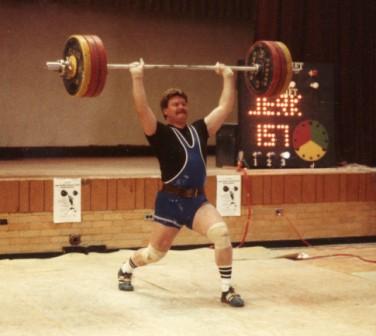
Scott Schmidt performing a 157.5 KG Clean and Jerk at the Ohio State Championships.

Al: When did you get started in All-Round Weightlifting?  Was there anyone responsible for introducing you to All-Round Weightlifting?

Scott: My first competition was the USAWA Winter Fest 2-15-92. Later that year, on 10-17-92, I was in the US Inlands meet. These were both held in the historic Ambridge Barbell Club.

I was first introduced to the sport in 1990 by Bob Karhan, past USAWA Champion and record holder, from Cleveland, Ohio. We both trained at the Westpark YMCA at t

he time. Since I was already in shape to move heavy iron, Bob encouraged me to try my strength on some new events. The Nationals wereheld in Akron, Ohio that year, but due to my Olympic style training schedule, I did not compete.

I did attend the meet, however and was able to coach Hall of Famer Jim Malloy with his lifts at his first All-Round competition.

Al: I know you have competed several times at the USAWA Nationals.  What have been some of your favorite meets?

Scott: I have fond memories of every one of them. They have all provided me with the opportunity to “bring out the beast in me”. I love to prepare for an event, then gain the satisfaction of putting up a goal breaking performance. Here’s a quick funny story. Good news? At the 2008 Nationals, I was mentally and physically ready to try my first 2000 pound hip lift. Bad news? They didn’t bring enough iron to accommodate me! They were able to locate 1800 pounds, and it did go up, at least!

Al: What are your favorite All-Round lifts and why?

Scott: My favorite All-Round lifts are: Overhead pressing and jerking events, gripping lifts, and hip and hand and thigh lifts. I haven’t posted a number yet, but I would love to try a back lift on the famous Al machine! The reason I consider these my favorites, is due to years of Olympic style training, I was able to make fast progress with these events. I strive to set the class record at what I am good at. Back in 1996, I was the first man in the USAWA to clean and push press 300 pounds. Made me happy!

Interview will be continued tomorrow.

Top Ten Lessons I Have Learned “The Hard Way” During My 25 Years of Lifting Weights


(and NONE of these lessons were funny to me when they happened!)

by Al Myers


1.  It is best to use collars in lifts where the bar may tilt. (as demonstrated by the tears in the carpet by my squat cage)

2.  Always check for small plates on the bar when pulling off a 45# plate. (It only takes a 2.5# plate to break a toe)

3.  Stay away from open grips when pressing.  (caused me a fractured cervical vertebra when I was in my early 20s)

4.  Low blood sugar and 20 rep squats don’t mix.

5.  Always keep your calluses trimmed off or a big deadlift will rip them off.

6.  Keep a puke bucket within reach of the squat cage.

7.  Don’t rehydrate after weigh-ins with apple juice.

8.  Don’t wipe the sweat off your face when you still have rubbing liniment on your hands.

9.  Always unload the bar EVENLY!

10.  It is best to skip a squat workout if you have been battling intestinal flu!

Deanna Springs Meet

Garcia Wins Deanna Springs Memorial  Meet

by Al Myers
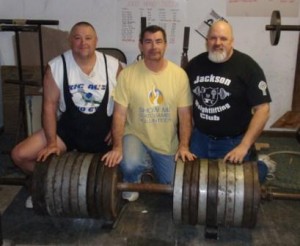
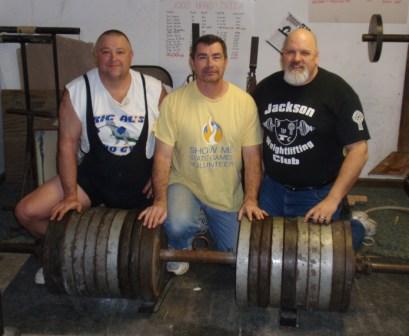
Deanna Meet Participants (left to right) in front of the Heavy Bar Al Myers, Joe Garcia and Thom Van Vleck

A slimmed down Joe Garcia still shows he has the mastery of the Heavy Lifts, and won this year’s Deanna Springs Memorial Meet. Joe has won this meet hosted annually by Bill Clark numerous times in the past. He had two challengers – Thom Van Vleck of the JWC and myself of the Dino Gym. The meet was about canceled this year due to lack of entries, but when Bill found out there were interested participants he graciously opened his gym up to another year of the challenging lifts contested in the “Deanna Meet”. Missing this year was Al Springs, who often attends in memory of Deanna.

Joe has been busy with starting his new business, but it was obvious he hasn’t let his training slack and looked in great shape. This was Thom’s first exposure to the Chain Lifts and did quite well his first time out – and with time no doubt will become very proficient in them. The meet started out with the Crucifix and I had the top lift, matching my personal best of 90 pounds. The next event was the Cheat Curl and Thom ended up with the top Cheat Curl at 195 pounds. I usually consider these first two events as warmups because at this point the Heavy Lifts start – and it’s time to get serious. The next event is the Deanna Lift – which was invented and named after Deanna Springs. It is the meet’s signature event – and has never been contested outside of this meet. It combines two of Deanna’s favorite lifts – the Zercher Lift and the Hand and Thigh Lift. This lift is very painful as it involves the Hand and Thigh bar positioned on the arms like a Zercher Lift, but with MUCH more weight involved. I had the top lift at 775 pounds.

The fourth event was the Hand and Thigh Lift. It is always a great privilege to compete in this event against the ALL-TIME record holder Joe Garcia. Everything I know about the Hand and Thigh Lift I have learned from Joe. Well, the years of tutelage finally paid off for me as I put it all together in this lift and broke 1500 pounds for the first time. My final lift was 1505 pounds, which broke Joe’s overall record in the 115K class. Joe was a class act about me breaking one of his Hand and Thigh records (not that he doesn’t have many others!!!) and sincerely congratulated me on my efforts. This meant a lot to me, and even more when Joe said, “this is the first time in 20 years that I have been beaten in a meet in the Hand and Thigh and I am glad that it is by you”. He then reminded me that he was at his Hand and Thigh peak when he was 43 years old (the same age I am now)! I’m still trying to figure out what he meant by that – but regardless, thanks Joe for all the help you have been to me in this lift!!

The meet ended with the Hip Lift. Thom got an easy 1205# lift (and had MUCH more in him) and Joe and I both ended at 1685 pounds. We were both capable of much more, but I made a huge jump on my last attempt as a strategic move to put the pressure on Joe for the overall. He made the jump with me but this big jump was just too much for both of us on this day. When it comes to a meet like this, that includes an assortment of Heavy Lifts, Joe is about impossible to beat. I was just glad to be able to push him a little on this day – something I haven’t done in previous Deanna Meets.

We concluded the day by filling up on the buffet at the Golden Corral – a Clark’s Gym post meet tradition. I also want to mention the All-Round celebrity guest we had in attendance – Wayne Jackson. Wayne is Thom’s Uncle, and one of the founders of the Jackson Weightlifting Club. Wayne told me that he first met Bill in 1962 while attending a meet hosted by Bill. They both enjoyed “reminiscing about the old days”. I want thank Bill for putting this meet on – EVERYONE had a great time!!

Below is the full meet results:

Deanna Springs Memorial Meet
Clark’s Gym, Columbia, Missouri
March 28th, 2010

Meet Director:  Bill Clark

Official (one used):  Bill Clark

Lifts:  Crucifix, Cheat Curl, Deanna Lift, Hand and Thigh Lift, and Hip Lift

Results:

Lifter Age BWT Crucifix Curl Deanna H&T Hip Total Adj. Points
Joe Garcia
56 215 70 155 575 1285 1685 3770 3611.64
Al Myers
43 251 90 175 775 1505 1685 4230 3487.68
Thom Van Vleck
45 299 80 195 485 885 1205 2850 2196.57


BWT is bodyweight in pounds.  Total is total pounds lifted.  Adj. Points is adjusted Lynch Points for age and bodyweight.
Get Out and Compete in the USAWA

by Al Myers

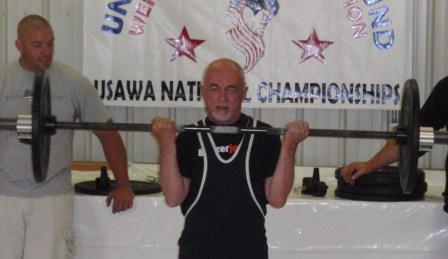
Dr. Charlie Scott, at age 74, competed in his first USAWA National Championships last year. Dr. Scott was previously an Olympic Lifter and Gymnast, and now a great addition to the USAWA!

I have often heard this answer in the gym when I have asked guys if they compete or not, “I’m not strong enough yet to enter a competition”.  It’s amazing how this time never comes for them.  It seems the expectations of what they want to lift in order to enter a competition is not EVER enough – and in the mean time they lose out on having enjoyable experiences challenging themselves in a competitive meet environment.  That is one of the great things about weightlifting – your competition is the bar and weights laying in front of you on the platform. You have full control on whether you are successful or not.  It’s not like boxing or the UFC, where you may be at the top of your game, and the “other guy” is just better than you, and you end up with your face smashed in!   I would understand it, if in those sports, someone says they are not ready for competition!  But competitive All-Round Weightlifting – give me a break!  The challenges are always there to get stronger, or maybe just get better at a lift no matter what your age is.  I have come to the conclusion and accepted that I have probably reached (or passed) my physical peak.  At age 43, I know my best years are behind me.  But I still enjoy training and “giving it all I have” in competition.  All-Round Weightlifting has been a blessing for me – the multitude of different lifts provide unique opportunities to get better at lifts for a long time.  I am constantly learning new techniques in particular lifts that make me better.  Just at this past World Championships, Frank Ciavattone gave me a tip that put 20 pounds on my Ciavattone Deadlift immediately!  Last year at the Heavy Events National Championship, Dale Friesz and Art Montini told me “the secret” on the Neck Lift which has translated into over a 100# increase in my Neck Lift.  Bill Clark has given me numerous training advice through the years that has helped me tremendously – which I only got because I went to the meets that he hosts. Joe Garcia has helped me in the Hand and Thigh Lift  – I was doing it totally wrong until Joe showed me the correct technique.  Now if I was staying home training by myself waiting for the day to enter a competition, would I have learned these things?  Not much of a chance.

For those of you that have never tried a weightlifting competition, or just want to try something different – give the USAWA a try!  You will find out that the competition is fun. The lifters involved in the USAWA are a special breed – everyone involved is down to earth and just enjoys challenging themselves with weights. Everyone is very helpful and supportive to each other at meets. They are no EGOS in this organization – mainly because everyone involves knows that even though there may be lifts that you can excel in, there are also ones that humble you.  But even with those lifts  – if you work at them you will improve. Don’t be one of those gym lifters that really would like to compete – but just doesn’t.

Give All-Round Weightlifting a try – and Get Out and Compete in the USAWA.

Trap Bar Training

by Al Myers

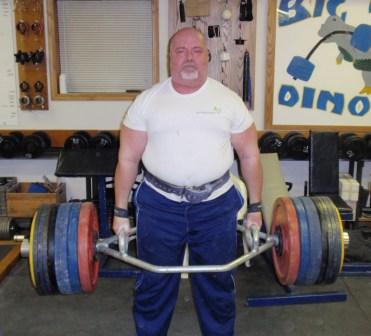
Dino Gym member Chuck Cookson set a new Dino Gym Record in the High Trap Bar Deadlift this week, with a lift of 800 pounds.

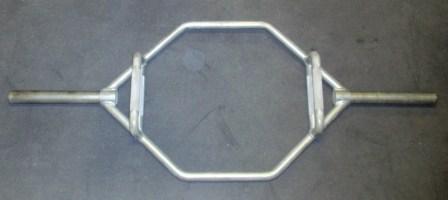
The Trap Bar Deadlift has been contested in the USAWA since 1996. I think this is one piece of equipment that every gym should have. The original Trap Bar was the Gerard Trap Bar developed by Al Gerard, a powerlifter from North Carolina, over 20 years ago. Since then several other companies have developed Trap Bars that are very similar, but with minor design changes, getting around the original patent held by Al Gerard. For those not familiar with a Trap Bar, it is an apparatus that contains a frame around the lifter, and has parallel handles located at the lifter’s side for gripping.

Trap Bar training is beneficial and supplemental to deadlift training for several reasons. First of all, it gives a “different line of pull” than deadlifting with a straight bar. By having your arms to your sides, the hips and legs are engaged much more than a bar deadlift, with less demands being placed on the lower back. It is easier to maintain good lifting technique in keeping the shoulders up and the back curved (instead of rounded). More weight can be lifted with the Trap Bar than a straight bar, unless you are a very experienced deadlifter. The grip is easier to maintain. Also, unlike a traditional deadlift where bad technique can lead to “hitching”, it is impossible to “hitch” a Trap Bar Deadlift. I have in the past trained young kids in weight training during the summer, and I always include the Trap Bar Deadlift as one of their key exercises. It is very safe for young kids to do as long as you limit the maximum you allow them to lift. I have a rule that I only allow them to lift up to 150% of their maximum squat set with the Trap Bar. So if they want to improve their Trap Bar Deadlift – they better be improving their squat! I once started training a young girl on the Trap Bar Deadlift, and immediately she complained about the “rough knurling” on the handles. Well, at the end of the week when I was reviewing the kid’s training logs, I noticed she had written the name of this lift as “the Death Grip”. Apparently she misheard me call it “the Dead Lift”, and innocently named it what she thought it should be called!

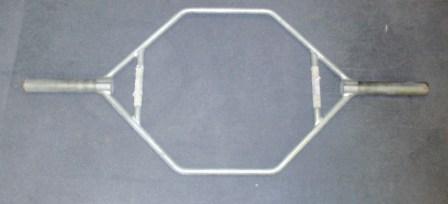
The "Hex" Trap Bar

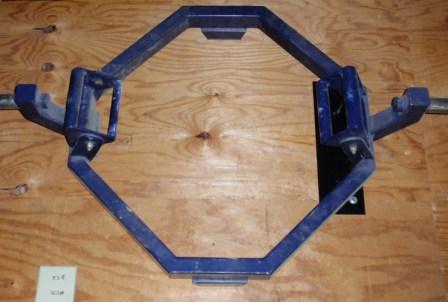
The "Hex" High Trap Bar

The Baier Trap Bar


I am not going into set and rep schemes done with the Trap Bar. There are several good programs that can be done -and in the gym we have tried them all. Describing all of these programs would take more space than I have for this story. We also have a couple of other types of Trap Bars in the gym – one with 3″ elevated handles (only regular handles are allowed in USAWA competition) and one very unique Trap Bar given to the Dino Gym by Shawn Baier, which we call the Baier Trap Bar. It has three adjustable handles with diameters of 1″, 1.5″ and 2″. The height of the pick is 12 inches from the floor (a normal Trap Bar pick is 9″). The use of these High Trap Bars is great for giving variety to Trap Bar Training. We will often add chains to the Trap Bar in order to increase the difficulties at the top of the lift. Chains really help in developing a quicker pull, as less weight is on the bar at the bottom position. I even like to do Trap Bar training in the same workout as straight bar pulls. I find I can do them after regular deadlifting and still able to workout heavy on them.

The Trap Bar Deadlift is going to be a big part of All-Round competition this year. It is in the USAWA National Championships and in the IAWA World Championships. This seems like reason enough to get one for yourself – if you haven’t already. You won’t regret it – and the progress you will make with it will pay off in overall strength gains.

1 25 26 27 28 29 33