Tag Archives: Al Myers

JWC Straight Weight Postal

Heavyweights Battle it out in Postal Challenge

By Thom Van Vleck
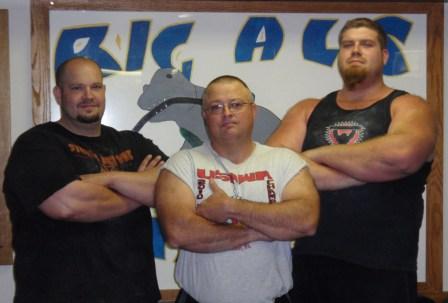
Team Dino Gym wins the Straight Weight Postal Challenge. Pictured from left to right: Scott Tully, Al Myers, and John Conner

Two teams participated in the challenge and the Dino Gym pulled out the victory.  This meet was a new concept for a USAWA meet and we will see if it catches on.  The idea being there would be no formulas used, the winners decided on who lifted the most weight…period.  I proposed the idea of the “straight weight” meet to get some of the bigger guys to come out and participate and as a result, some big boys showed up.  The Dino Gym had a combined weight that was a “Big Al Bacon n’Eggs style breakfast” short of a half ton at 991lbs.  The JWC was a relatively svelte 915lbs.  The average weight of the lifters involved was 318lbs!  I can only guess what that weight would have been had Al not had to replace his original team member, Mark Mitchell, who had to withdraw with a back injury!  Al’s paltry 255lbs brought the average way down!!!

I hope this meet was taken as intended:  Just another alternative and one that the Big Boy’s could embrace as their own.  I know my guys had fun doing it and hopefully it will motivate them to do some more USAWA lifting!  Oh, and one more thing, I calculated the age and weight factors just to see the outcome….and the Dino Gym doesn’t want to know those results!

Full Meet Results:

Officials for Dino Gym Team:  Al Myers and Scott Tully

Official for JWC:  Thom Van Vleck

Dino Gym Team: Al Myers (44 yrs, 255lbs), Scott Tully (34 yrs, 344lbs) John Conner (25 yrs, 392lbs)

Jackson Weightlifting Club: Thom Van Vleck (46yrs, 295lbs), John O’Brien (42 years, 285lbs), Josh Hettinger (29yrs, 335lbs)

Push Press – From Rack

  1. John Conner 380lbs
  2. Josh Hettinger 335lbs
  3. John O’Brien 300lbs, Scott Tully 300lbs, Al Myers 300lbs
  4. Thom Van Vleck 255lbs

DG: 980lbs & JWC: 890lbs

Vertical Bar Deadlift – 2 bars, 1″

  1. John Conner 500lbs
  2. Scott Tully 420lbs
  3. Josh Hettinger 400lbs, Al Myers 400lbs
  4. John O’Brien 380lbs
  5. Thom Van Vleck 280lbs

DG: 1320lbs & JWC: 1060lbs

Continental to Chest

  1. John Conner 385lbs
  2. John O’Brien 335lbs
  3. Al Myers 325lbs, Scott Tully 325lbs
  4. Thom Van Vleck 315lbs
  5. Josh Hettinger 275lbs

DG: 1085lbs & JWC: 925lbs

Cheat Curl

  1. John Conner 250lbs
  2. John O’Brien 235lbs
  3. Thom Van Vleck 215lbs, Josh Hettinger 215lbs
  4. Al Myers 201lbs
  5. Scott Tully 181lbs

JWC: 665lbs & DG: 632lbs

Shoulder Drop

  1. John O’Brien 95lbs, Josh Hettinger 95lb
  2. Thom Van Vleck 85lbs
  3. John Conner 45lbs, Al Myers 45lbs
  4. Scott Tully 30lbs

JWC:  275lbs & DG:   120lbs

Totals: 1st Place: Dino Gym 4087lbs, 2nd Place: JWC 3835lbs
Taking Care of Your Back – Part 4

Part 4 – Reverse Hyperextensions

by Al Myers

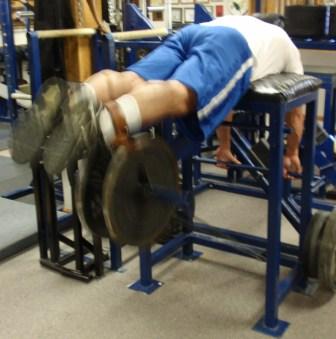
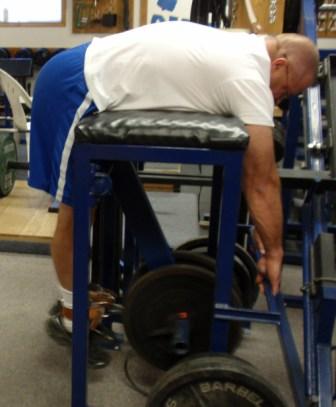
Al Myers demostrating the "bottom position" of a Reverse Hyperextension.

Al Myers demonstrating the "bottom position" of a Reverse Hyperextension.

The routine of using a Reverse Hyperextension Machine in your training is nothing new.  This exercising device has been around for close to 20 years now, thanks to its inventor Louie Simmons.  I remember reading years ago Louie came to develop this machine when he was recovering from a serious back injury, and the only exercise he could do was  leg raises while laying on his stomach in his bed after surgery.  As he improved,  he started letting his legs hang off the bed, and then eventually starting hanging small amounts of weights on his ankles as he did this exercise.  He made a full recovery, and returned to high levels of competitive powerlifting, after sustaining an injury that would have left most people as lifelong cripples.  He is the ONE who should receive full credit for the invention of the Reverse Hyperextension.

I have used the Reverse Hyperextension in many ways, but I have found that the BEST use of it is for back recovery.  It has always been part of my “active recovery” back workouts on Thursday.  I don’t go very heavy on it, usually just 100 pounds for sets of 10.  I only do 4 or 5 sets.  This exercise is a non-compressive exercise, meaning that it does not apply any compressive force to the vertebrae.  It is the ONLY back exercise that I have found that will  “work out the back” at the same time it stretches the back muscles in tension.  You will especially feel it in the muscles at the lower lumbar – pelvis tie-ins.  You will feel a slight “pump” in these muscles after doing this exercise. This increase in blood flow to these muscles will greatly enhance the back’s recovery from your  previous hard deadlifting sessions.  Truly an essential exercise that should be part of everyone’s training program!  All together you can accomplish this with only 15 minutes per week.   I add a unique “twist” to the Reverse Hyperextension by adding a light band to it.  This band adds slightly more tension at the “top” of the lift, when your legs are fully extended behind you.

Al Myers demonstrating the "top position" of a Reverse Hyperextension. Notice how the band is attached.

Another exercise I like to do with the  Reverse Hyperextension Machine is Leg Curls, to work the hamstrings muscles.  I have never read about anyone else doing this particular exercise with this machine, even though I am sure others have.  To perform this Leg Curl, my initial movement is to curl the legs, after which I extend the legs behind me (while keeping the legs bent)  like a normal Reverse Hyperextension.  You will feel the ENTIRE hamstring being involved in this movement, from the knee to the pelvis tie-ins.  I used to do recumbent lying leg curls to work my hamstrings, but abandoned that movement in favor of this one. I felt lying leg curls only focused on the lower hamstrings, and didn’t work the upper hamstrings adequately. Again, I’ll do 4-5 sets of 10 of this exercise following my normal Reverse Hyperextensions in another 15 minutes.  So there you have it- 30 minutes a week on the Reverse Hyperextension, but with benefits that far exceed that time commitment.

This sums up my Thursday workout.  I feel it really helps my back recovery so I can train my back hard twice per week on a regular schedule.  Other things – make friends with a good chiropractor and make frequent appointments.  A slight shift in vertebral alignments or pelvis alignment needs to be adjusted as soon as it happens to avoid training setbacks.  Don’t wait a week and see if things get better – make an appointment immediately!!   I don’t have access to massages, but I know some lifters who feel that really helps in back recovery.  I use a jacuzzi a few times per week – and I know that helps relax the back which aids in recovery.  Occasionally I combine it with a cold shower, or a “cold douche” as my English friends would call it.  This was a favorite recovery method used by the great Old-Time Strongman Arthur Saxon.

If anyone has more specific questions on this workout on mine, please contact me and I’ll be happy to explain it further.

Taking Care of Your Back – Part 3

Part 3 – Have Strong Abs

by Al Myers

Training the abdominal muscles is often overlooked by weightlifters.  Bodybuilders usually go overboard with ab training because they are in search of the perfect 6-pack.  Us weightlifters are just as happy having a perfect keg instead. I learned in college during a physiology course that opposing muscle groups should be of comparable strength in order  to prevent injury due to muscle imbalances.  That hit home for me in my training.  It is easy to overlook less important muscle groups because they don’t seem to be “the  major players” needed in a certain lift.  Think about this, and I’m going to use Powerlifters as my example. Are most Powerlifters upper back as strong as their pec and front shoulder muscles?  Are their hamstrings as strong as their front quad muscles? And are their abs as strong as their back?  I would say usually not because the first muscle groups is not directly involved in the strength of the three powerlifts as the second muscle groups,  with the result over time leading to muscles strength imbalances,  setting up the possibility of injuries.

I’m a real believer in ab training in order to keep your back healthy.  I also believe the abdominal muscles should be trained like any other muscle group.  Too many lifters make the mistake of thinking the ab muscles are different somehow. These lifters  will do sit-ups or crunches EVERYDAY, and wonder why they are not getting stronger or building more abdominal muscles.  They will train with repetitions in the 100’s on these movements and wonder why it isn’t working.  Would these same lifters even THINK training the squat or deadlift like that would improve their strength??  I train my abs once per week – and train them hard and with low to moderate reps, just like any other exercise.  I do sets and rest between the sets like any other muscle group.  I like variety in training the abs, and have over 25 exercise that I will train (not in the SAME workout) in a random fashion.  I also pick ab exercises that don’t put undo stress on my lower back on my Thursday workout, as that would defeat the purpose of this “active recovery” day for my back.  When I was training for the 1000 pound Roman Chair Sit-up that I did a couple of years ago it was not on this day!  It was on one of my back days. This would also apply to other All-Round ab lifts  like the Roman Chair Bench Press.  I have my ab exercises grouped into three categories – light, moderate, and heavy.  I do one exercise from each group, starting with the light ab exercise first, then the moderate ab exercise,  and finally the heavy ab exercise.  I try to spend 20 minutes per exercise, so my entire ab workout can be accomplished in 1 hour per week.  My abs are always sore the next day after this workout.  I don’t do more than 10 reps per set on any exercise.

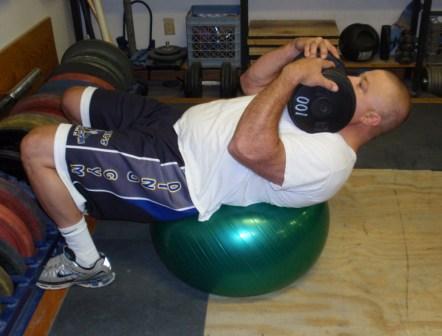
Al Myers performing a Front Ab Raise with a dumbbell on a Stability Ball.

One of my favorite ab exercises is an exercise I have called the Front Ab Raise on the Stability Ball.  OK – I admit I have one of those silly stability balls in my gym that have been popularized by Health Clubs across the country!  At first, I thought those balls seemed like they wouldn’t be of any value to a Hard-Core lifter like myself, but I always like to “test things out” before I form an opinion.  I found that using a Stability Ball with this exercise will put a heavy strain on the abdominal muscles and at the SAME time put no stress on my lower back.  I have a couple of other ab exercises I train using the Stability Ball – the Allen Lift (bar extended at arms’ length)  and the Abdominal Raise (bar behind my neck), but the Front Ab Raise is my favorite.   My advice for the heavy lifter is to buy the strongest Stab Ball you can find, and plan to replace it every 6 months.  The plastic will degrade with time and weaken the ball.  The forces I put on a Stability Ball is probably more than someone using it for general fitness  (often supporting myself at 250# and dumbbells over 100#s).   I have not had one “pop” on me yet, as I’m sure this amount of weight exceeds the ball’s rating,  but I always replace the Stab Ball if it is worn in any way.

Coming tomorrow – Part 4, Reverse Hyperextensions

Taking Care of Your Back – Part 2

Part 2 – Be Sure To Limber Up

by Al Myers

I initially was going to title this part Stretching.  But that didn’t define it the way I wanted it to.  Stretching to me means doing movements  like touching your toes or light calisthenics.  I next thought I would title this part Flexibility, as that could result from many things, including stretching.  This still didn’t fit the message I wanted to convey. I finally (with much deep thought!) decided  to use the expression  “Be Sure to Limber Up”, because that fits exactly what the first part of my Thursday workouts are all about.

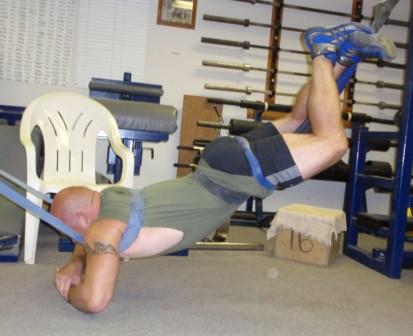
Al Myers suspended by bands to stretch out and limber up the back and hips.

As for my opinion on stretching, I believe a little is necessary but to much is harmful in developing maximum strength.  I know this is a BOLD statement, and there are probably many lifters who would disagree with me on this. Bill Clark once told a training partner of mine Mark Mitchell, when Mark trained at Clark’s Gym several years ago, that stretching the muscles in excess is like repeatedly stretching a rubber band – eventually it will SNAP.  I couldn’t agree more.  I have always been prone to hamstring pulls, and through the early years of my training  I did about everything to safeguard against this injury, including aggressive hamstring stretching.  Sure I got more flexible – but it didn’t solve my  problem of enduring hamstring injuries.  Being able to place your hands flat on the floor with the legs straight is beyond what is needed to be a competitive lifter (unless you are in training for the Mansfield Lift!).  Excessive flexibility, beyond what is required in doing a specific lift,  doesn’t help in being strong in that lift. In fact,  having just enough flexibility to “remain tight” in the bottom portion of a lift will enhance your strength in a lift. Think about the squat – do you WANT to be tight and ready to recoil when you break the legal depth?  I sure do.  This reminds me of a story my brother-in-law Bob Burtzloff once told me that re-enforces my opinion on this.  Many years ago Bob experimented with training the Bench Press using a cambered bench press bar (also known as a McDonald Bar). It allows the lifter to increase the range of motion on the bench press, with the hands going lower than the chest when the cambered portion of the bar touches the chest. Bob first thought training through this INCREASED range of motion would increase his Bench Press.  It did the opposite and made his Bench Press go down.  When he went back to a regular bar he didn’t feel the tightness in his chest and shoulder muscles when at the bottom position.

However, stretching is still part of my Thursday workout. I think you need a balance in flexibility to optimize your lifting abilities.  On the other hand, I have seen lifters who were so in-flexible that they couldn’t even properly perform some of the All-Round Lifts that require flexibility.  In these cases, spending a little time stretching would help their performance.

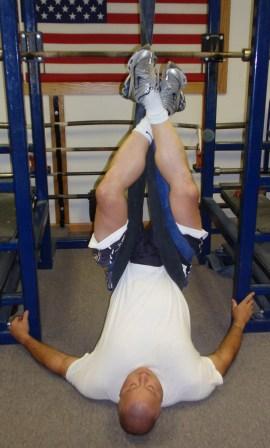
Chad Ullom performing a stretch with the Jump Stretch Bands that Dick Hartzell called "the rack". Chad is completely suspended off the floor and his back is being "stretched" by band tension.

For me, two days after a heavy back workout is when my legs and back are the most sore.  I start off this workout with some cardio, which usually includes  time on my recumbent exercise bike.  This “loosens up”  those bound-up leg muscles and hips, along with giving me some needed cardiovascular fitness.  After getting a good sweat going, I’ll proceed to wind down with some stretching.  Nothing fancy here – just 20 minutes of whatever stretches I feel like doing at the time. Next I’ll proceed to the “bread and butter” exercise that limbers up my back – Suspended Band Stretching.  I learned this “secret exercise” several years ago at the 2003 USAWA National Championships in Youngstown, Ohio. This meet was hosted at the Jump Stretch training facility, the birthplace of the Jump Stretch Bands.  Known as “the rubberband man”, Dick Hartzell showed several of us after the meet a very unique use of the Jump Stretch bands that I had never seen before.  It involved using the bands to decompress the vertebrae of the back by using band tension. Once I got home I immediately purchased a pair of the Big Black Monster Bands from Jump Stretch so I could replicate this movement  in my gym.  I wouldn’t really call it stretching.  But I’ll tell you, 15 minutes of hanging by the hips with these bands attached your back will be fully “limbered up”.  Any pain from tight muscles in your back will be gone.

More of this workout and the story “Taking Care of Your Back” tomorrow with – Part 3, Have Strong Abs

Taking Care of Your Back – Part 1

by Al Myers

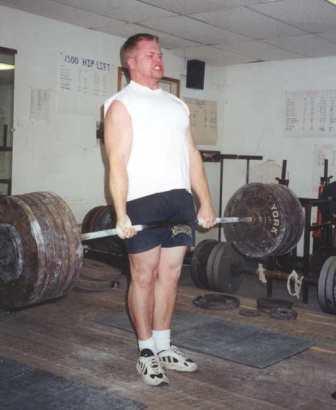
Mike McBride, the Best Lifter at the 2005 USAWA National Championships, performing a Deadlift with Heels Together with over 600 pounds. This All-Round variation of the deadlift increases the stress placed upon the back compared to a traditional deadlift.

Recently, I was contacted by an all-round lifter who asked my advice in dealing with persistent back pain caused from his training.  I’m not going to give his name out here, but he is one of the strongest current All-Rounders in the World and is capable of deadlifting over 700 pounds.  This says quite a bit about his overall back strength, as we all know All-Rounders have many exercises to train and can’t be deadlift specialists, like powerlifters.  He obviously knows how to train very hard to reach this level of performance.  This is just the way it is with All-Round Weightlifting – it is about being all a round strong, not just in specific lifts.  After reading his description of his training, it was obvious to me that he was over-training his back, which can be very easy to do. We have close to 200 lifts to prepare for at any given time, with about 75% of them requiring back strength to accomplish.  I once found myself in this same “over-training trap” as he is when I switched my competition focus to the All-Rounds from Powerlifting.  I still wanted to train like a powerlifter, but just decided to add in extra training for the All-Round lifts.  Combining this extra training volume on my back, in addition to being older, I quickly reached a state of over-training.  I don’t mind my back being a little sore after a hard back workout, but when it is constantly sore the entire week, and affecting my other training, I knew it was time to re-evaluate my training routine and make some changes.

Lots is written about HOW to train your back to make you stronger, but very little is written about how to TAKE CARE OF YOUR BACK  so you don’t sustain a back injury from your heavy training.  I consider this very important.  I have a history of back problems in my family.  My dad and grandfather both had back surgeries for herniated discs.  One of my brothers has issues with chronic back pain.   I know most health issues are linked genetically – and with this family history I am probably more at risk than others to have a “bad back”.   You can find all kind of information about how physical therapists rehab a person after back surgery, or exercises for the non-weightlifter to strengthen their back in suffering from back pain.  However, these things don’t really apply to a weightlifter who wants to be able to at least have one VERY HEAVY back training session per week, and recover fully so it can be repeated the next week. I am going to revel some of my “secrets” that I have learned through the years that have helped me keep my back strong, and preventing  injuries.  I not going to discuss ways of making your back stronger. The things I am going to discuss are all about recovery, things that help you be back to full strength for your next heavy back workout.  I am willing to bet that most lifters do NOTHING in this regard, outside of maybe just some “light stretching”.  That is not enough.  I have discussed these things with my friend Thom Van Vleck in the past, who also believes in this,  and he termed the expression calling these workouts “active recovery” workouts.  I plan to do a 4-Part story on my Thursday workout, which is geared completely to maintaining a healthy back.

The first change in my training philosophy  when I became an All-Rounder was realizing that I have to be careful not to train the back in every workout.  I ONLY train exercises that put ANY strain on my lower back TWICE per week to give adequate time for back recovery.  I am sure this training frequency is different for every lifter, but that is what works best for me.  Now you got to remember – exercises like doing Push Presses or Jerks constitute as a back exercises.  Doing 1 arm full body exercises, like the One Arm Snatch,  puts demands on the back, even though the demands are not like deadlifting.  These exercises need to be trained on one of these “back days”.  Training the upper back also puts demands on the lower back. Even common All-Round upper body lifts like the Pullover and Push or a Clean and Press put pressure on the back.  So you can see where I’m going with this, it doesn’t leave too many exercises available for the other training days during the week!   My back day workouts are Tuesday and Saturday.  I like this schedule because if I have a small meet coming up on the weekend, I can just substitute my Saturday workout for the meet and it doesn’t interrupt my training.  It also spaces my “back days” out evenly – 3 and 4 days.  I do my active recovery back workout on Thursday – two days after my heaviest back workout of the week.  The sole purpose of this workout is to get my back  ready to lift heavy again on Saturday. The details of this workout of mine is what I’m going to highlight over the next three USAWA Daily News segments.

Coming tomorrow – Taking Care of Your Back  Part 2 – Be Sure To Limber Up

1 22 23 24 25 26 33