Can you Cheat on the Cheat Curl?

 by Thom Van Vleck

I love me some Cheat Curl! There may be some rule changes that bring the USAWA in line with IAWA rules that will open this up for lots of new records!

The Cheat Curl will be contested at the 2011 USAWA Nationals held June 25 and hosted by the Jackson Weightlifting Club in Kirksville, Missouri.  An interesting paradox will take place with this lift.  As always, the USAWA annual meeting will take place.  This is the one time when rule changes can be discussed, voted on, and passed.  Interestingly enough, one of the lifts being contested is the Cheat Curl.  The USAWA rules currently are different from the IAWA rules and there is a proposal to change the USAWA rules to bring them in line with the IAWA rules.  One of the major differences is the USAWA requires the feet to stay flat on the floor while the IAWA rules allow for the heels to raise.  So, according to the USAWA rules if you did a Cheat Curl following the IAWA rules…you’d be CHEATING?  So I guess it is possible to cheat on the Cheat Curl! Now, here’s where the paradox comes in.

Traditionally, the rules meeting has taken place after the meet.  Since the meeting can be lengthy and since there’s usually a banquet of some sorts afterwards Al Myers and myself decided to have the meeting the night before the meet.  That way, we get the “business” out of the way and the day of the meet only focuses on the lifting and the fun afterwards!  This has created an interesting situation.  One of the lifts being contested on Saturday may have the rules changed on Friday!  If so, then which rules apply!

Currently, the USAWA rules state:

D7.  Curl – Cheat
The bar begins on the platform, and at the lifter’s discretion, is picked up with a grip that has the palms of the hands facing up or away from the lifter. Feet placement and hand spacing is optional, but must remain the same throughout the lift.  Heels and toes must not rise during the lift. Once the lifter is upright in a standing position with the arms and legs straight, the bar on the thighs hanging at arms’ length, an official will give a
command to curl. The knees must remain locked and the legs straight during the lift. The lifter is permitted to bend at the waist, sway the body, or drop the shoulders to gain momentum of the bar. The bar may be lowered prior to the beginning of the curl. The bar must be curled from arms’ length to touching the upper chest or neck in one motion. Any downward movement of the bar during the curl is a disqualification. Once the bar is motionless, and the lifter is upright, an official will give a command to lower the bar. The lift ends when the bar returns to the platform under control by the lifter.

So, be ready for both sets of rules and we will see how this plays out!

Dumbbell Snatch

by Thom Van Vleck

USAWA Secretary Al Myers has the top Dumbbell Snatch in the Record List with this 146# lift at the 2010 Club Challenge.

Let’s take a look at the Dumbbell Snatch which is one of the lifts contested at the 2011 USAWA Nationals being held by the Jackson Weightilifting Club in Kirksville, Missouri on June 25th.  I have listed three rules because one references the other.  If you want the “quick” version, scroll down!

E18.  Snatch – Dumbbell, One Arm
The rules of the Bar Snatch – One Arm apply except one evenly loaded dumbbell is used. The dumbbell may start at any position on the platform. The dumbbell is allowed to rotate during the lift and may finish in any degree of rotation.

A45. Snatch – One Arm

The rules of the Snatch apply with these exceptions. Only one arm is used to perform the lift. The bar is gripped in the center with one hand using any grip, but the palm of the hand must be facing the lifter at the beginning of the lift. The non-lifting hand may be braced or supported on the thigh or knee of either leg but must not contact the bar, platform, or lifting arm during the lift or it will be a disqualification. The non-lifting hand must be clear of the body upon completion of the lift. The bar may be in any degree of rotation during the lift and upon the finish of the lift.  Once the bar is overhead motionless, the lifter’s body in an upright position, the lifting arm straight with a locked elbow, the feet parallel and in line with the torso, an official will give a command to lower the bar. The lift ends when the bar is returned to the platform under control. It is acceptable to use two hands in lowering the bar.

D.  Snatch

The bar will be placed on the platform, in front of the lifter’s feet.  The lifter will grip the bar with the palms of the hands facing the lifter, and then in one single and continuous movement lift the bar overhead to arm’s length. The lifter may choose any width of hand spacing.   The lift begins at the lifter’s discretion. The lifter may drop under the bar as it goes overhead, using a squat-style catch in which the legs are bent, or a split-style catch in which the legs are split. The lifter may also choose to drop only slightly, using a power-style catch. The bar may touch the lifter’s thighs and body during the lift. The feet may move during the lift.  No other part of the body other than the feet may touch the platform during the lift.  The turning over of the wrists must not take place until the bar has passed the top of the lifter’s head.  The bar must not touch the head, stop, or be pressed as it goes to an overhead position. The lifter will recover and stand when ready, from the squat or split position, to an upright standing position.  The bar must be maintained in a final motionless position overhead, with arms and legs fully extended, and the feet parallel and in line with the torso.  At this time, a command from an official is given to return the bar to the platform. The lift ends when the bar is brought back to the platform under control by the lifter.

WOW!  Did you get all that!  Here’s the short version:

Grip the dumbbell and take it overhead in one movement and catch it at arms length with the elbow locked, no press out.  You can drop under it anyway you want as long as nothing touches the floor but your feet.  The free hand may brace against the thigh or torso but may not touch the other hand and once you recover, this is important, the free hand must be away from the body.  Finally, you can go left or right handed, your choice at Nationals!

BACKYARD LIFTING TOYS

BY  DAVE GLASGOW

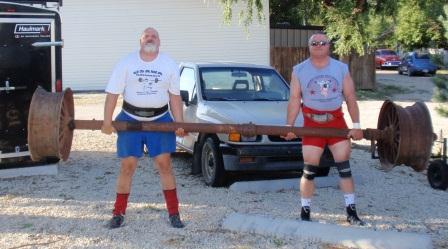
THIS IS JUST A SMALL SELECTION OF MY BACKYARD LIFTING TOYS.

THANKS TO SOME LESS THAN CONSCIENTIOUS WORKERS WHO PLUGGED TWO OF THE FOUR OIL WELLS ON OUR LAND, I SPENT A GOOD PORTION OF EASTER SUNDAY, CLEANING UP THEIR MESS.  THIS INVOLVED LOADING ROTTEN PIPE THAT WAS FULL OF RUST, CRUD AND ALL SORTS OF CORRUPTION THAT I WOULD RATHER NOT THINK ABOUT.  IT ALSO MADE FOR A WONDERFUL TIME TRYING TO TORCH THE PIPE AND SUCKER RODS INTO ACCEPTABLE LENGTHS FOR THE TRAILER.

IT WAS WHILE I WAS IN THE MIDDLE OF THIS PROJECT THAT I LOOKED AROUND ME TO SEE THE CORNUCOPIA OF HEAVY OBJECTS THAT WOULD MAKE FOR A GREAT WORKOUT WITHOUT EVER PICKING UP A BARBELL!!   NOW, I MUST SAY THAT, HAVING GROWN UP AROUND ALL THIS FODDER, IT DID NOT OCCUR TO ME, UNTIL I WAS WELL OUT OF MY PRIME, THAT THESE ARTICLES COULD AND SHOULD BE USED AS AN ADJUTANT TO A WELL ROUNDED LIFTING REGIME.   THERE HAS BEEN A LOT WRITTEN, AS OF LATE, ABOUT HEAVY LIFTING USING TRUCK TIRES, WHEEL BARROWS, RAILROAD TIES, HUGE STONE AS AN ADJUTANT TO BARBELLS.  THIS IS NOTHING NEW AND, WHILE NOT EVERYONE HAS ACCESS TO THE OBJECTS THAT, LITERALLY, LITTER OUR FARM, IT WOULD NOT BE HARD FOR EVEN THE MOST CITY BOUND PERSON TO FIND. IT ALSO OCCURRED TO ME THAT A GREAT COMPETITION COULD BE MADE WITH LITTLE TO NO PREPARATION AND OFFER A WELCOME RELIEF TO THE BARBELL “GRIND”.  IT WOULD BE ONE OF THOSE THINGS WHERE YOU SHOW UP WITH NO IDEA WHAT WAS GOING TO BE CONTESTED, NO WAY TO PREPARE OTHER THAN BEING “ALL-ROUND” STRONG.

I KNOW I AM NOT THE ONLY ONE WHO HAS THE “CULTURAL ADVANTAGE” OF HOME GROWN LIFTING IMPLEMENTS.  WHAT ARE SOME OF YOUR ‘BUILT IN’ DEVICES?  IT WOULD BE INTERESTING TO HEAR WHAT THE REST OF YOU HAVE IN YOUR OWN BACKYARD.

HMMMMMM…….. I WONDER WHAT KIND OF LIFTS I CAN COME UP WITH FOR A GOOD WEEKEND COMPETITION………

Ravenswood Formula

Thom Van Vleck flashes the "Red Light" at USAWA Heavy Lift Nationals as Head Judge Denny Habecker looks for the call. USAWA officials have a lot more to do than judging the lifts. There's a lot of math involved as well!

by Thom Van Vleck

I know we’ve probably overdone the talk on formulas to rate lifting performances, but here’s one more.  I got a copy of Peary Radar’s Lifting News (Sept. 1965) and notice a story on page 20 titled “A New Simplified Formula for Accurate Rating of Lifting Performances”.  This formula was being touted as an easy way to determine the best lifter.  Evidently, before calculators, the “long hand”  or “slide rule” multiplication using the “Hoffman Formula” often resulted on errors and hard feelings when the errors were revealed later.  As a result, the Ravenswood Formula was developed.

I’ll stop right here and say I’m not pushing this to be used by the USAWA nor do I know if it favors heavier lifters (which I’m not sure why anyone would think I would want that….well…maybe I would “like” that). This is just an interesting piece of lifting history from a time when formulas in lifting seemed to be quite the hot topic.

Laverne Myers and Denny Habecker have passed stringent testing to become USAWA officials

The Ravenswood Formula sought to remove the error prone difficulty of multiplication and replace it with the simplicity of adding two numbers together.  You were give two tables which are quite lengthy.  Table “A” had a bodyweight coefficient which went from 110lbs to 370lbs and Table “B” had a “Total” or lift poundage coefficient which went from 105lbs to 2550lbs.  You simply took the lifters weight and found the corresponding coefficient in Table A (a 4 digit number) and added it to the corresponding weight lifted/coefficient in table B (again, a 4 digit number).  The theory being that this formula was much more simple and less prone to a mathematical error.  You have to take the developer’s word that it’s “fair” or should I say “Accurate” as he does in the title.  The developer was Stanley Gorajczyk.  Not sure where “Ravenswood” came from….maybe easier to pronounce that “Gorajczyk”!   Stanley was an Olympic lifter who got 5th in the 1967 Senior Nationals, so he was a pretty decent lifter as well.

Al Myers looks like he's trying to talk Head Judge Denny Habecker into a good call, but really Denny is busy "doing the math" and calculating the winner using the formula!

I just found it another interesting part of lifting history and went with earlier articles on this website that discussed weightlifting formulas.   If you are interested in the tables let me know.  It might be interesting to compare the outcomes of this formula to others!

OLD ADAGES, NEW ADAGES

BY DAVE GLASGOW

Dave Glasgow now knows when to "take a break" from heavy training and enjoy a little relaxation in his rocking chair (photo contributed by the webmaster, which was taken a few weeks ago when Dave very successfully promoted a big Highland Games in Wichita, Kansas).

THERE IS AN ADAGE STATING, ‘IF ONE’S GOOD, TWO’S BETTER AND THREE’S JUST ENOUGH!” HOWEVER, IN TRAINING, THIS SAYING COULD NOT BE FARTHER FROM THE TRUTH!! LET ME EXPLAIN.

FOLKS WHO TRAIN WITH WEIGHTS ARE, FOR THE MOST PART, SELF-DRIVEN, HIGHLY MOTIVATED INDIVIDUALS. THEY SEE A MEANS TO THE GOAL THEY HAVE SET AND THEY “GET AFTER IT.” HOWEVER, IN MANY, MANY CASES, THIS ENTHUSIASM IS MISDIRECTED.

I WILL USE MY OWN EXPERIENCE AS AN EXAMPLE. WHEN I WAS JUST OUT OF COLLEGE, I BEGAN TRAINING ON MY OWN. ALL I KNEW WAS THE SPARSE, AND OFTEN MISLEADING, INFORMATION GLEANED FROM THE BODYBUILDING MAGAZINES OF THE TIME. I TOTALLY IGNORED, AS A WHOLE, THE INFO GIVEN BY PEARY RADAR IN THE NOW DEFUNCT, BUT NONE THE LESS VERY EXCELLENT ‘IRONMAN’.

BEING THAT ABOVE MENTIONED ‘ENTHUSIASTIC’ LIFTER, I WORKED THE SAME LIFTS TWICE A WEEK. BENCH, SQUAT, DEADLIFT. FIVE SETS OF FIVE. THOSE WERE MY ‘WORKING’ SETS!! SAME WEIGHT FOR EACH SET. SET AFTER SET, REP AFTER REP. I WORKED HARD BUT COULD NOT UNDERSTAND WHY I WAS MAKING VERY LITTLE PROGRESS! “IF ONE IS GOOD THEN TWO IS BETTER AND THREE JUST ENOUGH. WELL, THEN, BY GOD, FOUR TIMES A WEEK IS PERFECT!”. I THOUGHT!! WHEN WAS I TO RECOVER WITH THAT REGIME?? THE ANSWER? NEVER!! I HAD NO REAL RECOVERY TIME, AT ALL.

THERE ARE SO MANY FACTORS INVOLVED IN RECOVERY. AGE; WHAT ONE DOES FOR A LIVING; NUTRITION…. IT GOES ON AND ON. I FOUND THAT A GOOD NIGHTS SLEEP AND A COUPLE OF BEERS DID NOT CONSTITUTE RECOVERY.

WHEN WE WERE LIFTING IN COLLEGE, WE WOULD GO BALLS OUT FOR SIX WEEKS OR SO, THEN HAVE TO LAY OUT FOR A WEEK OR 10 DAYS FOR WHATEVER REASON. THEN WE WOULD COME BACK AND OUR LIFTS HAD ACTUALLY IMPROVED!! WHAT THE …???? SIMPLE. THE BODY HAD HAD TIME TO REBUILD AND ADAPT. WE WERE JUST TOO NAÏVE, AT THAT TIME, TO UNDERSTAND THE PHYSIOLOGY INVOLVED.

NOW, BEING MUCH OLDER AND WISER (!!??), I HAVE COME TO REALIZE THAT MOST TIMES A NEW ADAGE THAT HAS SPRUNG UP RECENTLY IS THE COURSE ONE SHOULD TAKE. LESS IS MORE!! WHEN YOU HAVE TO DRAG YOUR BUTT INTO A WORKOUT, CHANCES ARE YOU ARE JUST DEFEATING YOUR OBJECTIVE FROM THE GET GO. IN MY OPINION, YOU MIGHT BE BETTER OFF USING THAT HOUR OR SO THAT YOU WORKOUT TO TAKE A NAP. THAT, MY FRIENDS, MAY, INDEED, BE TIME WELL SPENT.

TRUTH IS, WHAT IS GOOD FOR LIFTER ‘A’, MAY NOT NECESSARILY, BE GOOD FOR LIFTER ‘B’. WE EACH HAVE TO FIND WHAT IS BEST FOR US AS INDIVIDUALS AND SEEK OUT OUR OWN LEVEL. THIS CAN ONLY BE ACCOMPLISHED BY A CONSTANT ‘TWEAKING’ OF OUR TRAINING, ESPECIALLY AS WE GET OLDER, TO GET MAXIMUM RESULTS FROM OUR EFFORTS. THIS TAKES TIME AND EFFORT; HOWEVER, I FEEL IT IS TIME WELL SPENT. NEVER FORGET!! TIME TAKES TIME!!

TRAIN HARD, SMART AND RECOVER. YOUR BODY WILL LOVE YOU FOR IT!!

###(AS A SIDE NOTE, I WOULD ENCOURAGE EVERY LIFTER TO READ WENDLER’S “5/3/1” PROGRAM. I FEEL HE MAKES SOME VERY VALID POINTS AND I HAVE HAD GOOD LUCK WITH THIS SCHEDULE. IT ALSO FITS IN PERFECTLY WITH MY THROWING AGENDA.)###

1 421 422 423 424 425 537