POSTPONED – Frank’s Barbell Club March Madness Challenge and Record Day
Frank’s Barbell Club March Madness Challenge and Record Day (scheduled for March 21st) is being postponed until further notice.
Frank’s Barbell Club March Madness Challenge and Record Day (scheduled for March 21st) is being postponed until further notice.
Last Saturday and Sunday, the calendar turned to March, the climatological beginning of spring. It must have been the perfect time to hold the USAWA Club Championship meet which was revived last year by High Country Vigour in Lakewood, CO. This year the meet drew four clubs to the competition at three locations and included 24 lifters! Remote sites included High Country Vigour and Habecker’s Gym. Clark’s Gym was the epicenter of the meet and we were visited by members from a new club, Per Aspera Strength from Shawnee, KS. The 24 lifters (six women and 18 men) formed a total of eight teams and threw around the eye-popping sum of 15,644 pounds of iron, nearly eight tons or an average of 652 pounds per lifter! The Lynch and Age factor points brought the total to more than 16,000 lbs, in spite of this contest including a very challenging set of lifts.
Following the procedure of the Team Championship at the end of 2025, the winners in three different categories (women, mixed, and men) will receive certificates with their placement. There was only one women’s team – and they hailed from Clark’s Gym and are the 2026 Women’s Champion. They were Janet Thompson, Allison Lupo, and newcomer Dylan Wenzel. Every member of that team either tied their own records or set age and weight marks and all weight standards in each of the four events! All members of the team were particularly strong on the Ciavattone Deadlift.
The mixed division was very competitive and showcasing three teams of similar composition (two men one woman). The newcomers – Per Aspera Strength led the way with 2531.4 Lynch and age points to capture the 2026 Mixed Category Championship. While the men placed second and eighth individually, no small feat, they featured lifter Esmie Tseng who finished first among all women with 640 lbs raw weight. She set ALL category records across the board and impressed the crowd with a 250 lb Zercher and 275 lb Ciavattone Deadlift. Her teammates Kyle Wiebe and Andrew Mykel were equally noteworthy with both lifters totaling 1000 lbs or more in raw weight, two of three lifters to get that amount. Kyle had the lift of the day with a 500 lb Ciavattone Deadlift and set two records overall. The mixed runners-up were from High Country Vigour and featured the veterans Sanjiv Gupta and K. Van Wagner, who were joined by newcomer Josh Williams. The two veterans contributed with five age and weight or all weight records. While Josh Williams led the way on a team that posted some strong Ciavattone Deadlifts and Zercher lifts. Finishing third by less than 150 lbs was Habecker’s gym a team led by Beth Skwarecki, whose total of 555 lb was second among women. In each lift she set records for age and weight or in the All category. Mike Locondro and Jerome Licini lifted admirably, both showing well in the Ciavattone Deadlift.
The men’s division drew four teams, three of which were Clark’s Gym teams. The difference between first and third was a mere 450 lbs. Clark’s team 1 wins the 2026 Club Championship in the Men’s Division. On team 1 were Abe Smith, Travis Luther, and Phil Marlin who were three of the top four male lifters. Abe Smith, who finished a mere four pounds under 1000 lbs, had the distinction of being the only lifter whose Lynch and age score cracked 1000 lbs. Abe set two new standards with his efforts. Phil Marlin contributed by lifting the most raw weight, including the best-in-the-record book Turkish Get Up, an incredible 136 lb hoist. Travis Luther had a great day all-around totaling 906 lbs – the best among Clark’s gym members who live in Columbia! This team was also the best overall meaning that for two straight years Clark’s Gym takes the crown. Not far off was Clark’s Gym team 2, which featured Toby Ortega and the father-son duo of Jeff and Riley Wenzel. Toby visited us from Champaign-Urbana, IL, and he always helps kick the gym’s spirit up a notch when he’s in town, this time by finishing fifth overall and setting three new records. Jeff Wenzel is always a strong lifter and finished the day as the fifth lifter to exceed 900 lbs overall. But young Riley is closing the gap on dad with each event – Saturday finishing only 53 Lynch and age adjusted weight pounds behind the old man. A true chip off the ol’ block. Habecker’s Gym, including Barry Bryan, Miles Pruznick, and Denny Habecker, was a close third, impressive because two members of the team are long-time veterans (and hall of famers) whose combined age topped the list. But, Denny and Barry demonstrated they still got it, and Barry was sixth overall with three age and weight records. The team’s youngest member was one of only four lifters to get 100+ lbs in the Turkish Get-up and finished a mere two pounds(!) short of 900 lbs. Clark’s gym contributed a third team which finished fourth and was led by John Carter, and included Tony Lupo, and Logan Wenzel. This team comprised of the two oldest Clark’s lifters from the weekend and our youngest. The former two did very well in spite of being a bit nicked up. John Carter and Logan Wenzel netted two age and weight records each.
See the rest of the story inside! There were some great Record Day contributions and the full team and individual results are also listed.
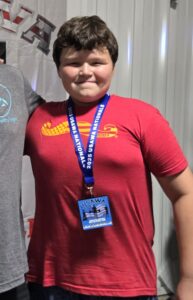
February featured the 2026 Bayou Beast Bash and the Ground to Overhead Challenge. Results from the USAWA Club Championships are still pending. Isaac Bankens earned lifter of the month with his amazing 397-pound total at the Bayou Beast Bash which was good enough to win the Junior Men category and was in the mix in the overall standings.
Following the competition, Isaac went on to perform a 361-pound Dinnie Lift and 300-pound Kennedy lift.
Isaac also competes in grip sport and shows a level of sportsmanship and poise that makes you forget he is only 12 years old.
Congratulations Isaac!
Do you know a USAWA member who should be recognized as lifter of the month? Send nominations to the acting Secretary at usawasec@gmail.com
As I was updating the member clubs page on the website, I was wondering why we subdivide our small club into even smaller clubs. I knew some obvious answers.
Outside of this, I did not see many references to clubs over the 17 years that the website has tracked club news. There was a 2017 article by Al referring to club certificates. Those have not been printed since I have been involved with USAWA. At the time of this article, there are (41) athletes in the USAWA and the majority have chosen a club affiliation.
Another (20) clubs have been founded over the years. New England All-Rounders, Prechtel’s AC and Ambridge VFW BBC are the only non-active clubs to have over a decade of involvement.
Traditionally, the winner of club of the year has not been eligible for the following year. However, Clark’s Championship Gym is living up to its name and has won the title 3 of the past 4 years.
Questions that came up for me?
Do you have to be a member of a club? No
Does it cost extra to be join a club? No
How do I choose which club to join? This seems to be regional based on where you will compete most often, but you could join any club
What benefit is there to being part of a club? Building community, planning and coordinating events
Can I sanction a meet without being part of a club? Yes
Where does the $30 annual club membership dues go? All USAWA income goes to a general fund to maintain the website, perform drug testing, purchase annual awards, maintain incorporation and perform general administrative functions. All board members and special assignment directors are volunteers.
Why did I choose to start a club? I had attended the National Championships when promoted by Clark’s Gym and competed in Al’s Dino Gym, but did not feel connected to either organization. We are fortunate to have a core group of athletes who like to compete together. I filled out the paperwork in hopes to build a community in Colorado. Having a club has not been much of a recruiting tool, but we were able to compete in the Club Championship last year (losing to Clark’s Gym).
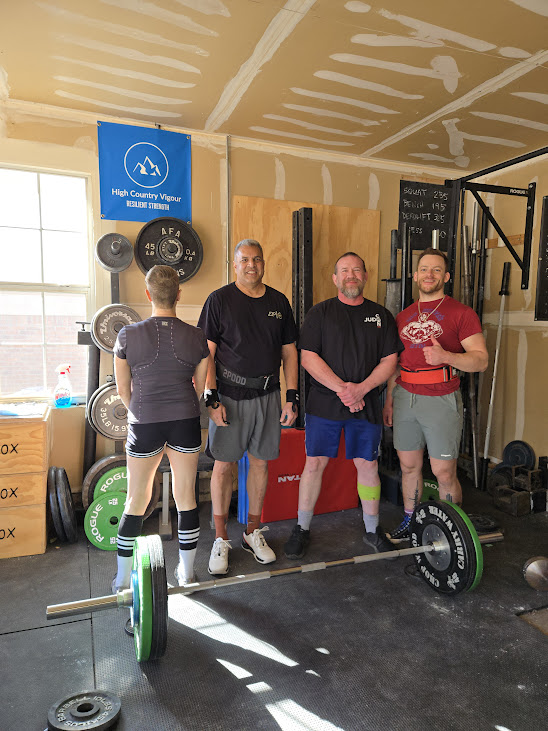
In 2025, athletes were put to the test on their single arm movements. In 2026, athletes were tested with their weightlifting movements. The Clean & Press, Clean & Push Press, and Continental to Chest & Jerk are unforgiving on athlete’s shoulders but does allow demonstration of technical lifting.
Of (14) registered athletes, only (9) were able to complete the event. Four athletes in Colorado took up the challenge and another five athletes took up the challenge in Missouri. In addition to the usual suspects, Josh Williams joined us. Josh primarily trains powerlifting and bodybuilding, but learned the All-Round movements quickly.
Clean & Press – This is one of the original lifts in the Olympics and was contested from 1928 to 1972 but was removed due to difficulties in judging proper technique. In Colorado, we had no issues judging and even the heaviest lifts, did not come close to the 27 degree maximum allowed back angle. Jarrod had the top lift in Colorado at 165 pounds and Abe had the top lift overall at 185 pounds.
Clean & Push Press – This surprised me as the strongest lift among most athletes that showed a decline or only modest improvement when allowed to perform a jerk. Jarrod again had the top lift in Colorado at 185 pounds and Abe had the top lift overall at 185 pounds.
Continental to Chest & Jerk – This is the closest lift that USAWA has to a Clean & Jerk. The difference being that one can work the weight up prior to performing a jerk. I had to take advantage of this on my second attempt when I missed the clean, but caught it on my belly and then worked it up so that I could execute the jerk. Jarrod and new lifter Josh had the top lifts in Colorado at 165 pounds. Abe again had the top lift overall at 265 pounds.
Clark’s Gym had the most team points with 2,570 compared to 1,797 for the High Country Vigour crew.
None of the athletes in Colorado elected to do record session lifts. The die-hard crew in Missouri set fifteen records after the competition lifts were concluded.
Thank you to all the athletes that participated.
COMPLETE RESULTS:
Location: High Country Vigour, Lakewood, CO and Clark’s Gym, Columbia, MO
Meet Director: Sanjiv Gupta
Meet Scorekeeper: Sanjiv Gupta
Date: February 14, 2026
Officials: (1-Official System) Sanjiv Gupta, Jarrod Fobes, Allison Lupo, Jeff Wenzel, Dave DeForest, Bill Clark
Lifts: Clean & Press, Clean & Push Press, Continental to Chest & Jerk
WOMEN’S DIVISION
| Lifter | Age | BW (lbs) | C&P | C&PP | Cont & J | Total | Points |
| Kim Van Wagner | 58 | 127.3 | 70 | 75 | 75 | 220 | 418.6 |
| Janet Thompson | |||||||
| Allison Lupo |
MEN’S DIVISION
| Lifter | Age | BW (lbs) | C&P | C&PP | Cont & J | Total | Points |
| Abe Smith* | 44 | 183 | 225 | 255 | 265 | 745 | 735.2 |
| Jeff Wenzel | 50 | 231 | 185 | 185 | 190 | 560 | 513.2 |
| Jarrod Fobes | 48 | 218.2 | 165 | 185 | 165 | 515 | 477.7 |
| David DeForest | 66 | 183 | 120 | 135 | 130 | 385 | 463.2 |
| Josh Williams | 34 | 186 | 155 | 175 | 165 | 495 | 460.7 |
| Sanjiv Gupta | 54 | 205 | 135 | 145 | 155 | 435 | 440.5 |
| Tony Lupo | 59 | 244 | 152 | 155 | 150 | 457 | 440.1 |
| Riley Wenzel | 21 | 154 | 135 | 145 | 120 | 400 | 418.7 |
| Travis Luther | |||||||
| Dylan Wenzel | |||||||
| Logan Wenzel |
*No Official – Ineligible for Records
RECORD SESSION LIFTS
TONY LUPO. AGE – 59. BWT – 244
Deadlift – Fingers – index – 185
Piper squat – 180
Cheat curl – dumbbell left – 70
Cheat curl – two dumbbells – 2×50 – 100
Clean and press – alternate grip – 130
DAVE DeFOREST. AGE – 66. BWT – 183
Deadlift – Inch dumbbell left – 90
Middle fingers clean and press – 78
Clean and push press – two dumbbells – 2×50 – 100
Cont. to chest – 140
Cont. to chest – Fulton bar – 140
JEFF WENZEL. AGE – 50. BWT. – 231
Clean and press – 12-inch base – 150
Clean and press – alternate grip – 140
Clean and press – behind neck – 140
Clean and press – reverse grip – 140
Clean and press on knees – 165