Tag Archives: Bill Clark

Bill Clark, USAWA, and the rest of the story.

by Joe Garcia

Part One:  Our beginning.
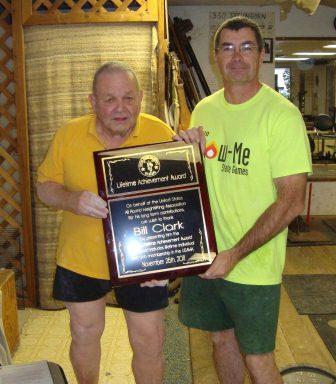
Bill Clark (left) receiving the USAWA Lifetime Achievement Award from Joe Garcia (right).

Most of you probably know that Bill is the founder and creator of the USAWA.  Recently the organization decided to honor Bill, and a letter of appreciation and a Lifetime Achievement Award were presented to him at the Goerner Deadlift Dozen Plus One a few weeks ago.  I also thought it would be both fun and instructive to go over the history of the USAWA and some of Bill’s story.  We sat down the other day for a lunch and I interviewed him about both subjects.  Keep in mind that this is bare bones as it would take a book or two or more to get the whole picture.  We’ll start this story with a chronological line from the beginning as he tells it.

The whole entity that was to become known as the USAWA basically started in 1959 with the local boxing team that Bill coached.  The boxers wanted to lift weights, so an Olympic weightlifting team was created.  In November their first state meet was held at the Armory in Columbia. A common theme for most of the meets is that odd lifts were almost always performed whenever meets were held.

The next year 1960, Bill was appointed as Chairman of the Missouri Valley AAU.  They had eleven lifters including Wilbur Miller, Art Tarwater, and Bill Fellows.  At the same time, the prison system became a hotbed of odd lifting.  Bill worked the ‘home’ games of baseball in the prisons from 1956 through 1967, and so was very familiar to the recreation directors in the system.  He was contacted by the Feds to start a federal program of lifting which he agreed to do.  Two stories from this era:  First, at one of the prisons, they cut metal decking for the weight plates.  These weighed between 10 and 25 pounds and the lifters used a short steel bar that limited how much weight could be loaded, so for the lifters like Joe Bradford, they would load the bar with about 400 lbs, then attach another 100 or so with wire, which wouldn’t come off the ground until the bar was just under the knees. This same concept was used in later years when performing lifts like the Hip lift. The second story concerns the Federal pen at Leavenworth.  Bill had been told they made almost all of their equipment, but when he went there, they had 22 platforms with commercial looking bars.  It turns out that they bought one bar, then had the shop fabricate 21 more for the lifters.

Coming into 1961, Powerlifting and Odd lift competitions were being held in Missouri Valley. These competitions were sanctioned under the Weightlifting umbrella as there was no official Powerlifting or Odd lifting at that time.  If anyone has access to old Ironman magazines, they would be able to find results listed there from some of the meets.  Rules for the odd lifts were first created about that time and records were kept as Missouri Valley Odd Lifts.

One of the key years was 1962. This was the year that the foundation was laid to make Powerlifting a separate event from Weightlifting. Lifters like Jim Witt, Homer Brannum, and Bill were some of the main forces to achieve this goal and they journeyed to the AAU Convention in Detroit, where they asked to make PL a subcommittee under Weightlifting.  At that time there still were no sanctions for either Powerlifting nor Odd lifting.  1962 was also the year of the first National Prison Postal Meet.  This first meet was an Olympic meet with subsequent years also having Powerlifting meets.  By 1968, they dropped the Olympic meets.  Typically the regular competition would be held, and afterwards the lifters would perform the Odd lifts. 

The first National Powerlifting Championships was held in 1963 by Bill at Jeff Junior High in Columbia even though it was an unofficial one as there was no sport of Powerlifting at the time.  One of the officials sitting in a chair was Bob Hoffman of York Barbell fame.  Another event that helped further our sport was Bill got the AAU to form a new committee – Correctional Sports and by 1966, convicts were granted full AAU memberships.  The following February one of the convicts won the National Flyweight Boxing Championship.  In 1968, Jenkins Hudson of the Maryland State prison defeated Bill March in Olympic lifting, Bill being a 5 time Senior National Champion.  That same year Otis Harrison won the North American title in body building.  By the time the correctional sports program ended, there were about 1000 participant lifters nationwide.

In 1964, at the National AAU convention at the Shamrock Hotel in Houston, Texas, a vote was held to allow Powerlifting to be a separate part of the Olympic Sport.  This motion was carried in a very close vote.  Later at the same meeting, Bill put in a bid to hold the National Championships which he won, beating Bob Hoffman by one vote.  Hoffman was able to get the AAU chairman to hold another vote on the bid, this time beating out Bill’s bid by one vote.  Due to this, Hoffman went into the history books as holding the first National Championships.

During the next decade, numerous Powerlifting and Odd lifting competitions were held in the Missouri Valley area and elsewhere.  Bill started having the Double Decathlon, a forerunner to the Zercher meet.  Twenty lifts were contested, with the Zercher lift and the Steinborn always being anchor lifts.  The Steinborn was originally known as the “Rocking Squat” but Bill renamed it to the Steinborn, in honor of ‘Milo’ and let him know that they had done so.  Years later, just before his passing, Henry sent $50 for a trophy.

In 1973 Bill brought forth another proposal to the AAU membership, that of having a Masters Program.  This was quite a contentious motion but did pass on a close vote.  The following year, Bill tried to host the first Masters Powerlifting and Olympic Championships. With only 4 entrants, Bill Fellows, Bill Clark, Jack Lano and Wilbur Miller, the meet was called off.  However, in 1975 the meet was held at Columbia College with a total of 15 lifters.  They also had a track meet afterwards where they ran the 880 and threw.  Today, the National championships have over 200 contestants and the Masters program exists in over 70 countries.

Around 1981, Tony Cook from England contacted Bill about holding a Postal Odd meet between English lifters and American lifters.  This meet was held in the US at Sailors Gym over in Kansas.  Twenty five lifts where performed in one day on three platforms and a single lifter might actually have been ‘up’ on multiple platforms at the same time.  Numerous meets have been held at Sailors Gym, and in the early years of the USAWA, the Missouri Valley records were held as the standard for the USAWA, with most of them having been set at Sailors.  Sailors was owned by Bobby Fulgroat who himself was a master powerlifter and bicyclist.  He would ride everywhere including to Columbia for meets.

Bill and Tony started making plans for an international organization in 1985, and Bill flew over to England in October, 1986 to meet with Tony and Frank Allen, where the IAWA was organized.  In 1987, the USAWA was formed and the first IAWA meet was held, albeit it was a postal meet.  In 1988 the first USAWA Nationals was held with John Vernacchio as the host and also the first IAWA Worlds were held at Leicester, England with Frank Allen hosting.  As a side story, at the same time Bill was over in England in 1986, Bill Buckner committed his infamous fielding error during Game 6 of the World Series, allowing the Mets to tie the series and go on to win over the Red Sox.

From the beginning of the USAWA until 2009, Bill served as Secretary/Treasurer and starting with his first Journal on Sept 10, 1989 until his last one on October 19, 2009 wrote just under 150 Strength Journals, keeping the membership informed about meets, events and any other odds and ends that he saw as interesting.  He was also President of the IAWA for the first couple of years.  While his travels today are limited, he still hosts a few USAWA meets at the gym, notably the Zercher, Deanna Springs Memorial and the Goerner Deadlift Dozen Plus One.

Part II will continue with background information about events Bill has held plus accomplishments and achievements over the years.
Goerner Deadlift

by Joe Garcia

MEET RESULTS

GOERNER DEADLIFT DOZEN PLUS ONE

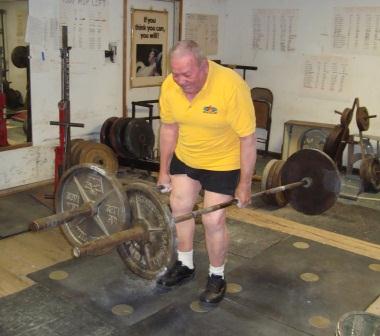
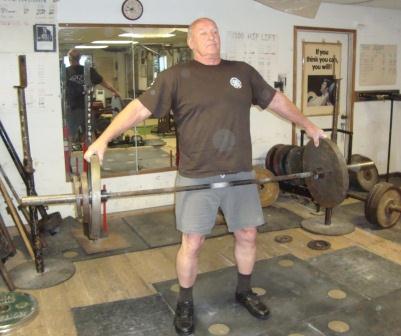
Bill Clark, at 79 years young, pulling a 2-Bar Deadlift of 270 pounds at the 2011 Goerner Deadlift.

It is amazing the lengths that some people will go to in order to miss this event.  Al ran off to some little contest in Australia, dragging Chad with him,  Eric was chowing down on turkey, and from the looks of the website, Thom was writing more ‘fluff’ pieces. Everyone not here missed out on a fun day at Clark’s gym.  When I drove up in the morning, Dean Ross and Mike Murdock were already there as was Bill Clark.  Evidently, Dean and Mike had arrived in town around 3:30 AM, not wanting miss out on one of the coveted parking spots in front.  We all weighed in, including Bill, who was on the platform for the first time in over a year.  Even though his right shoulder would give him painful problems all day, he managed at least one successful in each of the thirteen lifts and sometimes a second and a third attempt.  There were no fourth attempts taken during the day.

The day started out with the Thumbless Deadlifts.  That is definitely a lift that you can go from greatness to humility in 5 lbs.  One thing we elected to do during the day was to allow the lifter to do any of the lifts that he wanted in the order he wanted with the exception that the finger lifts were contested last.  This way, the loading was kept to a minimum by the lifters-loaders-officials.  That’s right, more multi-tasking at Clark’s gym.  Next up was standard One-Hand Deadlifts, if any lift in the USAWA could be called standard.  After finishing up with the one hand stuff, attention was turned to the two hand lifts.  Dean pulled the biggest Reeves lift with a 275, could have done a bit more but took a little too big of a jump and was unsuccessful in his next attempt.  I was happy with my 225 as I don’t remember the last time I did a Reeves deadlift.  Not only did Dean do a great job of lifting, he also kept us entertained with his stories and jokes.  Problem is that I think he believes most of them.  After the Reeves, the 2 Barbell, Hack, Heels Together and Jefferson lifts followed.  Finally, the dreaded finger lifts commenced.  Everyone began with the Little Fingers Deadlift, then the Ring, Index, and Middle Finger, except for Mike, who had to go back and finish with an Index Fingers Lift.  Everyone was grateful that Mary wasn’t around to show us up.

Dean Ross had the top Reeves Deadlift of the day, with this 275 pound lift.

The organization had elected to present Bill with both a letter of appreciation and a Lifetime Achievement Award.  I was honored to read the letter to Bill and to present him with his well deserved plaque for everything he has done for the USAWA over the years.  Bill also wanted everyone to know how much he appreciated the honor.

Results of the meet are listed below.  Amazingly, I won the Goerner, a deadlift contest.  I suppose that means I will have to defend it next year.

MEET RESULTS

2011 Goerner Deadlift Dozen plus One
November 26, 2011
Clarks Gym
Columbia, Missouri

Meet Director:  Bill Clark

Lifts: Deadlift – No Thumb, One Arm (left and right), Deadlift – One Arm (left and right), Deadlift – Reeves, Deadlift -2 Bars, Hack Lift, Deadlift -Heels Together, Jefferson Lift, Deadlift – Fingers, Little, Deadlift – Fingers,Index, Deadlift – Fingers, Ring, Deadlift – Fingers, Middle

Officials: Joseph Garcia, Bill Clark, Mike Murdock


Lifter Age Bwt DL Heels 2 Bar Hack Jefferson
Mike Murdock 71 234 225 270 135 185
Dean Ross 69 266 315 300 185 315
Bill Clark 79 235 225 270 185 185
Joe Garcia 58 203 315 300 275 275
      1 Arm R 1 Arm L 1 Arm NT R 1 Arm NT L
Mike Murdock     135 135 115 115
Dean Ross     185 185 160 160
Bill Clark     160 160 115 115
Joe Garcia     275 275 205 205
      Index Middle Ring Little
Mike Murdock     75 135 65 55
Dean Ross     120 170 120 95
Bill Clark     135 135 105 65
Joe Garcia     185 205 135 120
      Reeves   Total Points
Mike Murdock     205   1850 2004.1
Dean Ross     275   2585 2584.9
Bill Clark     135   1990 2282.0
Joe Garcia     225   2995 3158.1

NOTES:  Bodyweights listed in pounds.  All lifting poundages listed in pounds. Total is total pounds lifted.  Points are adjusted points for bodyweight correction and age amendment.

Clark’s Gym Meet Schedule

by Al Myers

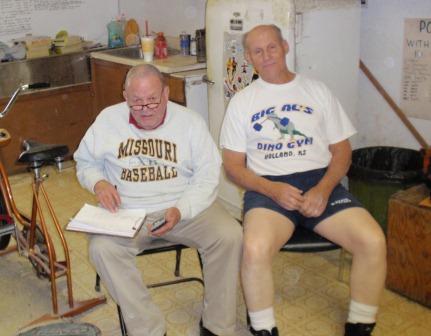
Bill Clark (left) and Rudy Bletscher (right). This picture was taken a couple of years ago, at the Deanna Springs Meet. Notice that Bill is tallying the scores using a hand calculator and pen and pad. No fancy computer, or even a printed scoresheet is needed for Bill to figure the day's results!

The Clark’s Gym Meet Schedule is now available.  USAWA events hosted in Clark’s Gym, Columbia, Missouri have been some of the longest running meets in the history of the USAWA.  Meets like the Zercher Strength Classic and the Backbreaker Pentathlon have been signature meets in the USAWA, and have the historic significance of defining the All Rounds in the United States.  As per custom in meets hosted by Bill Clark, there are no entry fees or entry forms to send in.  There are no awards given.  I have asked Bill in the past why he doesn’t give out awards, and his reply to me was “if you want one buy your own!”.   That sounded like a good reason to me!  After all, there are not very many events you can go to now a days that are free like Clark’s Gym Meets.  You get to enjoy a great day of lifting, along with all the free wisdom you want  from the Father of  All-Round Weightlifting himself Bill Clark, and it won’t cost you a dime! 

It is important that you contact Bill at least 3 days in advance that you plan on attending.  If not, you might show up on meet day and the meet has been cancelled (if no one has pre-entered).  

Clark’s Gym Meet Schedule

November 6th, 2011 – Schmidt’s Backbreaker Pentathlon

November 26th, 2011 – Goerner Deadlift Dozen plus One

January 28th, 2012 – Zercher Strength Classic

March 24th, 2012 – Deanna Springs Memorial Meet

Continental to Chest: It’s not a Clean!

 by Thom Van Vleck

The mid point of the Continental to Chest.

The Continental to Chest (Fulton bar) will be contested at the 2011 USAWA Nationals hosted by the Jackson Weightlifting Club.  Let’s get familiar with the rules:

A23.  Continental to Chest

The lifter starts with the bar on the platform in front of the lifter and raises it by any method of the lifter’s choosing onto the lifter’s chest above the pectoral muscle. The bar may be raised in one or a series of movements and may come to rest, be lowered, or make contact with any part of the legs and body during the lift. However, the bar must not be upended into any position on the body. Hand spacing and grip are of the lifter’s choosing and may be altered on the bar during the lift. The hands may be removed from the bar during the lift. The bar may come to rest on the lifter’s belt. A towel may be placed in the belt for the bar to rest on.  Touching the platform with a knee or the buttocks is permissible.  It is a disqualification for the bar or plates to touch the platform before the finish of the lift.   Once the lifter’s legs are straightened, the lifter’s body erect, the feet parallel and in line with the torso, the bar motionless, an official will give a command to lower the bar. The lift ends when the bar is placed on the platform under
control by the lifter.

F.  Fulton Bar (2” Bar) Lifts
Fulton Bar Lifts are approved for all bar lifts using a Fulton Bar and the rules of the individual lifts. 


We wanted to have one Fulton bar (or thick bar) lift and the Continental to Chest happens to be it.

In the past, this lift has often been referred to as the “Continental Clean”.  This was a pet peeve of  former USAWA secretary Bill Clark.  He would point out that the “Clean” refers to lifting the bar “cleanly” from the floor to the chest.  So, saying “Continental Clean” is an oxymoron……kind of like “near miss” or “alone together”.   Everyone knows what you mean but it really doesn’t make sense!

There’s a deeper story on how the Continental got it’s name.  In the early days of lifting, the British were often in competition with the French and German lifters (or Continental Europe, which did not include the British Isles).  The British took pride in how strictly they would lift the bar “cleanly” to the chest and would make fun of how the French and German would bounce the bar up anyway they could and the would refer to that method as the “Continental Style” in a negative fashion.  Later, the British were instrumental in the early lifting rules and the continental style was phased out and the clean style was accepted for major lifting competitions.  But the USAWA keeps the style alive and well!

So study the rules and get ready for some Continental action!

Heart of America Festival – Day 2

(Webmasters note: This is a reprint of the meet report covering the Heart of America Festival that occurred in August 1963 as published by the oldtime lifting magazine, the Lifting News. Dale Friesz passed this along to me to share, which characterizes one of the early-days All-Round Weightlifting Meets. Dale’s brother, Leonard, is included in the results as he was a member of the Columbia Athletic Club at the time. Our very own Bill Clark served as Meet Director, Head Judge, and Meet Reporter. He also competed! Past meets such as these are the reason why Bill organized All-Round Weightlifting into the USAWA. You will recognize several of the “meet stars” as they are legends in All-Round Weightlifting today. The meet was a two day affair, so I will divide the story into two parts, one covering each day. Enjoy!)

by Bill Clark

On the second day the squat and dead lift marks of Saturday are used and four other events are added to test a man’s back, endurance and will power.  The front squat opens the second day and Miller was very unhappy with his 390 front squat.  Wachholz made 385 and Friesz 380.  The Jefferson lift was next and Wachholz almost caught the lanky Kansas wheat farmer.  Miller did a straddle with 650, but Wachholz surpassed him on bodyweight with a 640 and moved within range with two lifts remaining.  Paul was able to make “only” 600 in the hack lift, but Miller endured with a 650 effort.  In the Zercher lift, Miller made 425 while Wachholz was good for only 365.   The meet was Miller’s once again.  This time with a total of 3320 and 2148 points.  Wachholz was close behind with 3020 pounds and 2072 points.  Your writer was third and felt happy with a mediocre performance after not working out more than five times since February.  He squatted 470 cold, made a 530 dead lift, front squatted 320, straddled up 560, hacked only 500 (has done 600) and Zerchered just 420 – 40 pounds under tops.  This was the meet he had planned to make a 600 squat, but baseball took care of that boast.  Maybe next year.  Too much umpiring this year and not enough time in the gym.

Lifter Squat Front Sq Deadlift Hack Zerch Strad Total Points
Miller 530 390 675 650 425 650 3320 2148
Wachholz 455 385 585 600 365 640 3020 2072
Clark 470 320 530 500 420 560 2800 1817
Friesz 445 380 490 450 385 475 2625 1790
Hahn 400 320 475 475 385 475 2530 1771
Hamilton 280 205 420 420 315 440 2080 1714
Witt 470 295 525 315 335 500 2400 1596
McPheeters 375 475 500
Lewellen 385 500 500
B. Fellows 420 315

Meet Director:  Bill Clark

Officials:  Bill Clark, Don Wickell, Ed Zercher

The question here, then, is how these two great lifters rank with strong men of the past.  Surely, in two days, few men of this size have ever lifted more.  To dead lift 675, hack 650 and straddle 650 along with the others is a phenomenal performance, and Wachholz was superb.  His 640 straddle must rank with the best.

These men are not goons, as power lifters have often been called.  Wachholz has done over 800 as a mid-heavy in the Olympic lifts and won the 100 yard dash, final event of the meet, in an amazing time of 11.3 seconds, running on asphalt in tennis shoes after a hard day on the platform.  Wachholz also throws the discus well over 160 feet and has a beautiful frame, placing high in every physique contest he enters.  He’s married and has two children.  He works in a bank and travels thousands of miles a year to meets. (No relation between his work and his ability to travel).  The marks he set at the Power Festival were all personal records.  In addition, he entered several of the side contests and won them.  He was best in the bench press with 315 pounds and did a stiffarm pullover with 110.

Miller was impressive as always.  He stands 6’3″, and weighs 235.  In high school he was a top miler and turned down a track scholarship at Kansas University after finishing his senior year at Ensign (Kansas) High School.  In his final high school race, he covered the mile in 4:33.6 and wound up third behind two great runners – Wes Santee, who later ran the mile in 4:00.2 and was America’s greatest miler until barred by the AAU for excessive expense money – and Billy Tidwell, a half-miler who represented the U.S. on many international fields.  Miller has done 930 in the Olympic Lifts and was second in the Junior Nationals this year.  He won one other event in the Power Festival, doing an abdominal raise with 105 pounds.  When the meet was over, a side bet came to pass concerning Wilbur’s ability to lift cars.  He promptly picked up the rear end of a Volkswagon, engine and all, and held it a foot off the ground.  He made the lift from the normal deadlift position.

Ed Zercher Sr., an old-timer who has moved enough weight to kill an elephant in his forty years on the platform, refereed all the lifts and branded Miller and Wachholz as two mighty strong youngsters.  He pointed out that their lifting was different from that in the old days when bars were not machined, but allowed the pair could have held their own with many of the greats.  Zercher, at 56, proved to be a horse even yet.  He took 600 pounds on his feet, and without any supporting devices, made 10 reps and held his balance perfectly in the leg press.  He then built a Roman Chair all by himself with 235 pounds balanced on his feet: 145 pounds in his hands and 130 pound Art Tarwater sitting astride the chair doing presses with 100 pounds.  When Tarwater lost his balance, Zercher held the chair steady – much to the amazement of the onlookers.

This meet was held in a shelter house the first evening and on the grass under a large shade tree the second day.  People driving through the park would stop and watch the lifting until they grew tired.  The crowd changed many times and townspeople still talk about the show they say in the park – for no charge.  It seems until someone comes up with a better performance, this must go down as one of the greatest ever.

1 2 3 4 5 6 8