Tag Archives: Al Myers

Rounded Back Platform Deadlifts

by Al Myers
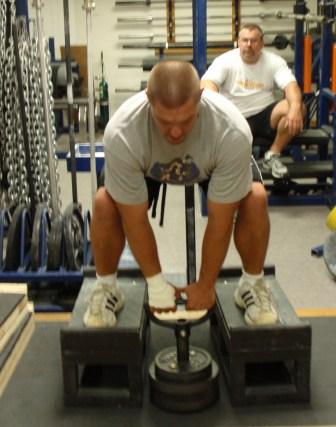
Dino Gym member Ryan Batchman demonstrating the proper way to do a Rounded Back Platform Deadlift.

We have our “Big Workout Night” at the Dino Gym on Tuesday night, and usually have a large turnout of lifters.  Everyone has their own workout, but it is the night to go heavy so most exercises trained involve the back and legs.  Lots of squats and deadlifts!  We start at 6:00 and sometimes don’t finish until 10:00 or 11:00.  The last part of the workout usually involves doing exercises that help with recovery or flexibility, or more commonly referred to as “accessory exercises”.  I am a firm believer in training heavy to get stronger, but at the same time don’t overlook lighter exercises as a way to supplement your heavy work. We constantly change these exercises from workout to workout as this is our way of “winding down” a hard workout. We have several back accessory exercises we do but I want to explain one that is not well known, which we call the Rounded Back Platform Deadlift.  This exercise could be a great addition to your back training program.

The Rounded Back Platform Deadlift is done is this manner. First, you place a foot on two different raised platforms, and place the weight on a loader in front of you between your feet. It is best to have a loader that a handle can be attached to so weight can be added. The height of the handle should be just above the level of the feet, but not as high up on the lower leg as a loaded bar on a lifting platform.  Use an overhand grip when picking up the weight, and with a bend of the knees allow the lower back to round over.  When rising, stand and come to a complete lockout. Lower the weight as low as possible without allowing the weights to touch or rest on the floor.  Keep constant tension on the body at all times. Perform the repetitions at a controlled pace, paying attention to keeping the proper form of rounding the back when rising up with the weight.  We perform sets of 10 reps, adding weight to each subsequent set. Usually we will do between 4 and 6 sets.  We rotate quickly between us and try to keep the rest minimal.  This exercise is not about maximum exertion – but rather about stimulating blood flow to the lower back and legs. You will feel “the burn” in your hamstrings after performing this exercise.

The Rounded Back Platform Deadlift improves flexibility because the weight has a deep pickup that requires a good stretch.  The cross-over benefits to an All-Rounder is that it will help with rounded back type lifts, such as the Zercher Lift or Hack Lift.  It is also a very good exercise for Strongmen to help build strength for Stone Lifting, which is also a rounded back type of lifting.
Dave Brown

by Al Myers

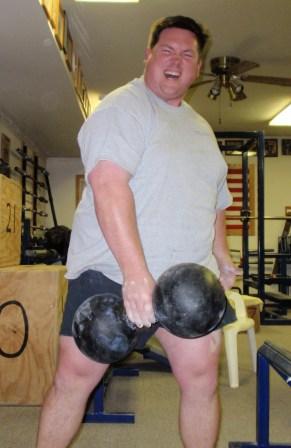
Dave Brown becomes ONLY the fourth person to ever pick up the Dino Gym's Inch Dumbbell Replica.

This past week the Dino Gym had a surprise visitor for our Tuesday night workout. It was my old friend Dave Brown, who was on vacation and decided to “stop by” and pay me a visit. He picked a good day – because Tuesday is our BIG NIGHT in the gym. This a big DEAL for the Dino Gym – having a STRENGTH CELEBRITY join us for a workout. It has been a few years since I have seen Dave – but he is still as big and strong as he used to be. Dave stands 6’3″ and weighs a little over 350 pounds – but carries his weight very well. His build reminds me of Paul Anderson when Paul was in his younger days. Dave has been a top level professional Highland Game athlete for 15 years. Before this, he was a record setting amateur athlete with the 28# and 56# weights for distance. Dave now resides in Redding, California and works as an engineer for a timber company. He is married to Shauna, and they have two children, a son Taylor (10 years old) and a daughter Arabella (2 years old).

Dave currently holds the WORLD RECORD in the 56# weight for height with a toss of 20’1″, which he set in 2006. I remember when I started throwing in the Highland Games (over 20 years ago) and athletes would “talk about 20 feet” in the WOB with anticipation that maybe someday someone would top that mark. Much like Olympic Lifters talking about a 600 pound Clean and Jerk. It seemed like an impossibility at the time, but the hope was always there that a SUPERMAN would come along and make the impossible happen. Well, that SUPERMAN is Dave Brown. Yet, Dave is as modest as they come. I have known him for close to 20 years and he is the same guy now as when he first started throwing. I remember many years ago when Dave was a 19 year old kid living in Tulsa, Oklahoma and was just starting in the games. Dan DeWelt commissioned me to “come down to Tulsa” to put on a Highland Games Clinic for new throwers, as I was the only Highland Games Pro around in the Midwest in those days. That was the first time I met Dave, and when we got to the weight over bar and he was matching me throw for throw – I knew he was going to be something special someday in the Highland Games. For a couple of years Dave would drive to my place so we could train together. He started going to more games. It wasn’t long before Dave turned professional and we were seeing and competing with each other several weekends a summer. And then it wasn’t long before Dave was far surpassing ALL of my throwing distances!!

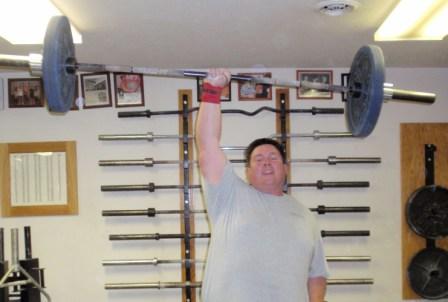
I introduced Dave to an All-Round lift I knew he would excel with - the One Arm Barbell Snatch. In his first workout ever he snatched an unbelievable 170 pounds!!

Dave is a “student of the game”, and when mixed with his amazing genetic ability and work ethic, has accomplished things that others just dream of. I really believe if Dave had decided on focusing on another sport besides the

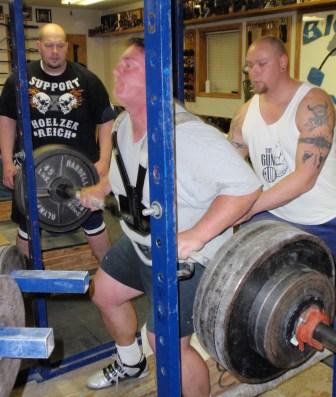
Dave has tremendous squatting ability. Here he breaks a Dino Gym record in the Zercher Harness Squat to a 15" box with a lift of 515 pounds.

Highland Games he would have been just as successful. In 1998, he tried Strongman Competition and with minimal implement training won the NAS Heavyweight Championships! And this was against seasoned Strongmen. I wonder what his Strongman career could have been if THAT was his focus? Dave also has a WORLD CLASS grip without working on it much. Many years ago at a Pro Highland Games in Arlington, Texas I will never forget him closing the #3 COC grippers with ease. This was in the days when that was a BIG DEAL! Carl Braun brought along a #3 gripper to “Challenge” Dave over our noon lunch break. I don’t even know if Dave had ever seen one before – but while he was sitting there with a sandwich in one hand and the gripper in the other he SMASHED it shut! Then he switched hands with the sandwich and #3 gripper – and did it again with his other hand! I’ll never forget how nonchalantly he did this! It just wasn’t that big of deal to him at the time. World renowned Strength Historian Dale Harder has been measuring athletes grips with a Baseline Dynamometer to get a very accurate reading of gripping strength. He has done this for over ten years now and has tested 1000’s of athletes. To date, Dave has the HIGHEST Dynamometer reading of ALL-TIME with a squeeze of 122 kilograms. Now THAT’S a firm handshake! It’s a shame Dave never gave football a try. With his size and agility I’m sure he would have had a lucrative pro career as an Offensive Guard in the NFL.

I only wish Dave would have planned his vacation so he could have made it to today’s Dino Grip Challenge. He would have been a MAJOR FORCE in the gifted lineup of grip-masters that are entered in this meet. Hopefully, the USAWA will see more of Dave Brown in the future.

The Weaver Stick

by Al Myers

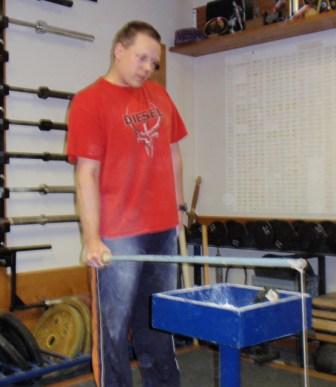
Ben Edwards training the Weaver Stick.

I saved the most interesting lift for this last story covering the lifts that are in this weekend’s upcoming Dino Gym Grip Challenge.  The Weaver Stick is one of the most perplexing and misunderstood lifts in the USAWA lineup of lifts.   Bill Clark once told me that “judging the Weaver Stick is more subjective than judging depth in a squat.”  I definitely agree!  I will be the Official Judge in this competition, and I will make sure that everything is done right and all competitors will be judged equally and fair.  The most subjective part of judging the Weaver Stick is making sure that the lifting arm remains straight at the side with elbow locked.  With just a little bend at the elbow, other muscles can be pulled in to play, and much more weight can be lifted. The Weaver Stick is a leverage lift that tests the ligament and tendon strength of the wrist, primarily above the thumb.  It is surprising how little weight can be supported this way.  John Grimek many years ago set the World Record in the Weaver Stick at 11 3/4 pounds.

The Weaver Stick is named after George Weaver of Brooklyn, who popularized it in the early 1940’s. However he didn’t really invent it.  Many years before this Paul Von Boeckmann of New York City found that he had a “special knack” for this type of lifting and had a early version of the Weaver Stick made out of a broom handle.  He won several bets with his ability to lift it with weight attached by a rope on the end of it.  George Weaver based the measurements of the Weaver Stick from Von Boeckmann’s broom handle, and the regulation Weaver Stick length of 36 inches was born. By the way, Paul Von Boeckmann was VERY GOOD with the Weaver Stick and is credited with a forward lift of 11 1/2 pounds. When he was over 60 years of age he could still do 9 1/2 pounds!!  The Weaver Stick has also been contested backwards – meaning you face away from the Weaver Stick.  Slightly more weight can be lifted this way.  However, at this meet you must perform the Weaver Stick in the forward manner.  I would say a great lift is anything over 6 pounds, with most lifters capable of between 4 and 6 pounds if done correctly.  Occasionally in the gym we have pulled out the Weaver Stick to “play around” at the end of workouts.  I am always surprised by what guys lift. You can never predict.  I don’t think there is any correlation between overall body strength and ability with the Weaver Stick.  It is a humbling feeling to fail with 5 pounds when you can deadlift over 500 pounds.  The great Warren Lincoln Travis is said to have been only able to do 4 1/4 pounds with the Weaver Stick.  The top lift ever done with the Weaver Stick in the USAWA is 7 pounds.  This was accomplished by two lifters – Tom Ryan and Mark Mitchell.

The Rules for the Weaver Stick

“A Weaver Stick is used for this lift. The Weaver Stick utilizes a wooden broomstick with these dimensions. The handle is 5 ½ inches in length. The junction of the handle and the rest of the Weaver Stick may be marked with tape, or with any material that is raised to provide a distinct separation between the handle and the rest of the stick. This marking is ½ inch in length. At a point exactly 36 inches from the end of the marking, or 42 inches from the end of the handle, a notch is made in the stick to allow a cord to be attached to it. This cord may be of any length.  Weight is tied onto the end of the cord. The Weaver Stick must rest on a flat lifting surface with the weight hanging free. The lift will begin at the lifter’s discretion. The lifter will take a position alongside the Weaver Stick, and grip the handle of the Weaver Stick by one hand, facing the length of the stick. The lifting hand and arm must remain straight with elbow fully locked, and must not be in contact with the body during the lift. The lifting arm must remain at the lifter’s side throughout the lift. The heel of the hand must remain on top of the Weaver Stick. If the hand twists under the stick during the lift, it is a disqualification. The non-lifting hand must not touch the lifting arm, lifting hand, or Weaver Stick during the lift. The lifter’s body must be upright with legs straight at the completion of the lift, but the legs may bend when picking up the stick. The Weaver Stick must be lifted entirely clear from the lifting surface while maintaining the stick parallel to the floor. If the end of the stick containing the weight dips to any degree, it is a disqualification. If the lifting hand moves to a position in front of the handle marking during the lift, it is a disqualification. Once the Weaver Stick is motionless, an official will give a command to end the lift. Records are also kept for the Weaver Stick with the lifter facing backwards, away from the length of the stick.”

The Deadlift – Fingers, Little

by Al Myers

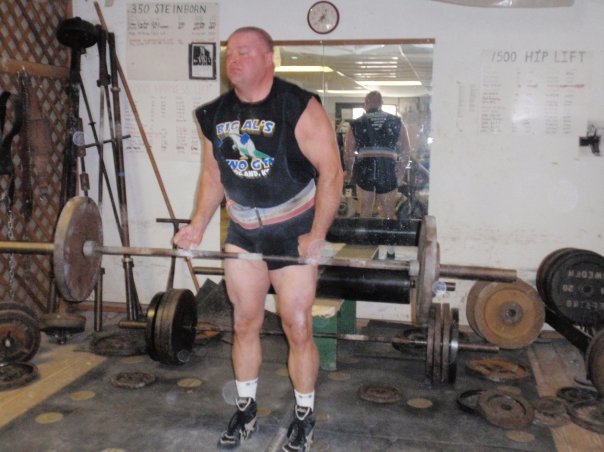
I pulled 155# in the Little Fingers Deadlift at the last Goerner Meet. Notice I have my eyes shut as I'm focusing on "pleasant things".

You can’t have a USAWA grip competition without at least one finger lift in it!   The USAWA has two types of finger lifting events. One type is using individual fingers of one hand, and by use of a ring attached to a loader, lift the weight from the platform utilizing just ONE FINGER.  The second type, which is type being contested in this competition, is using the same finger of each hand and deadlifting a bar from the platform. TWO FINGERS are used in this lift.  Ben picked the most sensitive fingers of the hand, the little fingers, to be contested in the Dino Grip Challenge.  The rules for this lift are very straightforward.

Rule for the Deadlift – Fingers, Little

“The rules of the Deadlift apply except only the little fingers of both hands may be used. The little fingers of both hands may grip the bar in an alternate manner.”
I wish I had some compelling advice on this lift – but I don’t.  It will hurt and you will probably tear flesh or injure a flexor tendon.  This lift requires MIND over BODY – and it is best to just “block out” the excruciating pain of the lift by focusing on “pleasant things”.  The Little Fingers Deadlift  hurts more than ALL of the other finger lifts.  I have theorized it is because all of the weight is focused on such a small area. It hurts like hitting your finger with a hammer, but the pain lasts longer.   Last year on the Discussion Forum it was voted as one of the most painful lifts in the USAWA.  But All-Round Weightlifting is NOT for sissies – so come to the Dino Grip Challenge and take on the Little Fingers Deadlift!!

Vertical Bar Deadlift – 1 bar, 2″, 1 hand

by Al Myers

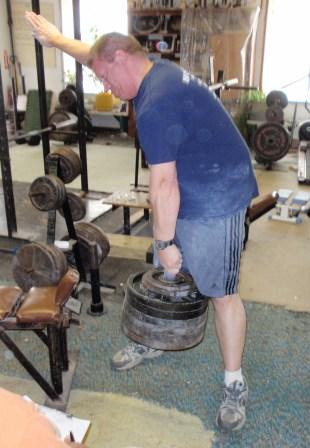
Ben Edwards doing a 235 pound Vertical Bar Deadlift - 1 Bar, 2", One Hand. This is the top All-Time record in the USAWA.

This lift was introduced to the USAWA several years ago by John McKean of the Ambridge Barbell Club.  Initially it was performed with a 2″ Vertical Bar in each hand, with the lifter completing the lift by standing up with the weight like a normal deadlift.  The first recorded meet this lift was done in was 1998, at Art’s Birthday Bash.  John McKean first introduced it as a One Hand Lift in 2003 at the Jump Stretch Record Day. Since then the popularity of the 2″ One Handed VB Lift has grown. The first big meet it was held in was the 2004 National Championships, in Youngstown, Ohio.  The Vertical Bar has a length limit of 18 inches.  The reason this became the USAWA standard length was because the original VB was the sleeve off of an Olympic Bar, measuring just under 18 inches.  The USAWA rules on Vertical Bar lifting are quite different than other grip competitions. The big thing to remember is the bar must become completely motionless at the completion of the lift, including any rotation.  Another USAWA rule I want to clarify is that in any One Handed lift the same hand must be used throughout all of your attempts. You can’t save “thy strong hand” for “thy hard lift”.

Rules for the Vertical Bar Deadlift

H18.  Vertical Bar Deadlift – 1 Bar, 1”, One Hand

The setup for this lift requires a Vertical Bar, which is a bar of one inch diameter with a maximum length of 18 inches. A collar or plate must be tightly fastened or welded to the bottom so plates may be added to the bar.  No knurling is allowed on the bar. The lifter may straddle the weight or have it placed to the lifter’s side. Width of feet placement is optional, but the feet must be in line with the torso. Feet must not move during the lift, but the heels and toes may rise. The bar may be gripped by any grip with only one hand near the top of the vertical bar.  The forearm is not allowed to touch the bar. The lifting hand must not touch the body during the lift, but the weight may accidentally touch the legs provided it does not aid in the lift. The non-lifting hand may be braced on the leg or body during the lift, but must be free from the body at the completion of the lift. The lift begins at the lifter’s discretion. The body must then straighten, lifting the Vertical Bar from the

platform. The legs must be straight and knees locked at the completion of the lift, but the shoulders and body do not need to be erect. The lifting hand must be above the level of mid-thighs at the completion of the lift. Any rotation of the bar must be completely stopped. Once the weight is motionless, an official will give a command to end the lift.

H19.  Vertical Bar Deadlift -1 Bar, 2”, One Hand

The rules of the Vertical Bar Deadlift – 1Bar, 1”, One Hand apply except a two inch diameter Vertical Bar is used.

1 27 28 29 30 31 33