Tag Archives: Al Myers

The Pullover and Push Part 3 – Technique and my Secret Tips

by Al Myers
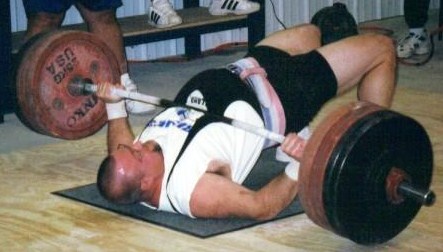
Al Myers attempting a 475# Pullover and Push at the 2004 Dino Gym Challenge

Since Part 1 already covered the rules of the Pullover and Push, I am going to assume everyone knows what is expected regarding the rules of this lift.  I am going to cover things here that AREN’T in the rules – and hopefully give you suggestions that will help you improve upon this lift. First of all, the Pullover and Push is a violent exercise and not for the “faint of heart”.  It is no wonder the modern day Bench Press has replaced it.  It is very easy to get hurt doing this exercise, and just being off a little in position and  technique can result in injury.  I have incurred several injuries myself from this exercise, and I consider myself knowledgeable of the proper technique. At the 2007 Nationals I fractured a carpal bone in my wrist. I have suffered bruised ribs, lacerations to the elbows, bruises to the chest area, wrist injuries, and even a couple of times been knocked unconscious from failing to get my head turned adequately when pulling the bar over my head. Now with THAT being said, if you don’t want to take any of my advice I would completely understand, and maybe THIS LIFT is one you might not want anything to do with!  But All-Rounders are a hard-headed group of lifters (myself included), and for some reason like pain and punishment.

A lot of lifters have benched pressed over 500 pounds, with some even doing it without bench shirts and with long pause counts on the chest.  But NO ONE has done over 500 pounds in the Pullover and Push!  I do think this is possible some day, but it will take a unique lifter who wants to specialize in this lift.  One big problem with the Pullover and Push is that it is not a good lift for large lifters.  Large lifters with big chests have an obstacle that smaller lifters don’t have – that is first you have to get the bar pulled over your head and chest to even START the push.  I have seen many strong bench pressers fail in even getting 200 pounds in position on the chest.  It is humbling to be a 400 pound plus bencher and fail with 200 pounds in the Pullover and Push! However, it will take someone with good size to be able to “break” the 500 pound barrier.  I think the “ideal body size” for putting up big weight in the Pullover and Push is a lifter around 6 feet tall that weighs between 220 pounds and 240 pounds. The height is needed to enhance an arch (or bridge) and 240 pounds is about the top bodyweight a lifter can weigh before excessive resistance is reached in the Pullover.

I was fortunate to learn many of “my secret techniques” from the best Pullover and Push lifter of All-Time – Bob Burtzloff. Bob has  the best lift of All-Time (and the All-Time USAWA Record) at 473 pounds, done in 1987.  Bob did over 200 kgs several times in competition.  You have to have “NO FEAR” when doing the Pullover and Push.  The Pullover and Push has a 1-2 punch, which you must be prepared for and overcome, before you will get to the Push portion of the lift.  The first “Punch” is the bar slamming into your chest during the Pullover, and the second “Punch” is the bar impacting your abdomen. You must have your abs “tighten up” when this happens or it will knock the breath out of you. Much like a hard punch to the gut.  I like to roll the bar three times on the platform, with the last roll pulling with EVERYTHING I got. I do the first two rolls to get me mentally prepared, much like a basketball player who will bounce the ball a set number of times before a free throw.  It is called a Pullover, but THAT is far from how it should be executed, as a pullover implies that you are lifting the bar onto the chest.  Instead, the bar should be PROPELLED onto the chest by the momentum of the rolling bar. Some of these tips on the pullover don’t really apply to smaller lifters – as I have seen lightweight lifters literally roll the bar into position onto the chest/abdomen without the plates ever leaving the platform.  It is very important to turn your head to the side when the bar is coming over the face as to prevent that knockout blow to the jaw. Once the bar has passed over the face I like to quickly turn my head face up and RAISE my head up as I think it helps drop the chest slightly to help the bar reach its desired location on my upper abdomen. Make sure you wear a shirt that doesn’t have a sticky vinyl logo on the front of it. Do everything you can do to reduce friction on the chest.  I like to wear a tight white T-Shirt.   Another “trick” is to take a wide grip on the bar (snatch grip).  This will shorten the length of “stroke” needed in finishing the push. Even if you are against wrist wraps, this is one lift where you should wear them.  The wrists have to “turn over” hard and fast in the transition between the pullover and the push, and lots of stress is placed on them.  I also recommend wearing a weight belt.  The bridge places lots of pressure on the lower back and a belt helps support the back.  I will wear my belt slightly higher on my abdomen than when doing a deadlift, and after I buckle it I leave a loop of belt sticking up. I have on occasion over pulled the bar to the abdomen and if not for this loop of belt “blocking” the bar and causing it to stop, I would have not have been in position to do the push.  Two styles of Pushing are used. Smaller lifters tend to pull the bar to the abdomen, let it pause while pulling the feet under, and lift it as high as possible with the bridge before finishing it out with a slight press. Larger lifters (like myself at 6 foot and 250 pounds) like to rebound it quickly from the abdomen to arms’ length.  To do this the feet must already be in position by the hips because you will need to bridge quickly. My biggest weights lifted have happened with this technique as I feel I get a “rebound” effect from the abdomen going directly into the bridge. Much like the rebound effect in the Clean and Jerk. However, everything has to be timed perfectly, because if you are slightly out of position you will lose the  direct line of push and miss the lift.  I find it important to have a mat under my body during the lift. Most lifters do this to cushion the impact of the elbows, but I find I need it to help “stick” myself to the platform.  On a slick wood platform during the  pullover without a mat, I will pull myself towards the bar and slide on the platform. It is best to use a mat that is thin with a rubber backing.  Usually these are not available in competition, so I resort to using a towel which works adequately.

I consider someone who is very proficient in the Pullover and Push to be able to do 150% of bodyweight. A goal everyone should have is to be able to do bodyweight. You are also considered good at the Pullover and Push if you can outlift your best raw Bench Press. You should DEFINITELY be able to do more in the Pullover and Push than the Pullover and Press!  I hope I have given a few tips that will help you improve your training in the Pullover and Push.
Harness Lift:Part 1

by Thom Van Vleck

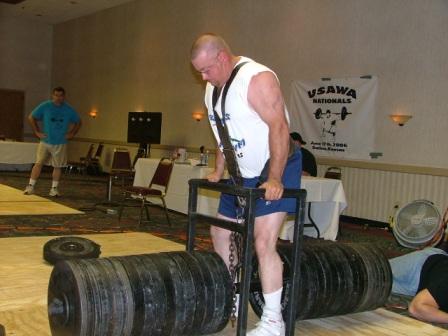
Big Al Myers lifted 2800# in the Harness Lift at the 2006 USAWA Nationals

The Harness Lift is one of the more intriguing lifts in the USAWA.  How often can a person lift a ton….literally!  Let’s review the Harness Lift rules from the USAWA rule book: A Heavy Lift Bar is used in this lift. A harness is also used, which fits over the shoulders and around the waist. An adjustable chain and hook is attached to the harness so it may be attached to the Heavy Lift Bar. The width of the harness must not exceed 4 inches around the waist and 3 inches over the shoulders. The lifter is also allowed to use hand rails to support the arms during the lift. The hand rails may be of any design. A hand rail does not need to be used, and the lifter may support the arms on the legs during the lift. The lifter assumes a position in which the lifter is straddling the Heavy Lift Bar. Width of feet placement is optional, but the feet must be parallel and in line with the torso. The feet must not move during the lift, but the heels and toes may rise. The lifter may adjust the chain length to his/her preference prior to the lift. The lift begins at the lifter’s discretion. The lifter is allowed one test lift to check the balance of the weight and to make adjustments to the chain length. The lifter will stand and lift the weights from the platform. The shoulders and torso do not have to be upright upon the finish of the lift. The legs must straighten, but the knees do not need to be locked. Once the weight is motionless, and the plates on both ends of the bar are off the platform at the same time, an official will give a command to end the lift.

Steve Schmidt is responsible for some of the most amazing Harness lifts of all time.  At the 1988 Backbreaker he did 3500lbs in the 105kg class and in 1992 Backbreaker he did 3315lbs weighing in some 10kg less in the 95kg class.  But the best of all time, was at the 1991 back breaker where Steve did 3515lbs in the 100kg class! Another amazing Harness lifter is Joe Garcia.

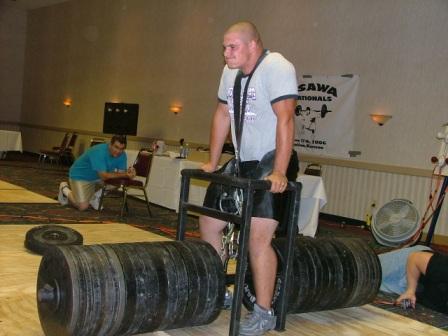
But to me, my favorite memory of the Harness lift took place when I was a head judge at the 2006 USAWA Nationals.  There was a lot of big Harness lifts that day but a real battle emerged between Al Myers and Ian Reel.  Al was the wiley veteran and Ian was the young rookie.  It was a battle for the ages!  I was extremely impressed with Ian (I’ve come to expect big lifts out of Al!).  I recall getting down at floor level trying to check for clearance and seeing that heavy bar bend like a bow!  That was some serious weight!  When the dust settled, Ian (who was officially lifting in the 110kg class) equaled Al’s 2800lbs (Al was in the 115kg class) so by virtue of bodyweight, I have to give youth the victory on this one.  I hope when Ian is done with his collegiate throwing career he makes a return to the USAWA….I hear he’s “filled out” now!

Youth is served! Ian Reel matches Al Myers lift for lift in the Harness Lift while recording the top Harness Lift of All-Time by a teenager.

Inspiration Photos

by Al Myers

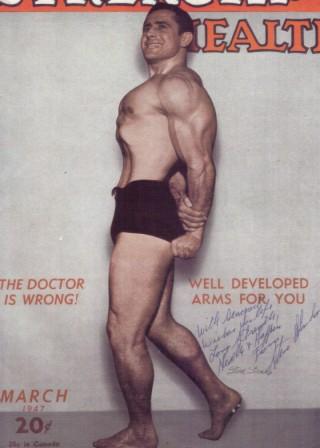
An autographed photo of Steve Stanko, which is displayed in the Dino Gym, courtesy of Dale Friesz.

I have been collecting pictures for a long time – and if you have been to the Dino Gym you have seen my collection covering the gym walls. There are now over 100 photographs lining the walls of the gym! I find that these photos of lifters, some famous and some just lifters that I have great respect for, inspire me to train harder. I can’t really explain why – it’s just that when I look at these pictures during a workout and KNOW the hard work and dedication that each one of these athletes put into working out – it is INSPIRATIONAL to me. It makes me want to workout even harder! Most all of my pictures in the gym have a story behind them. I didn’t just didn’t pick them out random and throw them up on the wall for a little gym decoration!

My favorite photos are the ones that have been autographed. So far, some of my autographed pictures include great lifters such as Wilbur Miller, Norbert Schemansky, Bruce Wilhelm, Joe Dube, Bill Pearl, John Grimek and Terry Todd. I also have autographed pictures of great throwers such as Al Oerter, Al Feuerbach, John Godina, and Brian Oldfield. Among others are great athletes including Vince Young, the “best Highland Games athlete of All-Time” Bill Anderson, Jesse Marunde, and Tom Manno. I probably have some more that I didn’t mention here. I am not the only one that has this fascination with inspirational photos. Thom Van Vleck has more pictures in the JWC Training Hall than he has weightlifting plates (and he has TONS of plates). I have been in Thom’s gym several times and each time I notice a photo that I hadn’t seen before. When I attended the USAWA Club Challenge this spring hosted by the Ambridge VFW Barbell Club, I noticed the many pictures they have lining the staircase as you descended into the dungeon of iron that is known as the Ambridge VFW BBC. By just looking at their photograph display, you are motivated to lift before you even enter the gym!

This is one on the many reasons why I prefer small club gyms over commercial gyms. You very rarely see pictures on the walls of commercial gyms – instead you see promotional posters trying to sell you something. Inspirational photos give a private club gym the “personal touch” that you don’t get in a big commercial gym – and this results in a better workout!

…And a Good Time Was Had By All

by Thom Van Vleck

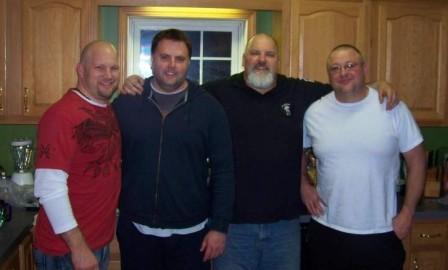
Chad Ullom, Tedd & Thom Van Vleck, & Al Myers have a good time after a meet

I grew up in Schuyler County, Population about 3500. We had a weekly newspaper (long since gone) that often was filled with social items. There was this one lady that wrote about the gatherings and she would talk about who came, what they ate, and what they talked about…..big news where I came from. To be honest, I kinda miss that kind of news over the stuff we deal with now! At any rate, she would end her column with “…..and a good time was had by all”. That kind of became a “catch phrase” in my family for social gatherings.

Recently, Chad and Al came up for a contest I put on. Al’s Dad came along, too. As is usual, we all ended up at a “get together” at my place after meet. And, as usual, we ended up telling stories until the wee hours of the morning…and maybe a liquid refreshment or two. My wife went to bed at a reasonable hour (we did not!) and commented the next day, “Al sure laughs loud!!!”. The point is, we all laughed and we laughed a lot!

The next day, when we went to the Deanna meet, Al and I talked about this part of almost every meet and contest we have been to over the years. Al commented later that his dad told him, “I finally understand why you like to do these meets”. While I enjoy the challenge of competing and I have many memorable moments of contests, I have just as many stories about the trips to, and from, and the get together’s that happen afterwards. It’s all part of the fun.

I hopefully have many more contests to come in my life time, and win or lose, I will do my best to make sure they all end with “….and a Good Time was had by All!

Interview with Scott Schmidt – Part 4

by Al Myers

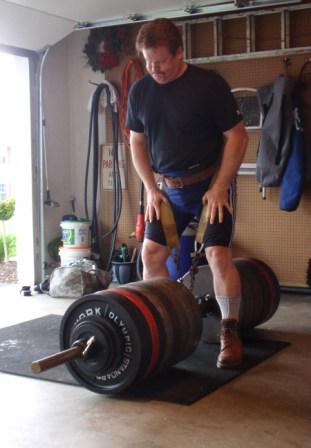
Scott's best official lift in the Hip Lift is 2000 pounds.

Al: I was glad to see you recently register your club with the USAWA and help with the growth of the USAWA Club Program.  Could you tell me the history of your club?

Scott: My club, The Schmidt Bar Bell Club, was founded in March, 1967. I was 14 years old at the time, lifting with my friends in my parents garage. We registered with the AAU later to be eligible to compete with the other clubs in the Cleveland, Ohio area. Our goal was to win team trophies, and that’s what we got good at! Our toughest competitor during our early years was the famous Olympic Health Club. Old Scotty Boy had to get some good talent to beat those guys! Ultimately, our winning strategy was boiled down to prepping our guys to be in the right weight class at the right time to have the best shot at winning. With weight control knowledge learned from High School Wrestling, our young guys in the light classes often scored more team points then their big guys. And if we were good enough to win the head to head battles, we often walked away with the title. As we got older and gained weight, by now we could still put up a good fight, because we had gained experience. One of our greatest accomplishments was winning the Ohio State Teen Age Weightlifting Championships. Believe it or not, when we won in 1971, it was the last year they held that specific tournament in our State. So, 39 years later, we are still the defending Champs!!

We stayed active as a club until the early 80’s. Since The Schmidt Bar Bell Club was not competing actively as a team, I personally have represented The Westpark YMCA for Olympic Weightlifting and The Prechtel AC  for All Round events since then.

But after a conversation with Al Myers, who is doing everything he can to grow our organization, I decided to resurrect the old club name for competing again in team competition. I love to train other folks to help them reach their potential. I have coached my family members and friends to World Titles and Records over the years, and my new goal is to repeat that process under the Schmidt Bar Bell Club banner!

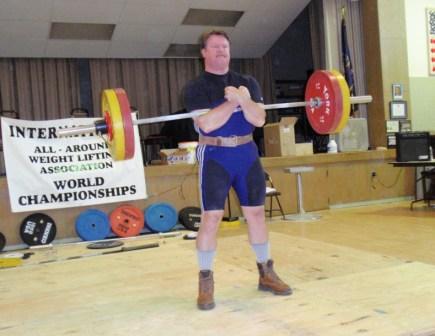
Scott is doing a Zercher Lift at the 2009 IAWA World Championships. At this meet Scott was the Open 120 kg Champion and the Best Master 55+.

Al: What do you think the future of the USAWA will be?  What does the organization need to do in order to grow?

Scott: The future for the USAWA looks promising. I think it’s all about telling others of our activity, and engaging them to have fun with us.

I think we are on an outstanding track of communication methods to have the best shot at growth. As in most endeavors, the best way to grow is by word of mouth. If we can all encourage others face to face in addition to our event postings, I feel we have a great chance to attract more members.

I thought of this idea the other day: As you know, the fitness industry is booming with participants. Moving weights is no longer looked down at, like when weight training was in it’s infancy. So to appeal to that audience, with the intent of drawing them into a few of our “exercises” , here’s my thought. What if we touted the prestige of becoming a “World Record Holder” to those folks who haven’t jumped on board yet?

In other words, stress the honor a new comer could achieve by setting a record in one of our over 200 events.  I’m sure there are a lot of folks out there who are good at some of the events we have. And to encourage them to try to obtain a “World Record” may just be the spark to get them to try our All Round Lifting.  The details of how, when and where we post this type of “advertising” would need to be figured out.  But it might spur some interest, in someone who trains hard at a fitness place and finally wants to test themselves against the record books.

Al: I agree!!  We have a great sport and all it takes is getting the word out. Thanks Scott for doing this interview.

1 24 25 26 27 28 33