Tag Archives: Al Myers

My Thoughts on the Gold Cup

by Al Myers
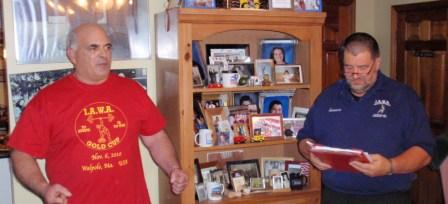
Gold Cup Meet Director Frank Ciavattone (left) and IAWA President Steve Gardner (right) directed the Awards Banquet after the meet.

I am a little embarrassed to admit this – but the 2010 IAWA Gold Cup in Walpole, Massachusetts was the FIRST Gold Cup that I have attended.  Truthfully, in the past I just couldn’t understand why someone would go to a meet where ONLY one (or two if time permitted) lifts for records were allowed.  It just didn’t seem to make sense to me – especially since I could go to a local record day or a meet and set SEVERAL RECORDS.  So I always passed on attending “the cup”.  But now since I have been to one, I now understand the significance of this meet and have a completely different feeling about it.  The Gold Cup is one of only two IAWA Events (the World Championships being the other) that is contested each year.  It signifies the excellence of our lifts and recognizes those that are representative of our organization on an International level.  By attending, it shows that you are one of the elite lifters of the organization.  The Gold Cup was initially organized by Howard Prechtel several years ago with the concept that this meet would allow lifters who were World Champions to come to perform their BEST lifts for records, and in the process have a RECORD DAY that was the BEST of the BEST, and thus give our organization more exposure by demonstrating the tremendous abilities of the lifters within our organization.
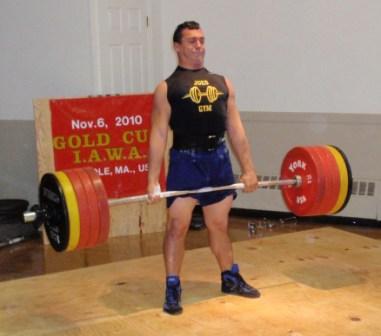
Joe Ciavattone Jr., at 17 years of age, deadlifting 227.5 kilograms for a World IAWA Record.

What all can I say about the efforts of Frank Ciavattone for organizing this great event???  Frank has been a National and World Meet promoter for many years, and his experience of putting on a TOP QUALITY EVENT was evident.  Frank had an excellent venue for us to compete in.  It was held at the Italian American Club in Walpole (which is just outside of Boston).   Lots of room for lifting and viewing, a great platform to lift on, and plenty of weights.  Our IAWA President Steve Gardner handled the scoretable and announcing and kept things flowing very well. Judy Habecker assisted with the scoring and does more “behind the scenes” than anyone else in the USAWA.  Thank you Judy from all of us!!!  Eighteen lifters competed and set many new IAWA World Records.  I really enjoyed seeing the variety in lifts performed – from deadlifts to presses, to unique lifts like the Clean and Press on Knees.  Some of the lifters were “seasoned” competitors like Art Montini and Denny Habecker, while others were still teenagers, like Joe Ciavattone Jr, Jonathon Ciavattone,  Frankie Ciavattone, and Kohl Hess.  The age of the lifters varied between 16 and 83 years of age.
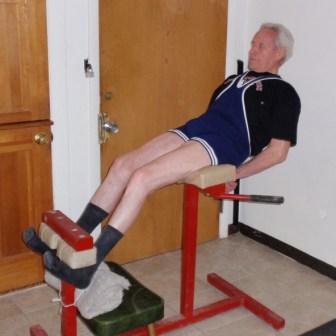
Dennis Mitchell, at age 78, performed 600 repetitions on the Roman Chair Situp!!

What were the highlights of the meet?  That is a hard question to answer because it seemed every Gold Cup Record was a highlight.   Things that really impressed me where:  seeing Frank do 160 kg in his signature lift – the one armed deadlift, watching the wily Dennis Mitchell performing 600 reps in the Roman Chair Situp at the age of 78, and seeing Art perform a stiff-legged deadlift of 100 kg with ease. Most guys his age couldn’t bend over to pick up 50 pounds and he does over 200 pounds with straight legs!!  Of course, I really enjoyed watching Joe Ciavattone Jr. deadlifting over 500 pounds for the first time!  I very clearly remember when I did that for the first time as a teenager.  That had to be one of the best lifts of the day.  My father LaVerne attended the meet with me and I talked him into lifting.  He did a 187# one handed Ciavattone Deadlift.  At the awards banquet when he was presented his trophy he remarked to the group that it was the first trophy he had won in a weightlifting meet!  And speaking of trophies, Frank went way beyond expectations with the trophies he gave out.   He awarded EVERYONE a large Gold Cup in appreciation of their performances.  Just another little thing that SHOWS why the Gold Cup means just a little bit more than another ordinary record day!  Chad and I were the only ones to do a two man lift for IAWA record.  We decided to do a 2-man deadlift, after first wanting to do a 2-man one arm deadlift (but it is not an IAWA lift).  After doing 1000# in the 2-man deadlift, we were allowed to do our 2-man one arm deadlift for exhibition and USAWA Record.  I wanted to do this lift for Frank – and thankfully (because I didn’t want to let Frank down) – we got our 800 pounds.  Another great performance of the day was John McKean’s one arm dumbbell deadlift of 266# (I know his inspiration was that DINO GYM SWEATSHIRT he was wearing!).  This broke a record he set over 10 ago – which shows he is getting better with age.  I really enjoyed getting to FINALLY meet Joe Ciavattone.   We always seem to “just miss” each other by attending different meets, and he is the great lifter and person I expected him to be.  His passion for lifting shows when he is busy coaching his boys.
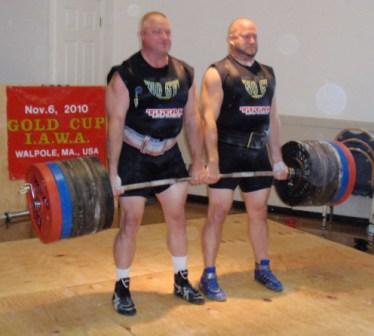
Al Myers and Chad Ullom performed a 2-Man Deadlift of 1000 pounds, and a 2-Man One-Armed Deadlift of 800 pounds.

Afterwards, Frank hosted the banquet at his house.  That is the type of generous person Frank is – opening up his house to his lifting friends.  The food was fabulous!!  Frank’s Mom and his sister Cara prepared an Italian Feast that had everyone “licking their chops”!  I know I ate my share.  After the awards were given out, I conducted the ceremony in which Scott Schmidt was officially inducted into the USAWA Hall of Fame.  Scott gave a very thankful response in appreciation.  I will have more on that in a future USAWA Daily News story. Another special moment for me was when Frank presented me with a special award thanking me for my work and efforts in the USAWA.  It meant more to me than the big Gold Cup I received for lifting.

NOW I know what the IAWA Gold Cup is all about, and it is more than just going to a meet to set a record.  It is about being part of an elite competition promoted by the  International All-Round Weightlifting Association.
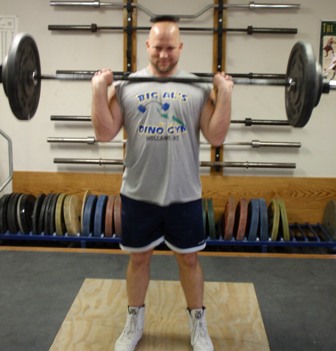
COMING SOON – VIDEOS FROM THE GOLD CUP

The 10 Worst Lifts in the USAWA

by Al Myers

Ok, I’m getting tired of Thom getting all the recognition for his  “human interest” stories involving his weightlifting life experiences, while the deep  thought-provoking technical stories I write (which require actual research)  get ignored (I actually wonder if anyone EVEN read my last one on the fairness of the Lynch Formula).   It’s time I step up my game – and put a little controversy in what I write!!   The truth is that I really don’t like to OFFEND anyone, and thus my avoidance of any story that may seem offensive.  On the other hand, Thom doesn’t care if he gets hate mail!  He even reads it with a smile on his face. That is what makes him a much better columnist than myself – but TIMES ARE A CHANGING and I’m going to try to “stir the pot” a little with this story.  Here it goes – and I hope AT LEAST one person gets offended and makes a derogatory comment about this story on the USAWA Discussion Forum (and that’s NOT counting YOU Thom).

The Ziegler Clean even makes "The Champ" Chad Ullom look like a clown, despite the fact that he has lifted the most weight ever in this lift. But who really cares about that? All you see is that silly little plate balancing on the top of his head.

1.  French Press – Definitely the WORST  lift in our list of lifts.  That is why I’m listing it first.  Whoever wrote the original rule for this lift must have been a cynic.  Why else would the rules of this lift be written in such a way that it is impossible to perform and COMPLETELY different than how it is performed in the gym by EVERYONE else that trains it?  Judging this lift is even worse.  Did the bar touch the neck? Did the elbows drop?  The answers are always NO and YES. I have YET to see this lift performed the way our rules call for it to be done.  Any lift that has rules so subjective  that it would require instant replay in slow motion  to make an official  judgement needs to be RE-WRITTEN.

2. Press – Dumbbell, One Arm – This lift was just in the World Championships and after what I saw there  it now makes my list of Ten Worse.  The IAWA rules require the center of the rod of the dumbbell be no higher than the clavicle.  Obvious the person who decided on this rule knew NOTHING about human anatomy.  Do most lifters know where the clavicle is?  From watching the judging,  it was obvious the judges don’t.  I have a copy of Gray’s Anatomy, I’ll send you a picture. It is MUCH lower than the top of the shoulder. Practically no one  started the dumbbell this low (myself included!). Also, what’s up with all  the side pressing when doing a dumbbell press?  That’s not supposed to be allowed – we got ANOTHER LIFT for that one!  The bottom line – this lift is performed and officiated differently than how the rules are written so SOMETHING should change to “keep it real”!

3.  Deadlift – Stiff-legged – Another impossible lift to judge.   Judging is ALWAYS very subjective and lifters will bend their legs and get the lift passed.  And I can’t figure out WHY sumo deadlifting is allowed in the rules – it seems to defeat the purpose of a stiff legged deadlift.

4.  Ziegler Clean – Come on, this lift is just ridiculous.  Balancing a plate on your head while you do a clean?  When I first heard of this lift I thought the person telling me about it must be joking.  No one would really want to train for THAT!?!  Lifts like this make a mockery of All-Round Weightlifting, and you got to know people probably LAUGH at us when we report on the Zeigler Clean.

5.  Van Dam Lift – This lift got approved for one reason – us “selling out” for publicity that we never got. Did we really think Rob Van Dam and his professional  wrasslin’ buddies were going to start lifting in our All-Round Meets?   We should be ashamed of ourselves for approving this lift.

6.   Inman Mile – Carry 150% of your bodyweight in the form of a bar across your shoulders for 1 mile??  Give me a break – even the person it was named after couldn’t do THAT!!   This is just another “official lift” that makes us look like a goofy weightlifting organization.

7.  Lano Lift – I respect the fact that lifts are named after someone deserving.  I have met Jack, and I wouldn’t be surprised if he proposed this lift as a joke  just to see if the membership was gullible enough to approve it.  How many different movements are in the Lano Lift?    I can’t keep track of them!  Who would REALLY want to do this?  It is the lift with the longest written rule in the USAWA Rulebook.  Even Jack has never  set a record in this lift that carries his name.  That should tell you something.

8.   Phumchaona Lift – Another screwball lift named after a famous USAWA lifter.  This lift requires you to clean and press a pair of dumbbells WHILE doing a Hip Lift!!  Like THAT is going to be better than your max Hip Lift.  If I was going to do this lift, I would use a pair of 1/2 pound dumbbells and after doing my MAX Hip Lift just raise up my arms.  This “official lift” is so stupid NO ONE  has EVER done it.  That’s right – NO ONE!!

9.  Carter Lift – The only thing more ridiculous than clean and pressing a pair of dumbbells while doing a Hip Lift is SQUATTING a bar while Hip Lifting.  But I’ll give John credit – the picture of himself  performing this lift in our Rulebook  does look IMPRESSIVE, and at LEAST he had the courage to perform his lift in public.

10.  Weaver Stick – Absolutely IMPOSSIBLE to judge fairly.  The arm is NEVER straight, and it only takes a tiny little bend to add a few pounds to this lift.  The records in this lift really are meaningless.   Now STRAP your arm to a fixed pole and THEN see what you can do in the Weaver Stick.  That’s the way it should be done.

**** The above controversial comments are mine alone,  and may not reflect the opinions of the USAWA membership.  Please direct your hate mail to me and not to Thom Van Vleck****

Is the Lynch Formula Fair??

by Al Myers

There has been “lots of talk” regarding the Lynch Formula recently.   Most of this centered around the fact that the Lynch Formula has just been expanded to contain factors for lifters that weigh over 138 kilograms.  Now the Lynch Chart goes to 180 kilograms.  The Lynch Formula has been the “adopted formula” of the USAWA and the IAWA since the early 90’s to calculate adjusted points in determining weight lifted to bodyweight comparisons in scoring.  The Lynch Formula creator, Ian Lynch, developed and modified his formula to apply to the lifts done in All-Round Weightlifting.  As far as I know, no other lifting organization uses the Lynch Formula.  So, you could say, that we have a Formula that tailors to our specific lifting sport – All Round Weightlifting!   I have never really heard the reasons how the Lynch Formula was derived.  Most other weightlifting formulas are derived from a data set of numbers, usually records or performances of lifters of different bodyweights.  I know this is how the Sinclair Formula was derived  in Olympic Weightlifting.  It has even been changed and modified over time when it is “re-evaluated” using new data, and new factors are created to maintain the fairest formula possible.  However, this is easier to do when you are analyzing only two lifts (the Snatch and Clean and Jerk) than when you are looking at over 200 lifts, like we have in All-Round Weightlifting. I find it hard to believe that Ian Lynch used any data involving All-Round Lifts when he developed his formula.  Afterall, what data involving All Round Lifting was available 20 years ago?

The big question always arises, is the Lynch Formula fair?  I have several larger lifters in my gym who feel that it isn’t, and that the Lynch Formula favors the lighter lifter.  But then I hear from light lifters who say it favors the heavier lifters.  And when the fact is pointed out that the  past several years  the Overall Best Lifter at the IAWA World Championships has weighed over 105 kilograms,  they have a good argument.  I always try to be as open-minded as possible, and I like to have the FACTS before I form a hard opinion on something.  This is why I performed my own self-study on this – to answer that question to myself.   In no way is this information I am presenting you a scientific study that has any statistical significance.  I am making that disclaimer LOUDLY, so my statistics friends like Tom Ryan (who is way smarter than me in matters like this)  won’t point out my deficiencies in the methods of my study.  This study is entirely just a compilation of data that must be taken on surface value.  But it is still VERY INTERESTING and should provide the best factual support  regarding the fairness of the Lynch Formula that has ever been available.

Study – Determining the Fairness of the Lynch Formula

Objective: The objective of this study is to evaluate the fairness of the Lynch Formula in regards to correction factors for bodyweight adjustments.

Design: The USAWA Record List will be used as the data source of information that will be evaluated.  The USAWA record list has accumulated information on records in various lifts for over 20 years.  Twenty lifts will be selected (the Heavy Lifts will be left out).  The lifts selected will be the ones that have the most records established in them through all weight and age classes. Three weight divisions will be arbitrary selected – lightweight lifters (80 kilogram class and below), middleweight lifters  (85-100 kilogram classes), and heavyweight lifters  (105 kilogram class and above).  The best record according to Lynch Formula will be selected from each weight division.  These three divisions will then be ranked according to the best lifts according to the Lynch Points, and all points will be added up to determine which weight division has the best ranking, and thus assumed to receive the biggest advantage from the Lynch Formula.

Assumptions: Since individual bodyweights are not known from the USAWA Record List, the weight of the weight class will be used in calculating Lynch Points.  Lifters in the 125 kg plus class will be assigned the Lynch Correction for 130 kilograms bodyweight. This may be an underestimate of the actual bodyweights of superheavyweight lifters, and if so, would provide numbers that would artificially elevate the lifts of SHW  lifters in regards to Lynch Points (NOT an advantage for heavy lifters).   Also, the assumption is made that the record lifts are representative of the average lifting ability of all lifters in these bodyweight classes. By picking the 20 lifts with the most records, it is assumed that these are the 20 all-round lifts that are performed the most, thus providing the best data base of numbers available from the Record List for evaluation.

Results:

Lift Lightweight

(80 K class and below)

Middleweight

(85 K to 100 kg class)

Heavyweight

(105 K class and above)

Bench Press

Feet in Air

320# – Smith

(70K)

LP – 320.0 points

480# –  Succarote

(100K)

LP – 406.6 points

441# – Meek

(125+K)

LP – 327.2 points

Clean&Jerk

Right Arm

132# – Zaremba

(75K)

LP – 132.0 points

160# – Bryan

(85K)

LP – 148.4 points

175# – Burtzloff

(125+K)

129.8 points

Clean&Press

Heels together

226# – Hirsh

(80K)

LP – 217.2 points

248# – Bryan

(85K)

LP – 230.0 points

300# – Meek

(125+K)

LP – 222.6 points

Cont Snatch 220# – Waterman

(70K)

LP – 229.9 points

248# – Bryan

(85K)

LP – 230.0 points

265# – Ciavattone

(125+K)

LP – 196.6 points

Continental

to Chest

325#- Waterman

(70K)

LP – 339.7 points

380# – Anderson

(90K)

LP – 431.1 points

385# – Conners

(125+K)

LP – 285.6 points

Continental

Clean&Jerk

287# – Waterman

(70K)

LP – 299.9 points

320# – Bryan

(85K)

LP – 296.8 points

369# – Anderson

(105K)

LP – 304.6 points

Cheat Curl 190# – Gazda

(60K)

LP – 220.8 points

235# – Anderson

(90K)

LP – 210.9 points

260# – DelSignore

(105K)

LP – 214.7 points

Deadlift

2 bars

463# – McKean

(80K)

LP – 445.0 points

610#- Schrock

(100K)

LP – 516.7 points

600# – Myers

(115K)

LP – 473.3 points

Deadlift

Heels together

560# – Hirsh

(75K)

LP – 560.0 points

605# – Schrock

(100K)

LP – 512.5 points

650# – Myers

(125K)

LP – 491.5 points

Deadlift

Rt Arm

369# – McKean

(70K)

LP – 385.6 points

402# – Ullom

(100K)

LP – 340.5 points

562# – Ciavattone

(125+K)

LP – 416.9 points

Deadlift

TrapBar

600# – Hirsh

(80K)

LP – 576.7 points

635# – Schrock

(100K)

LP – 537.9 points

661# – Myers

(115K)

LP – 520.9 points

Hack Lift 670# – Hirsh

(80K)

LP – 644.0 points

605#- Anderson

(90K)

LP – 543.0 points

620# – Schrock

(105K)

LP – 511.9 points

Jefferson

Lift

702# – Hirsh

(80K)

LP – 674.8 points

601# – Schrock

(95K)

LP – 523.5 points

601# – Spayd

(105K)

LP – 496.2 points

Pullover

& Press

287# – Hirsh

(80K)

LP – 275.9 points

275# – English

(90K)

LP – 246.8 points

352# – Myers

(115K)

LP – 277.4 points

Pullover

& Push

331# – Crowe

(80K)

LP – 318.2 points

446# – Anderson

(90K)

LP – 400.3 points

474# – Burtzloff

(110K)

LP – 382.0 points

Snatch

Rt Arm

127# – Waterman

(70K)

LP – 132.7 points

160# – Bryan

(85K)

LP – 148.4 points

171# – Burtzloff

(110K)

LP – 137.8 points

Front

Squat

355# – Fleischer

(80K)

LP – 341.2 points

441# – Bruner

(95K)

LP – 384.1 points

495# – Meek

(110K)

LP – 398.9 points

Steinborn 325# – Monk

(70K)

LP – 339.7 points

375# – Schmidt

(100K)

LP – 317.7 points

441# – Ullom

(110K)

LP – 354.6 points

Swing DB

Rt Arm

120# – Smith

(75K)

LP – 120.0 points

120# – Schrock

(100K)

LP – 101.7 points

150# – Ullom

(110K)

LP – 120.9 points

Zercher 504# – Hirsh

(80K)

LP – 484.4 points

500# – Anderson

(90K)

LP – 448.8 points

529# – Moore

(120K)

LP – 408.1 points

NOTES:  LP stands for Lynch Points.

Summary: Overall points were scored on placings with 1 point given for first, 2 points for second, and 3 points for third.  These points were then “added up” to give total points for the 20 selected lifts, which would give the low overall score  as being  the best.  The lightweight division had 40 points, the middleweight division had 38 points, and the heavyweight division had 42 points.  The lightweight division had 6 “firsts”, the middleweight division had 8 “firsts”, and the heavyweight division had 6 “firsts”.  Also, the Lynch Points were added for each division to give another comparison.  The lightweight division had 7057.7 points, the middleweight division had 6885.7 points, and the heavyweight division had 6671.5 points.

What can be interpreted from all this??

The “total points” are really not that much different.  A couple of points either way could easily be said to be an “acceptable tolerance”.  All it would take is one of those records broken and it could “sway” back slightly the other way. The differences between the divisions (in regards to points)  are not enough that anyone could make an argument one way or the other.

My opinion is that Ian Lynch was pretty much “right on” in regards to fairness to all bodyweights using his formula.  Whether he did this using  scientific calculations, or merely having “luck” in picking the right correction factors doesn’t really matter.  The evidence of comparing the Lynch Formula to over 20 years of collected data in the form of USAWA records prove to me that his formula is very fair and one we should remain using.   Of course, it is easy to pick out certain lifters that obscure the data due to their very exceptional lifting within their class.  Bob Hirsh is a prime example as he greatly distanced himself from the others in the Hack Lift and Jefferson Lift.  His Jefferson Lift record outscored the next lifter by over 150 Lynch Points, the biggest variation of all the lifts recorded in this data set.  But there are other lifters in the middleweight and heavyweight classes who are  “in a class of their own” also.  Everything averages out.  I was also concerned that the weight classes on the fringe of the lightweight and heavyweight classes (the 80 K and the 105K) would be overly represented, and thus tend to discredit the ranges I picked for this study.  However, this was not the case as you can see from the results  that the lighter lifters (70K and 75K), as well as the heaviest lifters (the 125+ lifters) were often represented as having the BEST lifts within their division. Only one 60K lifter made the list (this is not a largely represented class at meets), and he ended up having the BEST Lynch corrected Cheat Curl.  Geoff Gazda’s 190# Cheat Curl in the 60K class outscored Antonio DelSignore’s 260# Cheat Curl in the 105 K Class, 220.8 points to 214.7 points.  One 125+ K class lifter had the TOP Lynch Score among all divisions.  Frank Ciavattone and his 562# One Arm Deadlift ranks above all the others.

I welcome any comments regarding this study of mine.  You can either address them on the USAWA Discussion Forum or you can email me directly.

2012 IAWA Worlds to be held in Kansas City

by Al Myers

Chad Ullom and Al Myers will be the Meet Promoters for the 2012 IAWA All-Round Weightlifting World Championships.

Another thing that arose from the 2010 IAWA World Council Meeting was that Chad Ullom and myself submitted a bid to host the 2012 IAWA World Championships – and it was ACCEPTED!!   Chad and I will be co-promoters (meaning that we will SHARE in the expenses!).  We plan to have the Championships the first weekend of October,  which is the traditional date for it.  It will be held in Kansas City, which has a major airport to allow for lifters to fly into the meet without much additional travel.   We have not selected a venue yet.  We are excited about this opportunity and plan to host it in a “FIRST RATE STYLE”.   This location (Kansas City)  is the “center point” of All-Round weightlifting in the United States, and hopefully, will stimulate a big interest in attendance. This is the first time the IAWA World Championships will be held in Kansas.   The entry forms will not be available until after next year’s Championships, but I wanted to announce the date now so everyone will have plenty of time to get this date on their schedule.

USAWA in Print: Book Review

by Thom Van Vleck

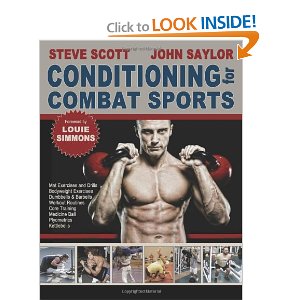
Steve Scott and John Saylor's latest book promotes USAWA members and USAWA lifts.

I recently got an issue of Steve Scott’s latest book.  He wrote it with John Saylor, a well respected martial arts instructor and Champion.  Steve sent me an autographed copy because of what was inside.  I’ll get to that in a moment.  First, let me tell you about Steve.

Steve is one of my best friends and someone I admire greatly.  When I first met Steve he was a top master’s thrower in Scottish Highland Games and was running Highland Games in KC.  Because of Steve, I became friends with Al Myers and Chad Ullom and was introduced to the sport that I’ve enjoyed my greatest athletic success.  For that, I’m very grateful.  Steve’s wife, Becky, also was a top thrower and always at his side in any project he took on.  I then found out that Highland Games were just the tip of the iceberg as far as Steve & Becky were concerned.

Steve was, and still is, a top Judo coach.  He has a widely respected club in Kansas City called the Welcome Mat that has been in operation since 1969.  It has produced National, Pan American,  and World Champs as well as some of the elite men and women in our fighting forces and a Secret Service Agent that was on George W. Bush’s personal detail.  Becky was a National, Pan Am, and World Champ and Steve once told me that Becky could have been an Olympic Champion but back then women did not compete in Judo in the Olympics!

Over the years, Steve has written over a dozen books on martial arts, training, coaching and this one is his best to date in my opinion.  It has a very broad appeal.  My Uncle, Phil Jackson, who is, in my opinion, the most knowledgeable person I ever met in regards to weight training, once told me that the hardest sport all the way around was boxing.  It was mentally, physically, and emotionally draining.  I would say the same applies to all combat sports.  You have to be tough and that comes from how you train.  Steve, with John Saylor, has (in my opinion) created the ultimate resource on Combat training.

This book is HUGE and full of all types of training.   There are over 300 pages of illustrated exercises.  There are detailed explanations of not only how to do the lift, but how to properly train and utilized the lift to fix a weakness. There are workout routines and tons of advice.   I would say that if you wanted to do some off season conditioning for USAWA lifting or Highland Games, this book would be a valuable resource.

Now, I’ll tell you why mine was autographed.  Inside were pictures of me, Al Myers, and Chad Ullom demonstrating some lifts.  Appropriately, it was in the “OLD SCHOOL” training section.  Steve  talks about training wisdom that came from Bill Clark,  and his book even contains an exercise that is a variation of the “Inman Mile”!  I knew Steve had requested the photos, but I had no idea what a first class product he was producing.

1 21 22 23 24 25 33