Tag Archives: Al Myers

Dumbbell Snatch

by Thom Van Vleck
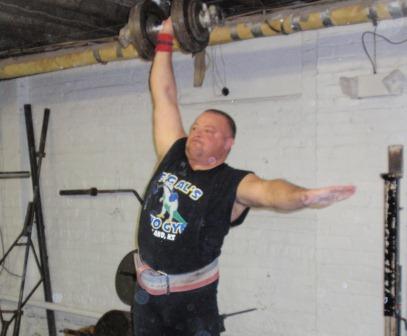
USAWA Secretary Al Myers has the top Dumbbell Snatch in the Record List with this 146# lift at the 2010 Club Challenge.

Let’s take a look at the Dumbbell Snatch which is one of the lifts contested at the 2011 USAWA Nationals being held by the Jackson Weightilifting Club in Kirksville, Missouri on June 25th.  I have listed three rules because one references the other.  If you want the “quick” version, scroll down!

E18.  Snatch – Dumbbell, One Arm
The rules of the Bar Snatch – One Arm apply except one evenly loaded dumbbell is used. The dumbbell may start at any position on the platform. The dumbbell is allowed to rotate during the lift and may finish in any degree of rotation.

A45. Snatch – One Arm

The rules of the Snatch apply with these exceptions. Only one arm is used to perform the lift. The bar is gripped in the center with one hand using any grip, but the palm of the hand must be facing the lifter at the beginning of the lift. The non-lifting hand may be braced or supported on the thigh or knee of either leg but must not contact the bar, platform, or lifting arm during the lift or it will be a disqualification. The non-lifting hand must be clear of the body upon completion of the lift. The bar may be in any degree of rotation during the lift and upon the finish of the lift.  Once the bar is overhead motionless, the lifter’s body in an upright position, the lifting arm straight with a locked elbow, the feet parallel and in line with the torso, an official will give a command to lower the bar. The lift ends when the bar is returned to the platform under control. It is acceptable to use two hands in lowering the bar.

D.  Snatch

The bar will be placed on the platform, in front of the lifter’s feet.  The lifter will grip the bar with the palms of the hands facing the lifter, and then in one single and continuous movement lift the bar overhead to arm’s length. The lifter may choose any width of hand spacing.   The lift begins at the lifter’s discretion. The lifter may drop under the bar as it goes overhead, using a squat-style catch in which the legs are bent, or a split-style catch in which the legs are split. The lifter may also choose to drop only slightly, using a power-style catch. The bar may touch the lifter’s thighs and body during the lift. The feet may move during the lift.  No other part of the body other than the feet may touch the platform during the lift.  The turning over of the wrists must not take place until the bar has passed the top of the lifter’s head.  The bar must not touch the head, stop, or be pressed as it goes to an overhead position. The lifter will recover and stand when ready, from the squat or split position, to an upright standing position.  The bar must be maintained in a final motionless position overhead, with arms and legs fully extended, and the feet parallel and in line with the torso.  At this time, a command from an official is given to return the bar to the platform. The lift ends when the bar is brought back to the platform under control by the lifter.

WOW!  Did you get all that!  Here’s the short version:

Grip the dumbbell and take it overhead in one movement and catch it at arms length with the elbow locked, no press out.  You can drop under it anyway you want as long as nothing touches the floor but your feet.  The free hand may brace against the thigh or torso but may not touch the other hand and once you recover, this is important, the free hand must be away from the body.  Finally, you can go left or right handed, your choice at Nationals!
Ravenswood Formula

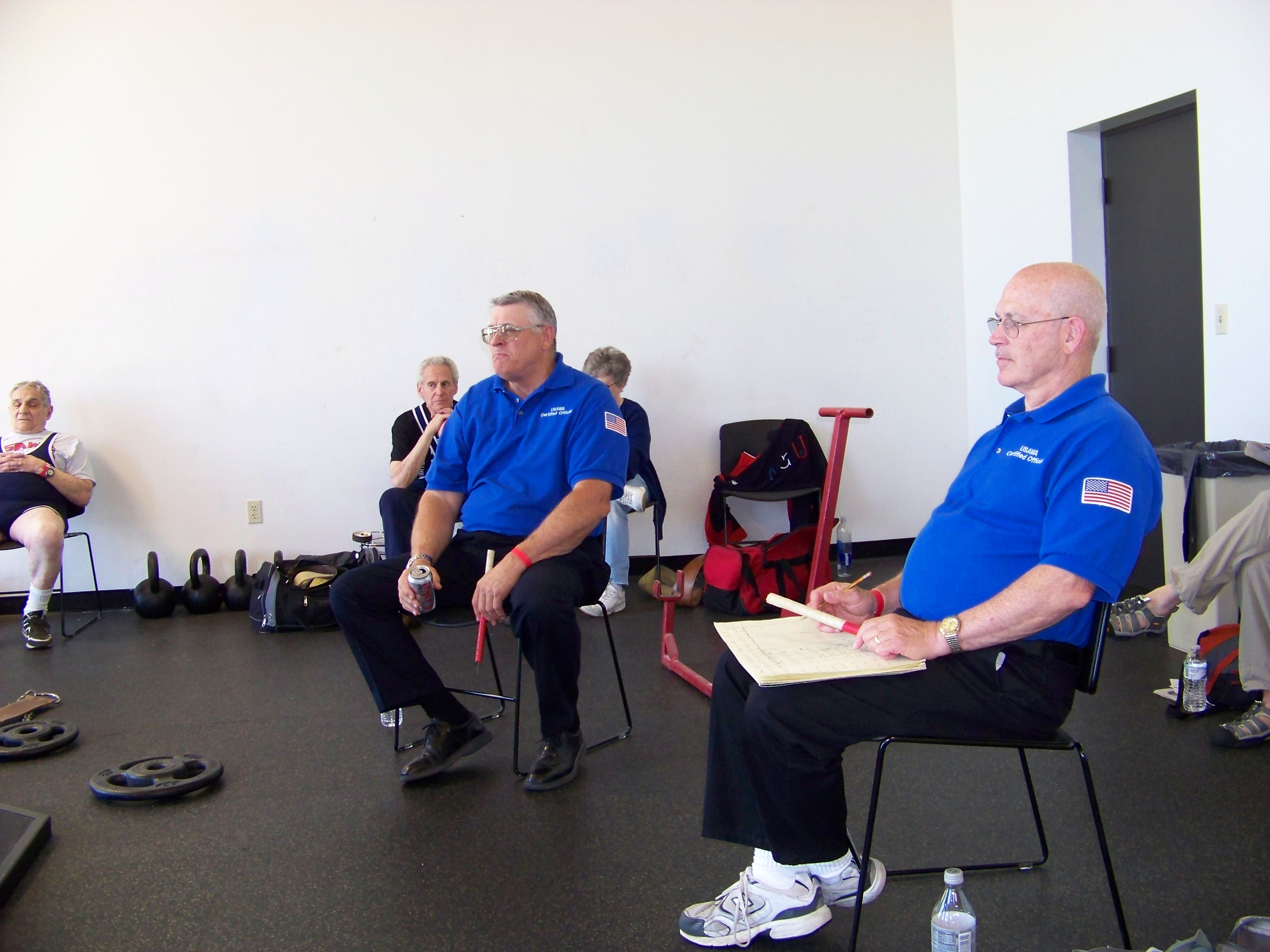
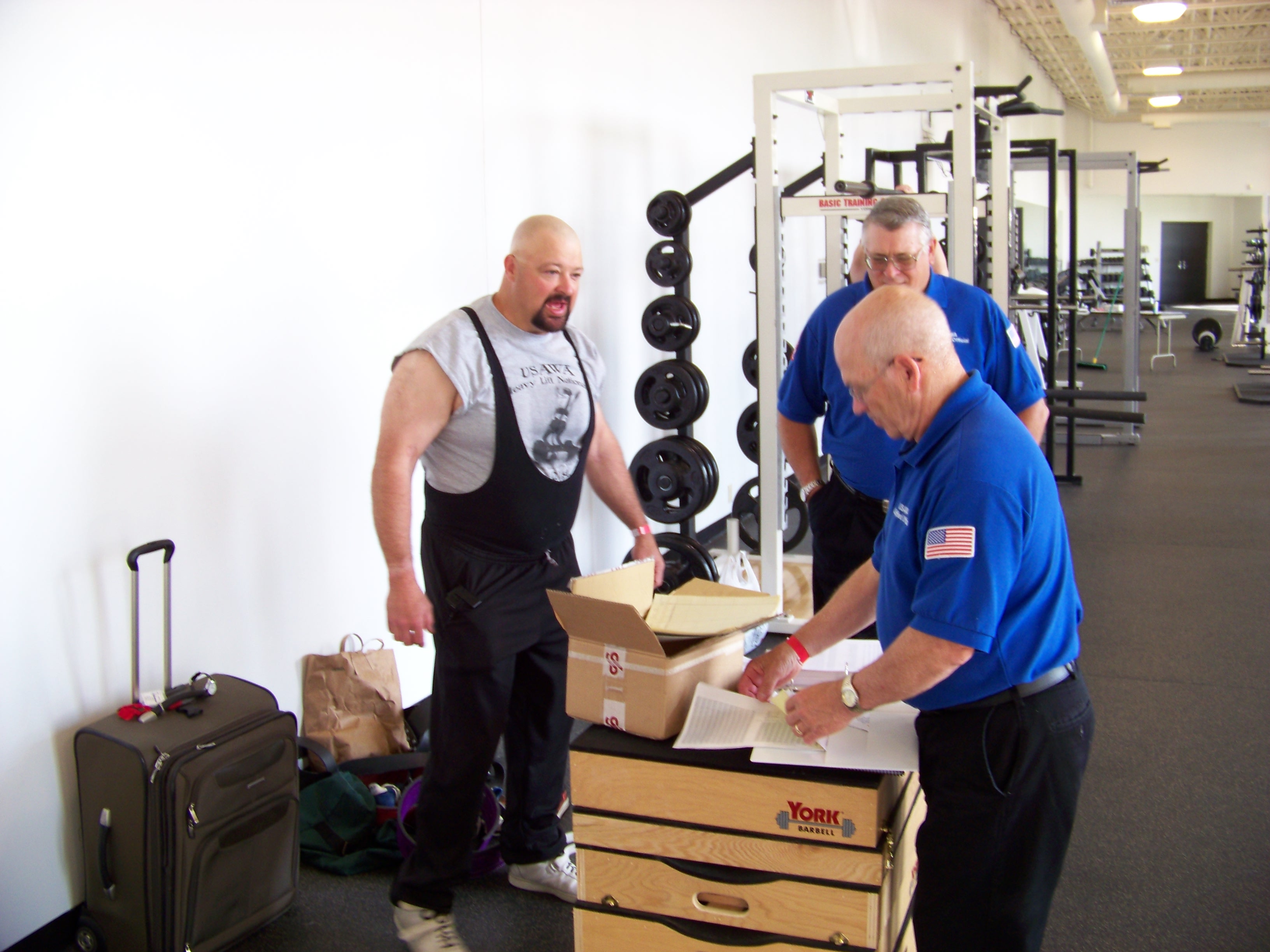
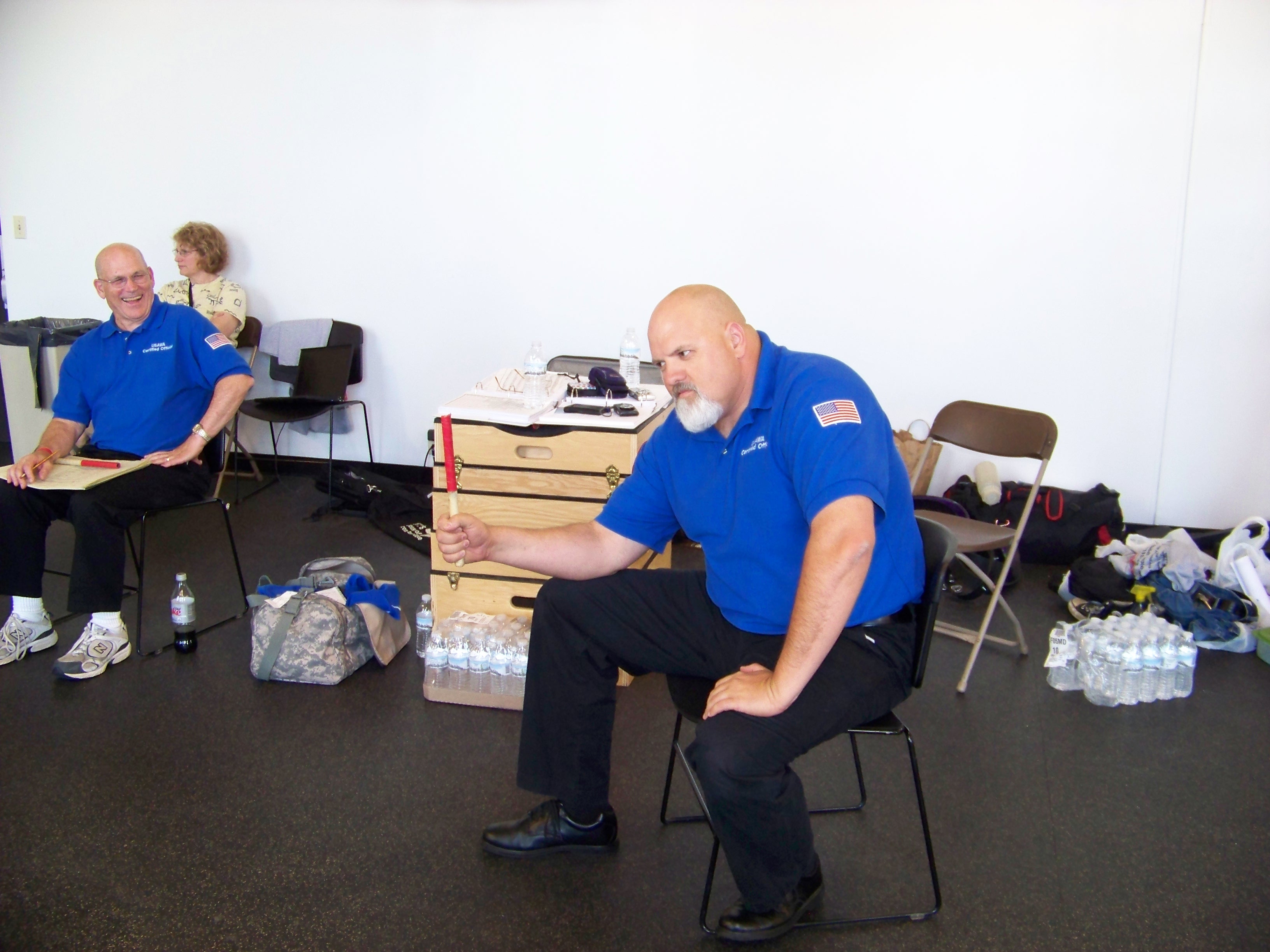
Thom Van Vleck flashes the "Red Light" at USAWA Heavy Lift Nationals as Head Judge Denny Habecker looks for the call. USAWA officials have a lot more to do than judging the lifts. There's a lot of math involved as well!

by Thom Van Vleck

I know we’ve probably overdone the talk on formulas to rate lifting performances, but here’s one more.  I got a copy of Peary Radar’s Lifting News (Sept. 1965) and notice a story on page 20 titled “A New Simplified Formula for Accurate Rating of Lifting Performances”.  This formula was being touted as an easy way to determine the best lifter.  Evidently, before calculators, the “long hand”  or “slide rule” multiplication using the “Hoffman Formula” often resulted on errors and hard feelings when the errors were revealed later.  As a result, the Ravenswood Formula was developed.

I’ll stop right here and say I’m not pushing this to be used by the USAWA nor do I know if it favors heavier lifters (which I’m not sure why anyone would think I would want that….well…maybe I would “like” that). This is just an interesting piece of lifting history from a time when formulas in lifting seemed to be quite the hot topic.

Laverne Myers and Denny Habecker have passed stringent testing to become USAWA officials

The Ravenswood Formula sought to remove the error prone difficulty of multiplication and replace it with the simplicity of adding two numbers together.  You were give two tables which are quite lengthy.  Table “A” had a bodyweight coefficient which went from 110lbs to 370lbs and Table “B” had a “Total” or lift poundage coefficient which went from 105lbs to 2550lbs.  You simply took the lifters weight and found the corresponding coefficient in Table A (a 4 digit number) and added it to the corresponding weight lifted/coefficient in table B (again, a 4 digit number).  The theory being that this formula was much more simple and less prone to a mathematical error.  You have to take the developer’s word that it’s “fair” or should I say “Accurate” as he does in the title.  The developer was Stanley Gorajczyk.  Not sure where “Ravenswood” came from….maybe easier to pronounce that “Gorajczyk”!   Stanley was an Olympic lifter who got 5th in the 1967 Senior Nationals, so he was a pretty decent lifter as well.

Al Myers looks like he's trying to talk Head Judge Denny Habecker into a good call, but really Denny is busy "doing the math" and calculating the winner using the formula!

I just found it another interesting part of lifting history and went with earlier articles on this website that discussed weightlifting formulas.   If you are interested in the tables let me know.  It might be interesting to compare the outcomes of this formula to others!

Gone Fishin’

by Thom Van Vleck

Our USAWA Secretary Al Myers knows how to relax from the stresses of work and weightlifting. He goes fishing! But by looking at the size of these two big paddlefish he caught this week, it looks like he had to put his training to good use!

I sent Al Myers a message the other day and he said he was on a fishin’ trip.  I said, “AGAIN!”   I often will call Al, and he’ll return my call and say, “Sorry, I was taking my nap”.  I like Al, he’s a good guy.  But he’s also a pretty smart guy.  Al works hard and when it’s time to rest, he rests hard.

Weightlifters are a special breed.  Some might say we were so special we are mentally ill!  We do tend to be pretty obsessive and often that’s a good thing.  But just as often, we don’t know when to back off (I can’t say “quit”….because we don’t like that word!).

Recuperation is more than sleep, it’s rest, it’s feeling rested and ready.  It’s often the lost ingredient in an effective training program.  I work at a medical school and the constantly tell the students…”GET MORE SLEEP”.  Because more sleep, more rest means less mistakes.  A doctor makes a mistake, and people can die.  A weightlifter makes a mistake and an injury can result that, at best, will set us back a few days, at worst, end a career!

But it’s more than just your body that needs sleep.  Sleep is probably most important for you brain.  I would argue that you brain needs sleep more than any other part of your body.  Why?  Well, science hasn’t quite figured that out yet.  But the fact is that the brain does some pretty important things ONLY when it’s asleep.  And your most important training tool is you brain.  If your brain is not fresh and focused, your body won’t be.

I think that every lifting program should also include how you are going to rest and how long.  It should also include the occasional break from lifting altogether.  So, every once in awhile you have to remind yourself to back off a little.  So, get more sleep.  Take a nap.  And go Fishin’.

Why the Deadlift is the BEST LIFT

by Al Myers

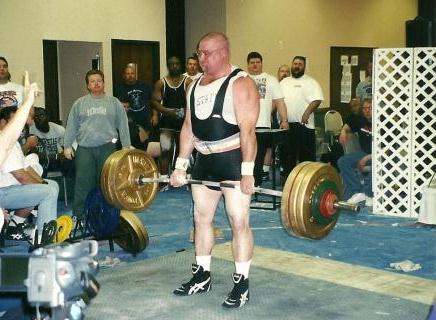
This is one of several 700 pound plus deadlifts that I did in powerlifting competitions through the years. This picture is from the 2002 NASA Natural Nationals Powerlifting Championships.

I know – this is a bold statement I just made.  But after years of training experience, I truly believe that the deadlift is the best exercise for building overall body strength and power.   I know there are people who would disagree with me on this  statement, and I’m sure they have their reasons, but let me explain my feelings behind this and then you can give your arguments! 

1.  Argument 1 – The Squat is the KING of LIFTS

Early on I thought the Squat was the KING of LIFTS (and I’m sure others think this as well), and the squat is  by far the best lower body exercise, but other than that the deadlift RULES.  Very little upper body muscles come into play while squatting compared to a deadlift.  The deadlift works EVERY MUSCLE – lower and upper.  A deadlift hits the thighs, hamstrings, lower back, upper back, and even the chest muscles.  Plus it works the forearm and hand muscles.  A squat doesn’t do that!  Just name a lift that works all the muscles like a deadlift does – I bet you can’t name one!

2.  Argument 2 – The Deadlift will make you slow

I know the “deadlift critics” will say that the deadlift will make you slow.  I just don’t believe that.  The “critics” are usually ex-Olympic lifters who favor the Clean & Jerk and Snatch and are poor deadlifters (mainly because they don’t like it and don’t train it).  Now – I’m not saying these two Olympic  lifts are not great lifts (they both make my top five), but for building overall body strength they pale in comparison to the deadlift.  The Olympic lifts are highly technical and unless you are training them exclusively you have a hard time maintaining the proper techique and ability in them.  Add in a little age and decreased flexibility, and both of these lifts are limited by your technique and not by your strength.  And by the way, I have seen several Clean and Jerks that were PAINFULLY SLOW – so don’t use the “explosive” argument with me.  Any exercise can be done in an “explosive manner”.  Just use less weight and increase your speed of execution! 

3.  Argument 3 – I don’t want to hurt my back

The argument of not wanting to hurt your back by AVOIDING the best back exercise known to man does not even make sense to me!  Exercise strengthens the muscles and prevents injury (of course you have to be training correctly, but that’s another issue).   Name one exercise that strengthens the back better than the deadlift??  Lots of money has been invested in machines that make this promise – but where are they now?  They come and go with different manufacturers but the deadlift remains.  That ought to tell you something.

3.  Argument 4 – I’m an athlete and not a powerlifter

I hear this all the time.  Just because the deadlift is one of the competitive powerlifts does not make it a BAD EXERCISE.  Several of  my Highland Game friends seem to think the deadlift is an evil lift and has no benefit to a competitive Highland Athlete.  Instead, they focus on dangerous  lifts like jump squats and lifts on BOSU Balls.  But I will tell you – STRONG IS STRONG, and if you want to be strong, you have to train to be strong.  And NOTHING makes you strong like the deadlift!  This translates to increased ability in ANY strength related sport.  I always loved the Caber Toss in the Highland Games the most, mainly because it directly reflected on who the strongest throwers were.  I always threw in the more advanced classes and at that level everyone was experienced, and everyone knew how to toss the caber.  It was always very apparent who the strongest throwers  were when it got to big cabers, because only the strongest guys turned them. Sure the weaker-strength caber tossers looked “picture perfect” with light sticks, but when things “turned ugly” with the big sticks all the weak throwers could do was make their pfiffers look pretty. Great caber tossers like Mike Smith, Jim “the Big Chief” McGoldrick, Ryan Vierra, and  Harry McDonald were BULL STRONG.  If the deadlift was contested instead of  the caber these same guys would have still been on top.

By now you can tell that I am a little partial to the deadlift!  But my feeling is that if I was given the choice to train only ONE LIFT – it would be the deadlift.   There is just not any other lifting motion as pure as deadlifting.  Men have been picking up things off the ground for years and the deadlift strengthens this basic physical function better than any other lift.  Of course, these are all just my opinions and I welcome anyone to debate these points on the USAWA Discussion Forum.

My Extreme Wrist Roller

by Al Myers

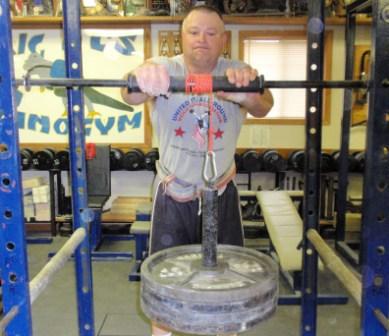
Al Myers finishing a set with 200 pounds on his Extreme Wrist Roller.

I am going to start off this week of stories on grip training by describing one of MY favorite grip exercises!   Don’t worry – I am NOT one of the winning stories as technically I’m not eligible since I’m the one running the contest!  I just want to share an exercise that is the backbone of my grip training.

The Wrist Roller has been around for years.  Everyone has one and everyone has done this exercise at some point in their training history.  Fifty years ago wrist rollers were practically the only grip exercise trained, and where included as part of “packages” in weightlifting equipment sales.  York Barbell would sell equipment packages (back in the 50’s) like this – a 220# set of weights with a bar, a neck harness, a pair of Iron Boots, and a WRIST ROLLER.  It was an important training implement back then, and still is – it’s just most lifters have forgot about it.  I have used several wrist rollers through the years – from a rope on a dowel rod to now what I call My Extreme Wrist Roller.   I am not a grip specialist, but I really enjoy the training exercises for grip.  I do a little grip training every week.  I don’t specialize on any specific type of grip strength – I try to do a little of everything.  Some areas of grip strength I’m stronger at than other areas.  I have a good squeeze grip, an average round bar grip, and not the best pinch grip.  It is interesting how different lifters will have different areas of  grip strengths.

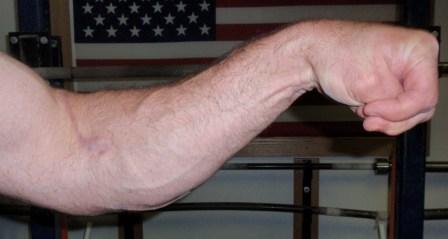
The one thing I really enjoy about the Wrist Roller is that it works not just the grip, but the forearm muscles as well.  Too many grip exercises are, what I call, “hand dependent”.  This means the “lifting capacity” of these grip exercises are more about the size of the hand or the contact area of the fingers.  Bigger hands and longer fingers – more surface adhesion.  Growing bigger hands is not exactly something you can do.  You are pretty much stuck with what you have.  That is why I like forearm training better.  You can ALWAYS increase the size of your forearm muscles or strength of your forearm muscles.  How many “hand dependent” grip exercises do you train that feel easy up to your max, and then you add 5 pounds, and it becomes impossible?  I can think of several – exercises like the Rolling Thunder and any Pinch Grip exercise.   These type of exercises go for me like this – easy, easy, easy, impossible.   And trying a little harder doesn’t help!!  It is still impossible.    The Wrist Roller is not like that.   You can push yourself as hard as you would like.  Sometimes I think I will NEVER get the loaded vertical bar to touch the bottom of the Wrist Roller (which I consider the finish of an attempt), but I keep after it till my forearms are SCREAMING WITH PAIN!  You can accomplish any lift with a Wrist Roller if you want to try hard enough!  That’s my kind of lift.

After a few sets with this Extreme Wrist Roller, your forearm will be PUMPED!

I like to do progressive loads with my Extreme Wrist Roller.  I will usually start with a couple 45’s and then add weight as I add sets.  I try to do 4-5 sets total in about 15 minutes.  As I said, I’m not a grip specialist and usually do my grip training at the end of a regular workout.   I only “train grip” with the time I have left over.   But I’ll tell ya – 15 minutes on my Extreme Wrist Roller and you will know it!  Your forearms will be “blood engorged” and cramping from the exertion.  At times I can hardly close my hands when I’m done.   I made this Extreme Wrist Roller several years ago.  I was getting tired of those silly “rope on a stick” wrist rollers because I felt my shoulders were limiting me in how much I could wrist roll, because of the way you had to hold your arms out in front of you during the exercise.  With my Extreme Wrist Roller, the wrist roller is supported by the cage and it takes all of the shoulders out of it, and places all of the stress of the exercise where you want it – on your forearms.  The roller has a two inch knurled handle.  Your grip will not fail before your forearm muscles give out.   A side benefit is that the knurled handle will shave off all of your hand calluses by the time you are finished.  After you get the VB to the top – the exercise is not over.  You then need to lower it under control.  Sometimes this seems like the hardest part.

Now I hope you won’t forget about wrist roller training.

1 18 19 20 21 22 33