Tag Archives: Al Myers

Team Nationals

by Al Myers

MEET REPORT
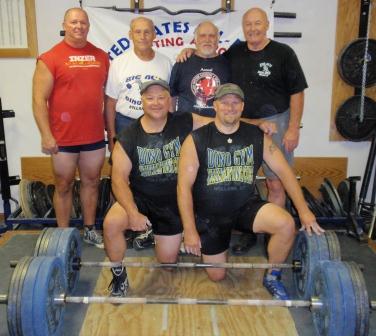
Group picture from the 2011 USAWA Team Nationals. (front row left to right): Al Myers, Chad Ullom (back row left to right): Russ Morton, Rudy Bletscher, Mike Murdock, Dean Ross

The 2011 USAWA Team Nationals was again an outstanding success this year.  It contained a couple of  regular teams (Myers/Ullom & Murdock/Bletscher) and one new team that made their debut (Morton/Ross) in team lifting.  Team lifting is MUCH different than just individual lifting. Teamwork is essential in being successful – things like timing and coordination between partners can either help you or hurt you in a big way.  The teams this year seemed very balanced in regards to the lifters size and height.  
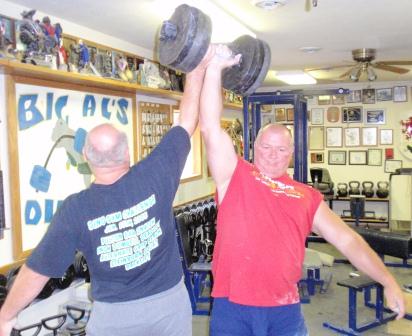
Dean and Russ put up the top Team One Arm Dumbbell Press with a lift of 180 pounds.

The Dino Gym brought another new lifter to the USAWA arena in this meet and he did a phenomenal job considering this was his first exposure to the crazy things we do in the USAWA, and I consider this meet an extreme meet in our yearly meet lineup. This man is Russ Morton. He is a VERY seasoned powerlifter who has MANY powerlifting meets under his belt, and it was obvious he was not intimidated in the least by the lifts that faced him.  He teamed with Dean “the Boss” Ross who in my opinion, has made his presence known in the USAWA this year.  Dean is one of the STRONGEST GUYS his age I have ever met.  He powers through any lift whether it requires technique or not, and through brute determination makes big lifts.  These two guys put up the TOP Team One Arm Dumbbell Press of the meet with a fine lift of 180 pounds. I’m sure you are wondering – how do you do a Team one arm dumbbell press??  At first it sounds next to impossible, but after “scratching our heads” awhile we came up with a way.  First of all, there is barely enough room to get two hands on a 6 inch dumbbell handle so the grip on the dumbbell is not the best.  All of us pressed the dumbbell standing to the side of each other facing opposite directions.  So it can be done.
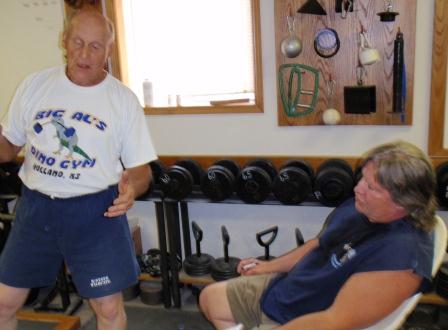
We were entertained during a break in the lifting action when Rudy and Dave sang a harmonized duet.

The second lift was the Team Continental Snatch using the 2″ Fulton Bar.  I was concerned grip might be an issue for the lifters but it wasn’t for anyone.  The difficulty with the lift was the minimal hand spacing on the bar.  You had to use a snatch grip much narrower than the normal snatch width, which made the lift slightly more difficult.  Chad and I had the top lift here with a lift of 320 pounds.  Mike and Rudy made a solid lift of 117 pounds, and Dean and Russ finished with 177 pounds.   Chad and I used a power snatch technique while the other two teams used the hang snatch technique.
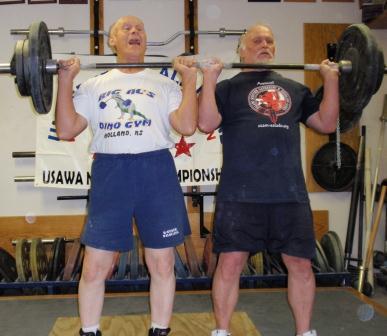
Mike and Rudy teamed up for a 175 pound Team Continental to Chest and Jerk. Not too bad for a couple of lifters over 70 years of age!

The third lift was the Team Continental to Chest and Jerk.  Chad and I had the top lift of 452 pounds, which is now the top lift done in this lift in both the USAWA and IAWA record books.  I was hoping that we could also break the mark from the old Missouri Valley Record List which record is an outstanding lift of 463 pounds set in 1983 by two legendary mid-west lifters, Bob Burtzloff and Kevin Fulton.   We simply ran out of attempts and didn’t start high enough.  Maybe next time!!! 
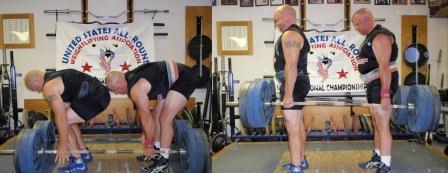
Chad and I had to use some tight teamwork to lift 1000 pounds in the Team 2-bar deadlift.

The last lift done was the Team 2-bar deadlift.  Each lifter gripped each bar just like in the individual 2-bar deadlift.  I actually thought this would be an easy lift for a team to do since the balance issue would be removed that presents when doing this by yourself.  I thought for sure that the lifters could lift more as a team than the sum of their individual lifts.  I was wrong!  This lift turned out to give the lifters the most failed attempts of all the lifts, because if both bars didn’t rise in unison, the weight would “shift” to the lifter on the lower end and force the lifters feet to move.   We tried it all ways – facing away from each other, facing each other, and even standing facing the same direction. I don’t think we ever decided which “lineup” was most favorable.  Mike Murdock took a nasty fall on one attempt after the weight “shifted”.  Luckily, Mike was not hurt (at least he was not bleeding!).   Chad and I had the top lift on this one with a lift of 1000 pounds.  I think we could have done a little more, but at this time we were ready to call it a day and head to town for supper!  Thanks to everyone who showed up to lift, and special thanks goes to Dave Glasgow for serving as the official the entire day.

MEET RESULTS

USAWA Team Nationals
Dino Gym, Abilene, Kansas
August 27th, 2011

Meet Director:  Al Myers

Official (1-official system used): Dave Glasgow

Lifts:   Team Press – Dumbbell, One Arm, Team Continental Snatch – Fulton Bar, Team Continental to Chest and Jerk, Team Deadlift – 2 bars

Lifters:

OPEN AGE GROUP & 115 KG WEIGHT CLASS
Al Myers – 45 years, 253# BWT
Chad Ullom – 39 years,  244# BWT

MASTERS 50-54 AGE GROUP & 125+ KG WEIGHT CLASS
Dean Ross – 68 years, 281# BWT
Russ Morton – 50 years, 275# BWT

MASTERS 70-74 AGE GROUP & 105 KG WEIGHT CLASS
Mike Murdock – 71 years, 231# BWT
Rudy Bletscher – 75 years, 217# BWT

RESULTS

Lifters DB Press Snatch C&J DL Total Points
Myers/Ullom 175-R 320 452 1000 1947 1535.4
Ross/Morton 180-R 177 253 617 1227 1019.9
Murdock/Bletscher 90-R 117 175 440 822 896.7

Notes:  All lifts recorded in pounds.  Total is total pounds lifted.  Points are adjusted points for bodyweight correction and age correction.

EXTRA LIFTS FOR RECORDS:

Murdock/Bletscher: MASTERS 70-74 AGE GROUP & 105 KG WEIGHT CLASS
Team Curl – Reverse Grip: 205#

Ross/Murdock: MASTERS 65-69 AGE GROUP & 125+ KG WEIGHT CLASS
Team Curl – Reverse Grip: 205#

Dean Ross:  MASTERS 65-69 AGE GROUP & 125+ KG WEIGHT CLASS
Swing – Dumbbell, Right Arm: 70#
Swing – Dumbbell, Left Arm: 70#
Swing – 2 Dumbbells: 100#
Accepting the Aging Process

by Thom Van Vleck

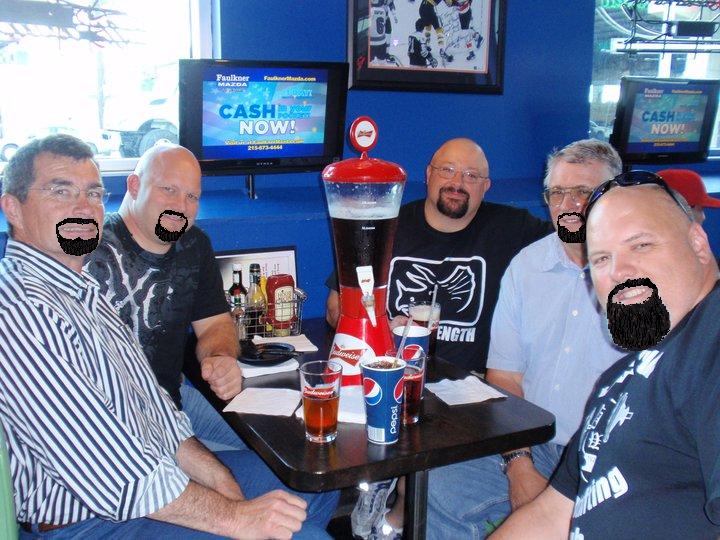
None of these guys are showing any sign of aging any time soon! This "unretouched" photo shows that lifting keeps you youthful! Joe Garcia, Chad Ullom, Al Myers, LaVerne Myers, and Thom Van Vleck getting ready to down Cheese Steak Sandwichs in Philadelphia before the Heavy Event Nationals!

I have said it before, the USAWA sometimes seems like a retirement sport for lifters.   The organization has it’s fair share of older lifters and I think it’s great.  I don’t think it has anything to do with it being an organization for older lifters but everything to do with the wide variety of lifts available to the lifters.  This allows those who have injuries that keep them from Powerlifting, Olympic lifting, or strongman meets to stay active and still make gains.

I have known Joe for at least 25 years, Al and Chad for 17 years, and have really gotten to know LaVerne that last 5 years.  We have all had long lifting careers and our fair share of injuries.  And yet, in the photo above we don’t seem to have a SINGLE grey hair…at least in our beards….that PROVES lifting keeps you young!

In particular, I have known Al through having his bicep reattached not once, but TWICE on his right arm a ONCE on his left.  Yet he continues to plug away breaking record after record.  Had he stuck to just powerlifting or just Highland games, that would have been difficult to do.   So that’s a second reason the USAWA is popular among older lifters, they can keep setting records and that keeps them motivated to lift hard.

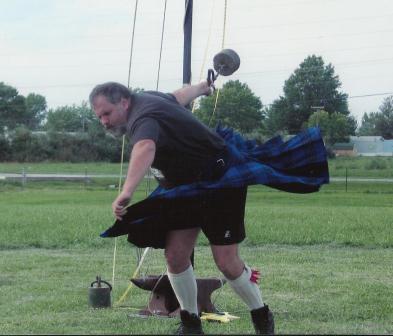
Many of you know, but maybe a few don’t, that Al was a high ranked Professional Highland Games Athlete.  He even held a Pro world record!  That’s no easy feat!  It’s actually how I met him and not through my affiliation with Bill Clark and Bob Burtzloff (Al’s brother in law).  That was just one of those “small world” deals that we found out later.   There was a time when Al “retired” from throwing.  I was personally pretty sad about this because I had enjoyed our many road trips to Highland Games.  Al told me one time it was hard to stay motivated about throwing when he knew he’d peaked in that sport and would likely never be as good a thrower as he was when he was at his prime.  However, in the USAWA he could still find lifts that he could work on and set not only USAWA records in, but personal bests, too.  And that keeps a guy motivated about his training when he feels he can keep setting “personal bests”!

Now, the photo above, to be honest, was “retouched” just a little.  Al recently dyed….errrrr…I mean “highlighted” his beard because when he grew it back after a long absence (Al used to sport a beard for most of the early years I knew him) it had gotten a little grey…..OK, let’s be honest, it was as snow white as Santa’s beard!   So Al “highlighted” it a little and we gave him a hard time about it.  But seriously, Al is an ageless wonder and I have no doubt that someday he will challenge Art Montini, Dennis Habecker, and the other top record holders for most records ever.

USAWA is a sport that keeps you young at heart!

HASA Winter Banquet

by Thom Van Vleck

(Webmasters note:  Every year HASA, Heart of America Scottish Athletes, would host a winter banquet where impromptu competitions and awards are given out to the members.  I always enjoy these banquets, and the camaraderie shared between friends.  The best part of the banquet is the “gag gifts”.  We each take turns making fun of each other.  Sorta like a roast.  Today I’m going to share the report from one of the best banquets HASA ever had,  the 2002 Winter HASA Banquet, which was covered in the Braemar Stone Tablet by Thom Van Vleck)

This year we had the HASA awards banquet at the community center.  Steve and Becky were in charge and everyone was asked to bring a carry in dish.   It was more laid back than in the past and I personally enjoyed it.  People could hang out, do whatever they wanted (which for us included pulling out a caber and trying to throw it in a tree).

We again had the “Stone Cold Heavies” contest with a WOB contest.   I had some mugs made up for awards, everyone that entered could get one.  Eleven gus and two gals entered for fun and bragging rights.  The final winners were as follows:

Men: Al Myers first (14 ft), Chad Ullom and Thom Van Vleck second (tie) (12 ft).
Women:  Lori Myers and Leslie Kress first (tie) (12 ft)

I would like to point out that Kevin McAllister beat out his brother Shawn for 10th place when he touched the bar at 10ft with the handle after both cleared 9ft.  Shawn failed to “touch” the bar and in a little known rule, Kevin declared himself the winner by virtue of “touching” the bar.

We had a little impromptu contest where the guys threw the 28 for height. Pretty fun stuff.

As for the awards winners for the year:

Al Myers: Angus Award (top athlete)
Dave Glasgow: Sportsmanship Award
Mike McGhee:  Most Improved Award (and most injured, too)
Scott Campbell:  Best Newcomer

We then handed out “gag” awards and had a blast.  Some notable awards included Dave Henderson’s propeller driven hammer for Steve Scott, who immediately vowed he would throw it “down hill” to pick up extra distance.  Below is a report on another gag award (luckily, the editor of this newsletter has a tremendous sense of humor and is a wonderful person…..Paybacks, Al, Paybacks….)

From Al Myers:

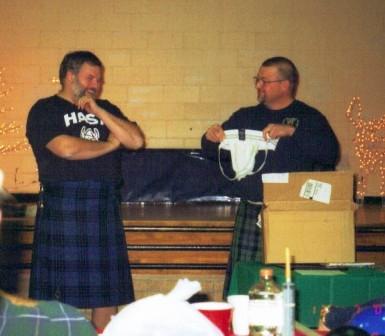
Thom Van Vleck accepting the insulated jockstrap award at the 2002 HASA Banquet, given to him by Al Myers. This gag award was given to Thom because he would always host his fall Highland Games on one of the coldest days of the winter.

I had a great time at the HASA Baquet last weekend.  I finally got my pictures developed and had a good one of Thom accepting his insulated jockstrap award.  I can only guess what he is mumbling to himself as he looks down —

1.  “Hey buddies, we are going to get a warm winter!”
2.  “This jockstrap is furrier than I am!”
3.   “Hey everyone – do you think it could cover this bald spot!”
4.  “I wonder how I am going to get this over my kilt!”
5.  “If I wore this thing backwards, it would be a thong!”

That Al, He’s a funny man…….Paybacks, you hear me Al, Paybacks…..

(Webmasters comment:  So now you know, Thom and my rivalry goes back LOTS of years and he is STILL trying to get the upper hand on me!  Since then I have to add Thom’s comment number 6. )

6.  ” I better wear this when I visit the Dino Gym so I can have some padding for protection for when I run into the Enforcer!”

CREDIT:   The Braemar Stone Tablet, Volume #4, Issue #4

Ban the Spin

by Thom Van Vleck

(Webmaster’s notes:  The following is an editorial written by Thom Van Vleck 10 years ago in the Braemar Stone Tablet regarding his dislike of the spin in the Highland Game height events.  I found this editorial very ironic and humerous on so many levels because since then Thom has totally changed his tune and is now an advocate for the spin.  He has used the spin in the 42# WOB to set a World Record and numerous game records.  But he sure gives a good argument why the spin should be banned!!!!  How does it feel Thom to have to EAT YOUR WORDS??????)

Thom Van Vleck utilizes the spin in the Weight Over Bar to perfection. In 2005, Thom set the All-Time World Record in the 42# WOB with a toss of 20'6". He has won or tied in the WOB at 3 World Championships (2004, 2007, and 2010). (photo credit Kevin Viet)

Recently, there have been some innovations in technique in the highland games.  Namely, the spin on the sheaf and WOB.  I have talked to a great many people about this and want to make their voices heard and to give my own opinion.  You don’t have to like it, or even agree, but I think this is something we need to address before it goes too far. 

A couple of years ago we began to see a few guys spinning on the sheaf.  This year Harrison Bailey (I think) began spinning on the WOB.  This has started to push some records up, and will no doubt continue to do so.  I am opposed to the new techniques on several grounds.

First, they are dangerous. About a hundred years ago a woman was struck and killed in Canada by a wayward hammer.  The man that threw it was so despondent he never competed again.  I know how I would feel if I were responsible for a tragic accident.  I would feel just as responsible as an Athletic Director who allowed unsafe practices to go on.  It was also around that time that there was an innovation in technique.  The athletes began to spin with the hammer.  Yes, much like the Olympic hammer, the athletes would spin and throw the hammer.  However, they quickly realized how dangerous this was and the practice was stopped. I feel that spinning with the sheaf could lead to serious injury as I witnessed Mike Smith flatten a metal chair with a wayward sheaf toss (old style) in McPherson a couple of years ago.  A twenty pound sheaf could seriously hurt an adult and kill a child.  I won’t even go into what a 56 could do raining down from 15 plus feet in the air.

An answer to this would be to create large safe areas, but you push the crowds back when you do that and isolate the athletes even more.  That is a problem within itself.  Many venues I have been to are limited to a confined space and a large field is out of the question.  I want the crowds in as close as they can get, especially the children.  Otherwise, why not go throw in somebody’s back yard?

My second issue with the techniques is they take away the power events.  The Sheaf and the WOB were relatively simple to execute and the strongest guys would usually prevail in these events. There was no hiding your true level of strength.  Making them technical will take away from that aspect.  You also have a great many guys that are strong and love this sport, but have difficulty with the spinning events who will now be left out.  I will admit that I am one of those guys.  The WOB and sheaf, as well as the caber, were my best events.  I do not consider myself athletic, but I have built considerable strength over the years through weightlifting.  By making the event more athletic you will alienate a majority of athletes who are either not as athletic, don’t have the time to work on technique (i.e. have jobs, families), or do this for the love of the sport. YOU TAKE AWAY FROM THE SELF-BUILT ATHLETE WHO MAY NOT BE BLESSED, BUT CAN BUILD ON WHAT HE OR SHE HAS THROUGH WEIGHT TRAINING.

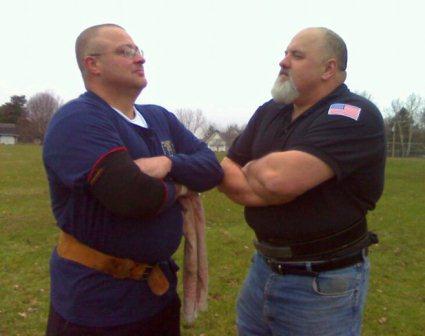
Al Myers (left) and Thom Van Vleck (right) squared off against each other a couple of years ago in a 56# WOB contest, infamously referred to now as the WOB Border War. The rules of the contest required it be a traditional standing toss, in which the spin would not be allowed. I issued this challenge to Thom because I felt he had snubbed the standing toss and everything he once believed in! Chad Ullom served as the official, and due to his incompetence the outcome was questionable as to who had actually won. We each claimed victory, but Chad determined it a tie. (photo credit Chad Ullom)

An answer to this issue would be to only allow the spin in the A class and Pros.  The idea being that once you reach that level you should have worked on the technique enough that you would be safe as well as guys capable and have the time to master the style.  I do not agree with this, but would go along with this solution.

Third, it is hard on equipment.  I have run meets and they are quite expensive.  Al Myers made a good point to me that I feel every athlete should hear. On average at a good meet the AD will spend about $100 per athlete.  The most I have ever paid for entry is $20.  The rest is absorbed through sponsers, gate (which we all know is not great unless you are in a huge games), and straight from the pockets of the AD’s.  Plus sweat and toil equity.  I personally don’t want to have 3 sets of sheaf standards and WOB standards for back ups because the others are getting tore up.  And they will be once everyone starts doing these styles.  You run one meet and you will see how tore up the equipment gets and just how expensive it is to fix it back up.

The simple answer would be to make the athletes more financially responsible.  Higher entry fees or make them agree to pay for repairs to anything damaged by an errant throw.  I don’t want to do this at my meets so I will likely limit the Super A’s to the option of the spins and only if they can demonstrate they have mastered it enough in warm ups they won’t be be a threat to anyone.

While I personally would like to do away with the spinning styles this is not my sport to make demands.  I am not a cry baby and will adapt if that is what I have to do.  I have just heard so many complaints about it I felt I should lead a charge.  If no one follows then I will look foolish (as I have many times before) and walk back and get in line with my fellow athletes to learn the new styles.  If you agree, get on the chat rooms, talk to the AD’s, and organizations (NASGA, RMSA, SAAA, SSAA, etc).  Let’s make the push to make hard decisions on this matter before it goes too far.  Otherwise, it is moving along and until someone get hurt the athletes are going to do whatever it takes to get an edge.

CREDIT:  The Braemar Stone Tablet, Volume #3, Issue #2

How to make your training more productive

by Al Myers

(Webmasters note:  This was a story I wrote for the Braemar Stone Tablet several years ago that applied to Highland Game training, but it contains ideas that can be applied to All-Round Weightlifting as well.  I had actually forgot that I had written this!)

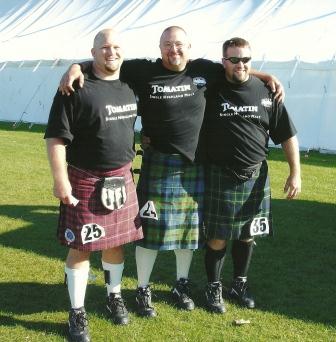
Nothing inspires your training as much as good training partners. I was fortunate to have two of the best training partners around when I was training the Highland Games. This is the three of us when we competed together at the 2005 Inverness Highland Games in Scotland. Pictured left to right: Chad Ullom, Al Myers, and Scott Campbell

The throwing season is upon us again!  Time to dust off those hammer boots and put a new coat of paint on the throwing implements!  It always amazes me how fast the winter goes and all that off-season weight training that you have been doing to make you a better thrower never seems to be enough. It is now time to hit the throwing field and put in time with the throwing weights.  I want to share some of the things I have learned (mostly the hard way!) about how to make your training more productive.  These are the 5 most important things to focus on in making your training better.

1.  Set workout times – This is critical.  It is too easy to procrastinate if you don’t have a scheduled workout time.  Saying too yourself that I’ll workout a couple of days this week after work, if I’m not too tired, if it is not too hot or cold, if nothing good is on TV, won’t do it!  Even if time only permits one workout a week, plan for that day and then no matter what DO IT!!! Remember, the highland games are not a leisure activity!

2.  Keep a training log – How in the world are you going to be able to evaluate different training programs if you don’t have a good record of what you have done?  I know, there days that really suck and you wish not to remember them, but at least put something in a training log!  Maybe you are over-training?  Maybe you have a nagging injury that is keeping that one throw down? These are the things you want to avoid and by looking at what you have done leading up to it, it may be avoided in the future.  This is where a log helps!  I often look back at my log from previous years and evaluate training programs that worked for me and those that don’t .  Remember, it doesn’t really count if you don’t write it down!

3.  Set Goals – I know, everyone knows this.  You always hear guys saying I want to do this and I want to do that.  By next August, I’m going to throw that light hammer 150 feet!! Yeah right!!!  There are goals and then there are dreams!!!  To me, goals are something that you are actually taking steps in working towards, whereas dreams are those thing that you imagine doing while sitting on the couch eating Doritos. Goals need to be specific, and along with them the steps needed to accomplish them.  They need to be realistic, and they need to be short-term.  Long-term goals are okay, but will not give you the focus you need today!  Again, write these goals down, and develop a plan to achieve them.  Remember, real success is achieving what you set out to do!

4.  Get information – To be a better thrower, you need to continually learn.  Never tell yourself that you know it all.  Listen to the experts.  Look at tapes. Read everything you can get on the games.  Get feedback from other athletes.  Spend time watching other throwers and studying them.  Then after you do all of this, forget most of it!! What you ask?  Let me tell you something – there are no magic secrets, just good advice and bad advice.  It is up to YOU to tell the difference!!!  What works for one athlete won’t for another.  You have to find out those things that work for you.  And whatever you do, don’t change your throwing on game day because someone gave you a good tip right before you stepped up to the trig!  Take these “pointers” home and find out in training if they are good or bad.  I know that all throwers mean well and want to help out their fellow comrades, but this trick of giving someone a good “pointer” right before they throw is one of the oldest psych-out tricks in the book!!! Get information and study it at home and try to apply it to your training program.  Remember, it is not illegal to “steal” throwing information! 

5.  Have fun – This can sometimes be overlooked.   It is easy to put so much pressure on yourself that sometimes fun can be lost.  Enjoyment and having fun is one of the reasons that drew you to the games in the first place, but it is easy to drift away from this as you get more dedicated and focused.  I know, it has happened to me in the past.  Sometimes you have to step back, and ask yourself, what do I need to do to enjoy this more?  Maybe you need a different training environment for awhile.  Go to the park until they kick you out.  Maybe try a new training program.  Do a little traveling on the weekends and find other athletes to train with.  Training with other athletes will help with training enthusiasm greatly!!  In the past, I have done a lot of training by myself, and I can tell you, it is a lot more fun to have other athletes that can share in the throwing agony with you!!  Having fun, and enjoying the sport for what it is will go a long way in making those training sessions better.  Remember, you can’t set a personal record in every training session, but you can have fun trying.

I know I didn’t address any specifics, but these general points are the ones to focus on first in making your training more productive.  You may notice that I didn’t mention anything about having good implements.  Good implements are nice to have and may improve your self-esteem, but believe it or not they are not critical in improving as a thrower.  I know a lot of throwers that have homemade weights and made a lot of progress with them.  Don’t use this as an excuse that you don’t have the weights to train with or the weights you have aren’t Dodd weights.  Improvise, get something and start training!  I hope that these ideas will help a little in making your throwing season this year the best ever.  Consider yourself lucky to be involved.

CREDIT:   the Braemar Stone Tablet, Volume #3, Issue #1

1 15 16 17 18 19 33