Barbells Up, Dumbbells Down Part 1 – Dumbbell Training

by John McKean

Paul Anderson, Louis Cyr, Arthur Saxon, Hermann Goerner, Doug Hepburn, and John McKean. The question behind this answer is, “Name five all-time superstars of strength who extensively employed heavy dumbbells in training, and one other guy!” Of course, yours truly is the lowly other guy, but I do enjoy standing on the shoulders of these giants to seek some of the progress they found through brutally-intense dumbbell work.

Unfortunately, most dumbbell work nowadays is relegated to lightweight shaping movements, or, at most, relatively high-rip, non-goal oriented exercise with poundages that are “comfortable”. I don’t even like to recall how many gyms I’ve visited where the heavy half of the dumbbell rack is as dusty and untouched as their bench uprights shiny and worn.

Why is this? Simple – dumbbells hurt. That is, in exactly the opposite manner to how exercise machines ease and rob the work of a similar barbell move, dumbbells call for even more total bodily involvement than a long bar. Where machines isolate, dumbbells, on the other hand, require extreme control, utilization of many stabilizing muscles, coordination between muscle groups, and total concentration. They have a longer range of motion than barbells or machines, and bombard deep-lying muscle fibers from many different angles. Most importantly, with some intense effort, seriously-heavy dumbbells eventually adapt to our own personal groove – we’re forced to learn to control the weighty little beasts, and best compensate for out individual leverages. Eventually, then, we discover (perhaps even subconsciously) our own optimum angles of push or pull, to capitalize on innermost strengths.

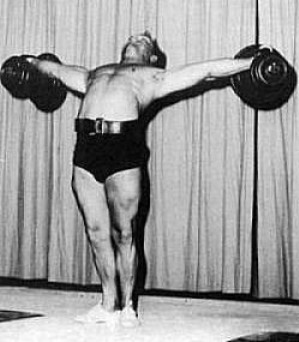
Many of the old-time strongmen never seemed to lack incentive to go to limit poundages on dumbbell lifts. Of course, back then they regularly contested dumbbell clean & jerks, presses, snatches, swings, and the crucifix. A look at U.S. and British record lists printed in magazines from the 1920s and 30s will show a slew of dumbbell marks which were recorded under official conditions. Do we have any such incentive today? You bet! Under the auspices of the IAWA we currently have 27 registered dumbbell lifts to go after. And, brother, if you thought my insistence on training barbell limits in past articles was taxing, I’m really setting you up for a wonderful world of pain this time.

No, you may not be interested in jumping into one of our dumbbell competitions – the British would call these “single arm championships” – but you sure can obtain huge overall strength gains while bringing out previously unnoticed lumps, bumps and strands of muscle. All that’s required is the desire to see just how heavy a single rep you can eventually achieve with one or more dumbbell lifts. Specialize if you care to, or build a total routine on 4-10 dumbbell moves per week.

Art Montini

by John McKean

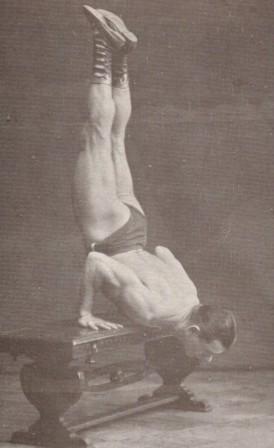
This is Art from his "younger days'. This picture is prominently displayed in the Ambridge VFW Barbell Club.

” I LOVE the aches and pains every morning! They tell me that I didn’t die in my sleep!!” Then, to assert this positive life-force, eighty four year old Art Montini heads to the gym every morning at 5 AM to lift weights. HEAVY ones!

You see, Art Montini of Aliquippa, Pennsylvania is perhaps the premiere Master (over age of 40) weightlifter in the world! He has been a competitor in olympic style weightlifting, powerlifting, and all-round lifting for 64 years and a master lifter for 44 of those years.He currently holds around 250 US national records in All-Round weightlifting for the USAWA which places him as first or second on the list for most records ever ( Art laughs at his good friend and record-numbers competitor, Denny Habecker, the USAWA national president. “He’s just a “kid” of 67!”,crows Montini.).But Art has proven that heavy training, rather than lightweight “over 50” programs is the fountain of youth & vitality.

With no sign of letting up (Art has been known to leave a hospital from minor surgery and typical age related procedures to drive straight to the gym for a workout!),  Montini plans to compete in this year’s All-Round National Championships in Lebanon,PA , set a few more records in the World’s Championships in Glasgow, Scotland, and finish the year by lifting in his own , annual birthday meet in Ambridge,PA.These days in his age group division of 80+ , ole Art doesn’t have a lot of head-on competition, but is quick to reveal his current secret of success -“If at first ya can’t outlift ’em, OUTLIVE ’em!”

My Pullum Patent Bar

by Roger Davis

Pullum Bar - made to exact patent specifications

“Thought you may be interested in my Pullum Patent bar. One of my engineer friends helped me make it to the exact specifications of the 1921 Patent. It has a brass sleeve that rotates around the bar, pre-dating the Berg Olympic Bar by some years. I also have an almost full set of CWLC (Camberwell Weightlifting Club, the famous gym of WA Pullum) plates to complement it. It is a real work of art, but it lives a full and useful life rather than being a museum piece. I train with it almost every day.”

Arm Over Arm Drag

by Al Myers

" A couple of weeks ago at the Dino Gym we did a training session with the Arm Over Arm Drag. These pictures show Dino Gym member Scott Tully pulling a 400# sled over a 80 foot course for time. This exercise will test the strength of the entire upper body, along with increasing your heart rate! Eric Todd is helping Scott by keeping the rope tight and out of Scott's way, while providing encouragement." - Al Myers

Seven Priniciples for Cleaning and Pressing Dumbbells

by John McKean

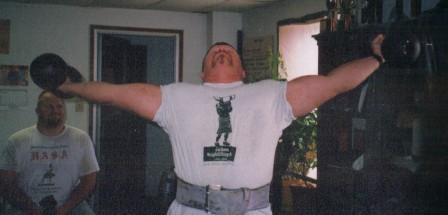
Mark Mitchell, of the Dino Gym, holds the Overall Record in the Clean and Press - 2 Dumbbells in the 125+ KG Class with a lift of 230 pounds (this is a picture of that record). This record was performed in the 2004 IAWA Postal Meet.

1.) Principles of cleaning and pressing barbells apply. You need an easy clean. If you’re stumbling all over as you rack the dumbells, or have to muscle them in over the last few inches, your chances of making a maximum single, triple, or even a set of five are slim.

2.) Concentrate on speed when you clean dumbells. You have to turn the dumbells over fast which requires getting the elbows to move rapidly. Remember, you’re not doing hammer curls.

3.) Dumbell cleans are easier if one uses ‘bells with thin, flat-style plates. I prefer 12½’s myself, the fewer plates the better. Hexagon-shaped dumbells are noticeably harder to clean, at least 90’s and up.

4.) For home training, spiral-lock dumbells are best. They can be changed quickly, and you never have to worry about the collars falling off and causing potential injury.

5.) For pressing heavy dumbells it’s essential to have a solid base. Total-body work comes into play here as you must maintain tight thighs and hips.

6.) When pressing the heaviest dumbells, I prefer palms facing each other, with elbows facing forward and angled slightly outward (as opposed to elbows to the sides).

7.) Keep dumbells directly over the shoulders and concentrate on driving them straight up, always being attentive to prevent the ‘bells from wandering out to the sides.

1 494 495 496 497 498 545