The Weaver Stick
(WEBMASTERS NOTE: The following was written years ago by the famous strength historian David Willoughby. This is an exert from an article he wrote, titled, Feats of Strength with Levers. Willoughby’s writings about the Weaver Stick provided the inspiration to adopt the Weaver Stick as an official USAWA lift. The purpose of reprinting this story is to provide the lead-in for my story tomorrow on the Weaver Stick, which for sure will create a Weaver Stick controversy.)
by David Willoughby
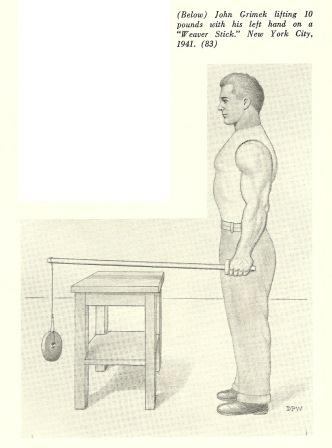
Drawing of John Grimek performing the Weaver Stick. This photo is from David Willoughby's book, The Super Athletes.
A direct and practical means of developing and strengthening the abductor muscles of the forearm is simply to swing a sledgehammer, preferably one that is sufficiently small and light to be gripped and swung with one hand. Such a movement is “practical,” because the use of the hammer, in one way or another, is something that has been going on for thousands of years and is still an essential element in many manual occupations. And so long as one is endeavoring to develop muscular strength, why use odd, artificial movements that rarely if ever occur in everyday life, when there are other movements, or exercises, that employ the muscles in a natural, practical manner? Away back in June, 1908, at the Crystal Palace in London, Arthur Lancaster swung a blacksmith’s 8-pound hammer for TWELVE HOURS without stopping. He was said to have “. . . the strongest wrist and forearm of any man alive.”
Many a feat of so-called “wrist strength” – actually, strength of the abductor muscles of the forearm (those that draw the hand toward the thumb side) – has been performed using either a standard, commercial sledgehammer, or “sledge,” or a long wooden bar, like a broom handle, with a light weight attached to the far end of it. Unfortunately, in most of the feats of this kind that have been reported, it has been difficult or impossible for one reason or another, to evaluate the merit of the performance. In some of the reports even the weight of the sledgehammer is left unmentioned; and rarely if ever does the performer state the exact length of the handle and how far his hand was away from the weight when he lifted it. Of course, without these essential items of information, no reliable comparison of the feat can be made with others of its kind.
Some years ago, in order to obviate these difficulties, my friend and co-enthusiast, George Weaver, who was then living in Brooklyn, designed a leverage-lifting bar of specified dimensions, with which he tested the “wrist strength” of many strongmen and weight trainees who were living in that area. In due course this bar became known as a “Weaver Stick.” This was a round stick (such as a mop handle), about nine-tenths of an inch in diameter, cut to the exact length of 41 inches. Here is Weaver’s description of the details of his stick:
Half an inch from one end, cut a notch. EXACTLY 36 inches from the CENTER of this notch, circle the stick with a line. Get two metal right-angles at a hardware store, and screw them into the top and bottom sides of the stick so that the rear edges of the right-angles come exactly to the circled line. The top side of the stick is the side where the notch is cut. lf one angle has once screw hole, and the other angle has two screw holes, the screws will not conflict. You can shave the bottom of the stick a little with a knife at these places, to make a flatter base for the angle. This leaves you with a “handle” just 5½ inches long, which you can tape to a thickness that suits your hand and affords a good grip.
It is important that the following rules be observed. The stick must be lifted approximately parallel to the floor, and not with the weighted end tilted downward. Above all, the stick must be lifted straight up from the chair; there must be no rocking of the stick on the chair before lifting. The lifting hand and arm must remain free of the body. And the heel of the hand must remain on TOP of the stick. If the hand twists under the stick, the lift is no good and cannot be allowed. The stick, when lifted, need not be held for any length of time; but it must be clearly lifted free of the chair (an inch is enough) and held in control (one second is enough).
This lift may also be made by turning the back on the weight and grasping the stick with the little finger toward the weight, instead of with the thumb toward the weight. More weight can be lifted in this manner. When lifting with the back toward the weight, the body may be bent forward as the lift is made.
The accompanying drawing of John Grimek shows the position to be assumed in making a Forward Lift on the Weaver Stick.
Many years before George Weaver thought up his leverage lifting stick, Paul Von Boeckmann, a professional strongman and physical instructor in New York City, by practice became exceptionally capable at feats of “wrist strength,” and used to win bets by raising weights on the end (straw) of an ordinary broom. He, like Weaver, saw that it was essential to establish a fixed distance on the stick between the center of the weight and the front (thumb-side) of the lifting hand. By doing this he eventually made a record by lifting 11½ pounds at a distance of 36 inches in front of his grip. This was equivalent to raising the same amount in a Forward Lift on a regulation Weaver Stick. At the age of 62 (in 1933), von Boeckmann could still raise 9½ pounds in this manner.
Weaver’s tests with his stick revealed a remarkable range in ability among the various persons who lifted on it. In this lift (in the Forward style) the “average” man would seem capable of about 4 pounds. Yet Warren Travis, the one-time world champion in back and harness lifting, who in addition could pick up over 100 pounds in a one-hand pinch lift, could only raise 4¼ pounds on the Weaver Stick. The best lift performed in the Forward style was recorded by recorded by Weaver was one of 10 pounds with the left hand by John Grimek. Later, in York, Pa., Grimek raised 11¾ pounds with his right hand on a stick that was 2” shorter than a regulation Weaver Stick. This would have made his lift, if it had been made on a 42” stick, equivalent to about an even 11 pounds. In any event, Grimek’s lift would appear to be the best on record with the exception of that made long ago by Paul von Boeckmann. But it would be interesting to know how much weight could be raised in this style by such old-time champions of grip and forearm strength as Louis Cyr, Horace Barre, Apollon (Louis Uni), John Marx and Hermann Goerner.
Of more recent weightmen, Mac Batchelor and Douglas Hepburn should have made good showings in this test. However, any guesswork in this direction could be highly unreliable. One would suppose that thick wrists and tight wrist ligaments would be of great assistance in this lift; yet actually some strongmen who possessed these attributes came out very poorly on the Weaver Stick, while others, who had more slender wrists and limber wrist joints, did unexpectedly well. I myself had, and still have, very limber wrist joints (which used to handicap me in heavy one-hand overhead lifts), yet I managed to raise correctly 7 pounds on a standard Weaver Stick, at a time when I was well past my prime.
In view of the fact that John Grimek was capable of raising approximately 11 pounds on a Weaver Stick in the Forward Lift Style, while weighing about 195 pounds and having a wrist of 7¾” and a forearm of 13¾”, it would certainly seem that one of the present-day superheavyweight powerlifters, with correspondingly larger wrists and forearms, should be able to similarly raise at least 12 pounds. However, unless and until such a lift is made, Grimek must be credited with being the contemporary record-holder in this test of forearm strength. Indeed, the nearest lifts to the 10 pounds recorded for Grimek’s LEFT- HAND record of 10 pounds were right-hand lifts of 8 pounds performed by John Davis and Steve Stanko, who were then at the peak of their Olympic lifting efficiency.
In the Backward Lift on a Weaver Stick, a considerably heavier poundage is possible than in the more commonly performed Forward Lift style. In the Backward style the highest possible poundage recorded by Weaver was 12½ pounds. This was accomplished by John Protasel, a heavyweight of New York City. However, in order to be equal in merit to a Forward Lift of 11 pounds, as performed by John Grimek, a Backward Lift (which employs the stronger adductor muscles of the forearm) should be somewhere between 14½ and 15½ pounds.