The Life of John Carter

By Bill Clark

Twenty five years ago, Harrisburg’s John Carter was on the top of the weightlifting world, then he disappeared only to resurface in recent months at Clark’s Gym – still the guy to beat when it comes to the world of chain lifting.

A quarter of a century ago, John, now 61 and looking as trim and fit as he did in 1988 when he first showed up in Clark’s Gym, compiled such world class marks as 3,405 pounds in the harness lift; 2,805 in the back lift; 2,525 in the hip lift: and 2,000 in the Carter Lift, named for him because few others in the lifting world even attempted it.

In his first meet back in 20 years, just before the corona virus pandemic hit, he took the title in the meet named for his main adversary of three decades ago – the Steve Schmidt Backbreaker Pentathlon. Steve was on hand to officiate.

John Carter about to complete his 3,405 pound harness lift. Note the position of his left hand .

John Carter about to complete his 3,405 pound harness lift. Note the position of his left hand .

And just who is this John Carter?

Let’s say he’s a survivor.

John was born November 28, 1958, the son of John Jerome Carter, Sr., and Delores Carter. He attended school at Harrisburg from the first through the ninth grades, but left school at age 16 never to return.

His dad was a heavy equipment operator and John wanted to follow in his dad’s footsteps. By the time he was eight years old, he was operating his dad’s bulldozer and soon thereafter was driving a car around the area.

At age 12, he took the family car to town, ran out of gas at the courthouse and approached life from a different angle for years to come.

In his junior high years, John showed his athletic ability and his strength by setting the school records in the shot and discus and playing basketball, but he also was plagued by discipline matters.

In the seventh grade, he took issue with a classmate in a gym class and went to fists, as he was wont to do on too many occasions then and later. In the fight that followed, John’s punch missed the opponent’s head and he hit the wall behind, breaking his arm in six places and shattering his wrist.

John had a powerful punch, but not well-directed.

The injury almost cost him his athletic future. He had to have plates inserted in the wrist that left it fixed in place without flexibility – and a four-month stay at Boone Hospital. Fortunately, it was his left hand. The plates are still there.

Even to this day, the injury hampers his mechanics as a lifter and golfer that requires modification of leverages and style, but not with final results.

When John reported to Harrisburg High to start his sophomore year, he was told his hair was too long and after a battle with administration, he left school three years short of graduation to get into the construction world at age 16. The bulldozers quickly followed.

John then began a journey through life that was filled with twists and turns. He spent two years at MFA Feed and Supply, worked concrete for NuWay Construction, was in a concrete footing business with two partners for three years, moved on to work on the development of Cedar Lake for Terry Sapp, supplemented his income by cutting tobacco for Henry Lamb, the “Tobacco King,” married, had a son, Jason (who is his best friend), divorced, then moved on to work for Columbia Public Works, retiring, after 23 years, in 2002.

He spent much of his career on the seat he loved the most – handling a bulldozer and heavy equipment. He still enjoys that role. He has owned Carter Construction since retiring from the city – which coincided with John’s fade from the world lifting scene.
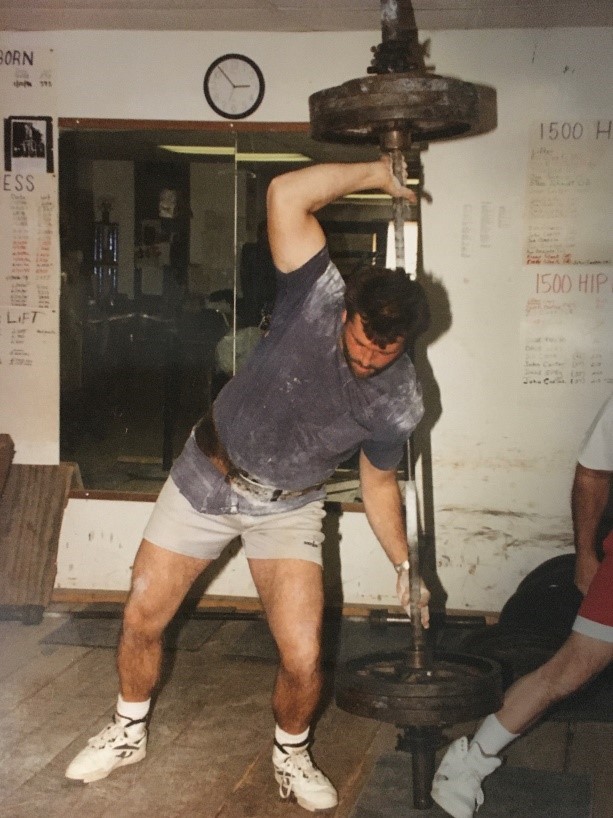
John about to shoulder a 375-pound personal record Steinborn lift. Note the left hand position.

John about to shoulder a 375-pound personal record Steinborn lift. Note the left hand position.

THE CARTER SPORTS WORLD

One of the personal losses that came with being a high school dropout was leaving behind his love of competitive athletics.

He soon joined a Looper League softball team, then spent the next 20 years as a slow pitch softball player.

“My career ended when I blew up at an umpire’s call and he threw me out of the game and said: ‘Don’t ever come back out here.’ The umpire was one of my friends at work, Bill Crum. I never went back.”

In 1982, he discovered bowling and was a regular on the lanes in Columbia for 20 years – good enough to carry a 190-plus average and add an 800 patch to his awards showcase. His high game was 297.

Golf came next – in 1986. The game proved to be a real challenge. The shattered left wrist caused John to develop a different stroke, but he can still drive past the 300-yard mark. Golf has been a part of life for almost four decades.

In 1988, for a reason John cannot recall, he decided to take up weightlifting. Clark’s Gym had just opened and, after visiting other gyms in Columbia, he gave Clark’s a look – and immediately joined.

“I made the right choice,” he said recently. “The gym saved my life.

“When I was going through my divorce, the gym became the place I could vent my anger. More than once, I almost let my anger misdirect me, but I would detour to the gym.”

John was an immediate world class lifter. To meet him on the street or even in workout gear, he looks normal. He’s 5-11, weighs around 215, has surprisingly slender legs and trim middle.

Within a year, he had emerged as a world class lifter, winning both the national and world all-round titles in 1989 in Philadelphia.

In a four-year stretch between 1994 and 1997, he won the national title and added golds in two of the toughest strength tests around – the Backbreaker Pentathlon and the Zercher Memorial.

In 1995, he performed the difficult combination hip lift and squat with 2,000 pounds – a lift that carries his name. No one else has done half that poundage.

He is proud of  his gym record of doing a single workout (two hours long) of 1,821 reps in the hip lift with 1,100 pounds – a total workout of 2,002,100 pounds.

In 1992, he met Diane Stone and she led the family cheering section in 1994 when John won a Gold Cup in Cleveland, Ohio, by setting a world record in the harness lift. She is still his head cheerleader.

Then, in 2004, it all ended. The business was a one-man operation and time-consuming. As it grew, so did the distance between John Carter and Clark’s Gym.

On rare occasion, he would drop in, tell stories with the owner about days gone by, see if he could still do a 1,500-pound hip lift, then disappear for a few more years.

Late in 2019, he found that, at age 60, he had trouble with 1,000 in the hip lift – and the reality of aging shocked him into action.

For 60 years, he had been headstrong, defiant, living life head-on, willing to fight. He lifted weights with the same mindset. Strength meant more than  technique, and failure was not tolerated as a chance to do things different.

Diane and being a business owner had both helped him get control. Golf, too, had been a stabilizer. He could still hit the ball hard, but he had to master the other shots as well.

Now, back n the gym full-time since 2004, John is the teacher as well as the student. He has accepted the fact that, at 61, he is no longer 31, and that a harness lift of 3,405 will never happen again and that 2,405 is a more reasonable goal – and still a world record for 61-year-olds.

Last month, in an unsanctioned competition to do 61 different lifts at age 61, John exceeded the existing national records in over 50 events for the 100-kilo class in the 60-64 age group.

Welcome home, John!!
Aging and Strong (Part I)

AGING AND STRONG

Part I:  On Fairness and Common Sense

By Dan Wagman, Ph.D., C.S.C.S.

All-round weightlifting uses an age adjustment formula in an effort to essentially equate the strength performance of competitors regardless of chronological age. Upon applying this formula, competitors are ranked to determine overall competition placings regardless of age or division entered (a body weight formula is used, too). For adults, once you turn 40 you receive an additional 1% per year up until you’re 60, at which point you receive 2% for each additional year of life. A few years back one lifter stated on the USAWA forum, loosely quoted, “I won’t win anything until I’m over 40.” Another lifter told me recently how “embarrassing” it is to be out-totaled, yet be considered the winner due to being older.

Now, you might wonder how much of a difference age adjustments can actually make. You’d have to take the body weight adjustment out of the equation by looking at two lifters in the same weight class, one being less than 40, the other over 40. In doing so, at the 2019 All-Round Weightlifting World Championships one lifter was out-totaled by over 300 pounds, yet placed higher. As this example illustrates, in all-round weightlifting—a strength sport—a lifter’s strength can be less meaningful than his/her age.


Contemplation

There are several ways to evaluate the age adjustment. With the above example in mind, perhaps the most basic is to ask whether it makes sense and is fair. However, these two very basic questions will invariably lead in to the realm of science. Allow me to illustrate.

On the question of being sensible, let’s approach it this way; take a lifter who’s born May 1st and is 39 years old. She receives no age adjustments. However, next year, when she turns 40 she’ll receive +1% in any meet that takes place on May 1st or thereafter. So what happened to her on May 1st of the next year that makes her 1% weaker than what she was on April 30th? Most anybody you’d ask would likely tell you this is silly because aging effects are gradual and occur over many years, decades even. Clearly this approach lacks common sense. So what are the effects of aging on a human’s muscles? You can only answer that via scientific investigation.

Regarding fairness, take that same lifter who’s born May 1st and competing on that very day against a lifter who’s born May 7th of the same year. The former lifter will receive a 1% adjustment while the latter won’t. How could that be considered fair? One week older makes a 1% difference in performance? What if the second lifter was born on June 2nd, or December 14th? Would that increased difference in age now all of a sudden make a more noticeable difference in strength performance? And if the difference is actually 12 months or more, is the difference really 1% for every year? In an effort to be fair to all competitors, wouldn’t we need to know for certain that the aging effect starts with 40 and not 38 or 44 or 63? If we don’t know that, how can this be fair? Science can help us figure it out.


Why Science?

At this point it might be worthwhile to explain why I always turn to science in an effort to derive at answers regarding weight training. The most fundamental reason is that if your training isn’t based on science you’re wasting your time on one end of the spectrum and on the other, increasing injury risk exponentially leading to decreased performance and a shortened lifting career.

Aaron Coutts, PhD, distinguished professor in sport and exercise science from the University of Technology in Sidney, Australia, and the Associate Editor for the International Journal of Sport Physiology and Performance offers more detail.(2) In writing about the importance of turning to sports science he listed the following reasons: improved training and performance, reduced training errors such as injuries and inappropriate training approaches, being able to balance benefits and risks in decision making, and being able to challenge belief-based views with evidence.

These are certainly compelling reasons for turning to science. But all-round weightlifting already relies on science, so why not regarding chronological age, too? Our sport employs science-based doping control methods and certified labs to analyze urine samples. This, to ascertain if lifters are using drugs to enhance their performance and thus achieving an unfair advantage. So why not also use science when making a determination about how chronological age may impact strength performance and competition placing? Isn’t the singular concept of fairness reason enough?


A First Step in to Science

What evidence is there that due to aging a 40-year old is weaker than a 39-year old, or a 33-year old, or a 27-year old? What evidence is there that a 60-year old is 2% weaker than a 57-year old? Why not use 0.8% and 2.36%, or 3% and 4%? If you’re thinking that I’m being silly and perhaps even nitpicking, consider that precision is the name of the game in strength sport. If you did a 315-pound one-armed deadlift in the 198-pound class and so did another lifter in the same weight class, you’d win if you weighed in at 195.5 compared to the other guy’s 196. If that half-pound difference bears consideration, wouldn’t logic dictate that we would have to know with as much certainty as possible what the aging effects upon strength are?

Here’s what we know about healthy but otherwise sedentary people:(1, 3-6)

  • A woman’s loss of muscle mass is greater than a man’s, particularly once she passes 60;
  • Decreases in strength are only slight by 50;
  • At 60 decreases in strength are more pronounced in both genders;
  • For women muscle contraction speed starts to decrease by 40, speed of muscle relaxation by 50;
  • Magnitude of strength loss is inconsistent among men and women;
  • Degree of strength loss is different between muscle groups and individual muscles;
  • Women show a slower decline in biceps and triceps strength than men;
  • Factors associated with strength loss impact upper body muscles differently than lower body muscles;
  • Strength loss appears to be most dramatic at about 80 for both genders;
  • Strength declines can fairly suddenly reach 30% beginning at about 80;
  • Strength losses are not linear and plateaus are observed;
  • 87 to 96-year old men and women showed a high capacity for strength and muscle gain following a science-based high-intensity resistance training protocol.

So this is what’s generally seen in a healthy but non-athletic population. What should jump out at you is the high degree of variability in strength loss and the higher age at which it occurs to a meaningful extent. Also, this is information I picked out and can be potentially misleading due to personal bias, the different research methodologies used in the studies, etc. Therefore, in Part II I’ll present research to show what the proverbial bottom line is. Then we’ll move on to people like you—the ageless barbell benders.


References

  1. Carmeli, E., et al. The biochemistry of aging muscle. Experimental Gerontology 37:477-489, 2002.
  2. Coutts, A. Challenges in developing evidence-based practice in high-performance sport. International Journal of Sports Physiology and Performance 12:717, 2017.
  3. Danneskoild-Samsoe, B., et al. Muscle strength and functional capacity in 77-81 year old men and women. European Journal of Applied Physiology 52:123-135, 1984.
  4. Hughes, V., et al. Longitudinal muscle strength changes in older adults: Influence of muscle mass, physical activity, and health. Journal of Gerontology: Biological Sciences, Medical Sciences 56:B209-B217, 2001.
  5. Landers, K., et al. The interrelationship among muscle mass, strength, and the ability to perform physical tasks of daily living in younger and older women. Journal of Gerontology: Biological Sciences, Medical Sciences 56:B443-B448, 2001.
  6. Paasuke, M., et al. Age-related differences in twitch contractile properties of plantarflexor muscles in women. Acta Physiologica Scandinavica 170:51-57, 2000.

Learning A New Skill

By Christopher Lestan

I thought I might make a post recently because I haven’t been active in a while.

During this time of social distancing I been learning about myself a lot since there is plenty of time to just think now. One of the important things I learned from my father is to keep headstrong and focused during times like these. In other words he says “Keep busy”. Now after school ended early for me around March I was lost in limbo for a few weeks. No more jobs are available. No ability to train with friends. Not being able to have a couple of beers with the boys at our favorite local bar where the beers are 2$ a pour!

This was a strange time indeed. Fortunately, my family is always there to help. My dad who recently became an electrician and worked for the city of Boston was off of work until mid-May. He realized that I was very lost in what to do. In a conversation he and I reached an agreement of him teaching me how to landscape and plant trees since he worked at our family’s nursery when he was young. He also added that he would help me redo our Aunt’s Yard, for she recently moved into a new house and the yard needed some fixing.

For the past month and a half I can confidently say my Aunt’s yard has new grass seed, mulch, trimmed bushes, and new plants. I also planted a couple Hemlock trees in our back yard. I was soon fixing both grandparents’ houses and even took a tree stump out of the ground and put in a new willow tree for one of them. Soon I was in charge of taking care of 3 lawns.

Now you may be asking what was the point of me telling this story… Well, I think it’s important for people to learn new things especially when times are strange and even in their free time. I never thought I would be redoing whole lawns and even spreading mulch and soil to make lawns look nicer, or even plant trees. It’s a rewarding experience.

When you do something rewarding you build confidence that can be utilized for other things. SUCH AS LIFTING!!! My lifts are finally coming back to normal after my injury in December and have learned to gain confidence when there are no spotters. Now with the nice weather I can build an outdoor platform and compete in the 3rd Postal!!

I can’t wait for things to slowly come back to normal and to see my friend group.

2nd Quarter Postal

By Denny Habecker

MEET RESULTS:

2ND QUARTER POSTAL MEET

SmithPP

Abe Smith putting up a big clean and push press of 257 pounds.

We had a great turnout for the Postal again this quarter.  Abe Smith was the top male this quarter and Elizabeth Skwarecki  led the women. Clarks Gym and K.C Strongman each had 6 lifters participate followed by Dino Gym and Habecker’s Gym with 4 each. Thanks to everyone who participated .

MEET RESULTS

2nd Quarter Postal
April 1 thru June 30, 2020

The Lifts: Curl- Cheat, Reverse Grip, Snatch- Dumbbell, One Arm, Clean and Push Press

MENS DIVISION

Abe Smith            – 38   – 184 Lbs.    –  190  – 131 -L   – 257    – 578     –  541.99

John Strangeway  – 42  – 206.4 Lbs.  –  205  – 120- L    – 215    – 540      – 488.39

Eric Todd             – 45   – 253 Lbs.     – 200  – 105 -R    – 210    – 515     –  430.71

Tony Hose           – 51   – 227 Lbs.     – 165  –  85  -R    – 180    – 430      – 401.84

David DeForest   – 60   – 195 Lbs.      – 135  –  85 – R    – 145    – 365      – 400.84

Al Myers            – 53   –  225 Lbs.      – 155   -100 – R    – 135   – 390      – 372.70

Barry Bryan       – 62   – 186.6 Lbs.    – 100  – 74.4- R    – 150    – 324.4   – 371.04

Barry Pensyl      – 72  –  148 Lbs.       – 100  –   54 – L     – 90     – 244      – 364.52

Chad Ullom       – 48  –  220 Lbs.       – 155   – 100 -R     – 135   – 390       -360.69

Chris Todd        – 40  –  273 Lbs.       – 180  –   95 – R     – 190   – 465       – 356.74

Denny Habecker -77 –  183.8 Lbs.     – 105  –  35  – R     –  99    – 239       – 336.27

Aidan Habecker – 16  –  214 Lbs.    – 121.25 –  70 – R     –  99     – 290     –  275.14

LaVerne Myers   – 76  – 224 Lbs.      –  95     –  45 – L     –   75     – 215     –  267.28

Leroy Todd        – 9    – 70  Lbs.      –  30      – 15 – R      – 35     –  80       – 232.05

Dean Ross        – 77  – 215 Lbs.      –  75      – 40 – L      – 65     – 180       – 231.87

Lance Foster     – 54 – 349 Lbs.       – 100     – 55 – R      – 125   – 280       – 217.99

Bill Clark          – 87  -208 Lbs.       –  22      – 10 – R      – 22     – 54         –  82.17

WOMEN’S DIVISION

Elizabeth Skwarecki – 39 – 146.8 Lbs. – 108  – 66- R  –    118     -292        – 316.06

Sylvia Stockall        – 62  – 140 Lbs.   – 77    – 50 – R –    100    – 227        – 311.65

R.J. Jackson           – 58  – 106 Lbs.   – 80    – 50  -R  –    85     – 215        – 298.82

Lynda Burns          – 45  – 175 Lbs.   – 70     – 45- L    –   95     – 210        – 215.09

Phoebe Todd         – 9    – 94 Lbs.     – 37.5  – 18- R    –    40     – 95.5       – 197.39

Janet Thompson   – 62   – 180 Lbs.   – 60     – 20- R     – 55      – 135        – 157.73

Kylie Smith          – 13   – 146 Lbs.   – 47     – 20- R     – 47      – 114        – 154.55

Crystal Diggs       – 34   – 164 Lbs.   – 50     – 30- R     – 55       -135        – 135.79

Officials:

Abe Smith             – Bill Clark & Dave DeForest
Tony Hose            –  Bill Clark & Dave DeForest
Leroy Todd           – Eric Todd & Chris Todd
Phoebe Todd        – Eric Todd & Chris Todd
Kylie Smith          – Bill Clark & Dave DeForest
John Strangeway – Lance Foster
Eric Todd            –  Chris Todd
Dave DeForest    – Bill Clark
Al Myers            – Chad Ullom
Chad Ullom        – Al Myers
Chris Todd         – Eric Todd
LaVerne Myers   – Al Myers
Aidan Habecker  – Denny Habecker
Dean Ross         – Al Myers
Lance Foster      – John Strangeway
Janet Thompson – Bill Clark
Crystal Diggs     – R.J. Jackson

Lifters with Non-Certified Officials:

Barry Bryan
Barry Pensyl
Denny Habecker
Bill Clark
Elizabeth Skwarecki
Sylvia Stockall
R.J. Jackson
Lynda Burns

Dick Durante

By Denny Habecker

I just got the news yesterday of the passing of Dick Durante on June 4, at age 87. I know many of you may not have known Dick, because he didn’t lift in a great number of our meets. Dick lifted in a couple of our Nationals and at least one IAWA Worlds in addition to a few smaller meets. I knew Dick from my days as an Olympic lifer. He and John Vernacchio lifted for the legendary Holy Savior Club in Norristown, Pa. Dick was a competitor in my first competition in 1962. He was a veteran lifter at that time, pressing 270, snatching 220, and clean & Jerking 305 in the 198 lb. class in that meet.  Five years later he was pressing 320 in the HVY weight class. I didn’t really know Dick that well until in the 1980’s as a master lifter, I started lifting for John Vernacchio’s Valley Forge Club.We got to be good friends through our mutual friend John. Dick was  well liked, had a great sense of humor, and a man of many talents. He was a police officer, a restaurant owner, Navy veteran, electrician, & air conditioner tech. Dick and his wife Mary Ann invited us to their beach home on Long Beach Island, New Jersey many times, and showed us great hospitality and friendship . I also remember the great time I had  traveling to the Old Time Barbell and Strongman Banquet with Dick and John and a couple of their Holy Savior team mates . Rest in Peace Dick.


1 154 155 156 157 158 546