Backbreaker Pentathlon

By Bill Clark

MEET –

BACKBREAKER PENTATHLON

Three legends of Clark's Gym gather for the Backbreaker (left to right): Steve Schmidt, Bill Clark, and John Carter

Three legends of Clark’s Gym gather for the Backbreaker (left to right): Steve Schmidt, Bill Clark, and John Carter (caption by webmaster)

John Carter was an easy winner, his second title in a month, capturing the best lifter award in Steve’s Back breaker Pentathlon held at Clark’s Gym in Columbia, Mo.

The field was limited to only three lifters due to the corona virus and restricted movement. What had been planned as a warm-up for the USAWA National Heavy Lift Championships in May, wound up being a friendly day in the gym and plenty of time to visit with Steve Schmidt, the USAWA Hall of Famer for whom the meet is named.

Steve served as the head meet official and passed along a few coaching hints as well – much to everyone’s gratitude. It was much like the days of old at Clark’s place – only the size of the crowd was different.

Amorkor Ollennuking continued her comeback from lymph node cancer treatment by performing what everyone consider the best life of the day. During the record session, the 57-year-old Kansas Citian did a little fingers deadlift with 125 pounds, breaking the long-standing mark of Mary McConnaughey. It is the highest little fingers deadlift by a female regardless of weight or age, in the USAWA record book.

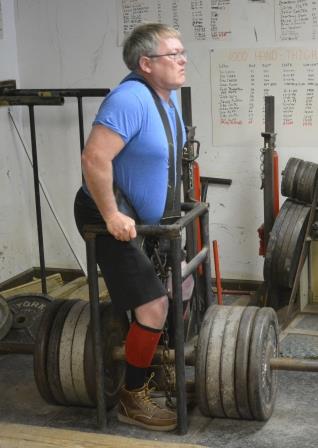
Dave DeForest pushing up a big Harness Lift!

Dave DeForest pushing up a big Harness Lift!

The busiest lifter of the day was 60-year-old Dave DeForest, who, like Carter, has revived a lifting career dormant for more than a decade. He set records in the harness, hip and hand-and thigh, then added five more during a record session.

Carter, too, set three records – hip, harness and back lifts.

Clark’s has put the outside competition on hold because of the corona virus, but will lift in the USAWA quarterly postal competition.

The results:

2020 Backbreaker Pentathlon
March 21st, 2020
Clark’s Gym
Columbia, MO

Meet Director: Bill Clark

Scorekeeper: Bill Clark

Officials (1-official system used): Bill Clark, Steve Schmidt

Photographer: Gene Baumann

LIFTERS:

Amorkor Ollennuking, 57, Female, Kansas City, Mo. Bwt. 76.9 kilos (169.5 lbs). Coefficient – .9896. Age differential – 1.18.

John Carter, 61, Male,Harrisburg, Mo.  Bwt – 98.9 kilos (218 lbs.) Coeff. – .8522. Age diff. – 1.22.
Dave DeForest, 60, Male, Fulton, Mo.   Bwt – 89.4 kilos (197 lbs.)  Coeff. – .9060.  Age diff. 1.21.

BACK LIFT
Ollennuking – 900
Carter – 1500
DeForest – 800

NECK LIFT
Ollennuking – 200
Carter – 225
DeForest – 250

HAND AND THIGH
Ollennuking – 705
Carter – 900
DeForest – 705

HIP LIFT
Ollennuking – 765
Carter – 1670
DeForest – 1125

HARNESS LIFT
Ollennuking – 1075
Carter – 2105
DeForest – 1305

TOTALS
Ollennuking – 3,645 lbs.
Carter – 6,400 lbs.
DeForest – 4,185 lbs.

BODYWEIGHT ADJUSTMENT
Ollennuking – 3,588.87
Carter – 5,594.08
DeForest – 3,791.61

AGE ADJUSTMENT – FINAL SCORE
Ollennuking – 4,234.86
Carter – 6,657.98
DeForest – 4,582.85

SUCCESSFUL FOURTH ATTEMPTS
DeForest – Hand-and-thigh – 805; Hip lift – 1,225.

RECORD DAY
Ollennuking – Little fingers deadlift – 125.
DeForest – Snatch on knees – 80; strict curl – 80; right hand one-inch vertical bar deadlift – 182; left hand one-inch vertical bar deadlift – 182; two-hand 1-inch vertical bars deadlift – 314

The Guessing Game – Box Squats Part II

By Dan Wagman, Ph.D., C.S.C.S.

THE GUESSING GAME – BOX SQUATS

Part II: Less Guesswork

“The progressive evolution of athletic performance and specific conditioning techniques is dependent on a thorough understanding of those mechanisms underlying dynamic muscular function.”(2)


In Part I, I presented someone’s guess that has huge intuitive appeal—that the box squat will enhance your squat strength and power for driving out of the hole. I made a guess, too, and to derive at it I asked what is perhaps the most important question anybody can ask about any training concept: by what physiological mechanism would that idea work? I could find none. The question is, might there be something going on that’s less well understood about muscle contraction mechanisms that might render the box squat a useful tool after all?

Our knowledge of how important the coupling and amortization phases (see Part I) are to you being able to produce maximal strength goes back to research published in 1931.(1) Back then, however, those phase-terms were not used. Since then research has built upon itself and advanced our knowledge of what we now term the stretch-shortening cycle. What all this scientific study would suggest is that the promise that performing box squats will enhance your regular squat is nonsense. But I wanted to verify or refute my “guess” based specifically on research that looked at the squat and box squat.


A First Look

I believe the best starting point to be research published in 1998.(2) The researchers recruited 40 athletes of various sports. They all had a minimum of 1 year squatting experience and could squat a minimum of 1.5 times their body weight. The entirety of testing methods are too complex to mention here, but to briefly illustrate included a modified Smith machine that measured and controlled speed of movement, among other things; a force plate to gather much data on force, power, work, etc.; electromyography to measure muscle contractions; and more.

The subjects were tested in three conditions: 1. They had to squat from the bottom position up, similar to a box squat. What was dissimilar to a box squat was that they had to first hold an isometric contraction for no more than 1.5 seconds before exploding upward; 2. The “stretch-shortening squat” was tested, which you may view as a normal competition squat with an intact coupling and optimized amortization phase; 3. The subjects had to perform a maximal isometric contraction against an immovable bar for 100 to 200 milliseconds before it automatically released and allowed the athletes to explode out of the hole.

Among many data points analyzed, the most important consideration for the strength athlete is that the greatest effect on the squat was achieved in the stretch-shortening condition, i.e., a regular squat. That was followed by the squat preceded by a maximal isometric contraction and lastly by squatting from the bottom up as in a box squat, which resulted in the weakest readings. In fact, the readings generated from the standard squat were more than twice that compared to the box squat style. The research team concluded that the quicker you transition from lowering the bar to exploding upward, the more strength you’ll be able to demonstrate. This finding is entirely in line with what you would expect considering the basics of muscle contraction mechanisms/physiology. Bottom line, you must have an intact coupling phase along with the briefest amortization phase possible. Only then can you expect to demonstrate maximal strength and power.

Still, because this was initial work done on the squat and how different methods of commencing the ascent might influence strength and power, there were a lot of methodological controls put in place. Researchers place a great deal of control into their studies in an effort to eliminate extraneous variables that might influence the outcome. In doing so, they obtain very specific and accurate information. From there, future research builds and looks at additional variables that might have an impact. And so it could be argued that since in this initial work the squat was performed with an empty bar and the speed of ascent could not exceed the 0.4 meters per second set by the modified Smith machine, no matter how hard each athlete tried, the squatting was not as specific to a regular competition squat as necessary for an accurate comparison. Of course the research team acknowledged this while outlining in painstaking detail the reasons for their approach. Moreover, it could be argued that when the subjects commenced the squat from a dead stop without pre-stretch or isometric contraction first, that movement pattern was not exactly the same as what’s generally advised in doing a box squat.

So far things don’t look good for the box squat, but the above concerns may or may not be valid, which means I had to dig deeper into the research advancements. Part III will look at comparisons between the actual box squat and standard squat.


References

  1. Fenn, W.O., et al. The tension developed by human muscles at different velocities of shortening. American Journal of Physiology. 97:1–14, 1931.
  2. Walsche, A., et al. Stretch-shorten cycle compared with isometric preload: contributions to enhanced muscular performance. Journal of Applied Physiology. 84(1):97–106, 1998.

The Guessing Game – Box Squats Part I

By Dan Wagman, Ph.D., C.S.C.S.

THE GUESSING GAME – BOX SQUATS

Part I: Two Guesses

Like most guys and gals that got bit by the iron bug, I used to read all sorts of stuff about training. Once I came across something that seemed promising, I couldn’t wait to put it to practice in the gym, not to mention the torture I went through trying to manage the anticipation of huge gains. Of course those huge gains never happened, not until I learned about an area of scientific investigation called exercise physiology and started to apply what I learned. You see, that stuff isn’t based on guesses and conjecture. What I would like to share with you is a perfect example of why what might seem like really good training advice, when looked at from the perspective of human physiology, it couldn’t deliver as promised. My hope is that you’ll then be able to make more educated decisions about from whom to take training advice and what sort of questions to ask in your assessment of that advice.


The First Guess

It seems beyond obvious; for you to squat a ton of weight you have to be able to descend to below parallel in a controlled manner and once you hit depth you need to explode out of the hole in an effort to complete the movement. Nearly every lifter will tell you that the hardest part of the squat is blasting out of the hole. Naturally, this begs the question: might there be a method of training that’ll enhance your strength and power for getting out of the hole? Decades ago one very passionate powerlifter and coach came up with box squats for that very purpose.

The guess he made is that if you could squat down to a box that’s just the right height to break parallel, and you literally sat on it while rocking back, pausing on the box for one to five seconds or so, then blasted off it with all your might, you’d be able to increase the power you need to get out of the hole in a regular squat. This sounds really good. And so decades after the box squat idea was conceived tons of lifters still use it to increase their overall squat strength (though other purported benefits are said to exist). My guess, however, is that what seems to be such a good idea is far less than that when viewed through the lens of exercise physiology.


The Second Guess

The origin of my guess is based on the physiology of muscle contractions. Therefore, it’s really not a guess, but just humor me and let’s stay with the guessing theme.

When you squat down to depth your quad and glute muscles elongate, this is called an eccentric contraction (note that other muscles are involved, too, but addressing the entirety of functional anatomy and biomechanics is beyond the point of this article). When you reverse direction out of a deep squat, those same muscles shorten in what is termed a concentric contraction. For a very brief moment, as your muscles switch from eccentric to concentric, they contract isometrically. The linking of these contractions is referred to by some scientists as the coupling phase. Now, a fascinating thing occurs in your muscles during the eccentric phase of the squat—your muscles store elastic energy. As you reverse direction that stored elastic energy is released resulting in a powerful completion of the lift. The singular moment of switching directions is called the amortization phase and the entirety of what occurs here is often referred to as the stretch-shortening cycle. And here’s where another fascinating thing occurs; the longer the amortization phase, the more elastic energy is lost for the subsequent concentric contraction. Simply put, the longer the time you spend sitting on a box, the weaker you’d be during the ascent.

The above represents perhaps the most important amortization phase mechanism—reutilization of stored energy. Other proposed mechanisms include a stretch reflex, muscle-tendon interactions allowing muscles to remain at optimal lengths and to shorten at the best velocities, optimized muscle activation patterns, and increasing pre-force before the concentric contraction. Regardless of the mechanism(s) involved, it seems clear to me that the basics of muscle physiology deeply contradict the stated benefit of the box squat; as you sit on the box you’re increasing the amortization phase and ostensibly breaking the coupling phase, thus squandering valuable elastic energy. How could that possibly result in increased squatting abilities?

With that in mind, it’s well and good enough to reject the box squat. But is it possible that there is some component within the neuromuscular system that scientists have as of yet not discovered that would indeed warrant employing the box squat in your training? Could the original guess have accidentally hit on something? The way to get answers is to test the box squat hypothesis via controlled research. That’s what I’ll discuss in Part II.


Reference

Stone, M.H., M. Stone, and W. Sands. Principles and Practice of Resistance Training. Human Kinetics, 2007.

Presidential Cup

By Al Myers

*****CANCELLED*****

MEET ANNOUNCEMENT
THE 2020  USAWA PRESIDENTIAL CUP

For the ninth year in a row, the now “Annual” USAWA Presidential Cup is being hosted again by our USAWA President Denny Habecker.  This is one of the CHAMPIONSHIP events hosted in the USAWA, and is the Championships of Record Days.  It follows along “the lines” of the IAWA Gold Cup – a lifter picks their best lift and contests it for a USAWA record in this prestigious record day.  After all lifters have performed their record lifts, Denny will pick the effort that impresses him the most and award that lifter the PRESIDENTIAL CUP.  Only one lifter will receive this very important award.   If time allows, lifters will have the opportunity to perform other record day lifts.  So it is a good idea to come with the BIG LIFT in mind, but also be prepared to do other lifts for record if the time allows.

Now a little “rehash” on the Presidential Cup.  These are the guidelines:

The Presidential Cup will follow along some of the same guidelines as the Gold Cup, which is the IAWA meet which recognizes outstanding performances by lifters in the lift/lifts of their choosing.  The Gold Cup started in 1991 under the direction of then-IAWA President Howard Prechtel.  However there will be some differences in the guidelines of the USAWA Presidential Cup:

  • The Presidential Cup is hosted annually by the USAWA President only.
  • Must be a USAWA member to participate.
  • A lifter may choose any official USAWA  lift/lifts (up to a maximum of 5 lifts) to set a USAWA record/records in.
  • The lifter must open at a USAWA Record Poundage on first attempt.
  • The top performance record lift of the entire record day,  which will be chosen by the President, will be awarded the PRESIDENTIAL CUP.

MEET DETAILS:

USAWA Presidential Cup

Saturday, August 1st, 2020

Meet Director:  Denny Habecker

Location: Habecker’s Gym, Lebanon, PA

Lifts:  Bring your best lift for record!

Start time:  10 AM,  with weigh-ins before this

Entry Form:  None, but advance notice is required.

Lebanon Valley RD

By Al Myers

***POSTPONED TILL FURTHER NOTICE***

MEET ANNOUNCEMENT –

LEBANON VALLEY RECORD DAY

Denny has just announced his spring record day at his gym, Habecker’s Gym.  Please contact him in advance if you plan to attend and he can fill you in on the details.  Remember – only 5 lifts for USAWA records can be performed at record days. That’s a rule of the USAWA.

Meet Promoter: Denny Habecker

Meet Date: May 16th, 2020

Location: Habecker’s Gym, Lebanon, PA

Contact Denny if you plan to attend.

1 153 154 155 156 157 543