Category Archives: USAWA Lifts

The Fulton Dumbbell Deadlift

by Al Myers
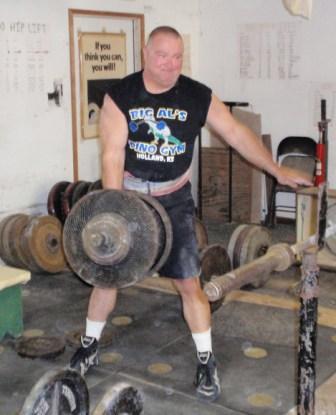
Al Myers performing a One Arm Fulton Dumbbell Deadlift with 170 pounds at Clark's Record Day.

One of the lifts I did last weekend at Clark’s Record Day was the Fulton Dumbbell Deadlift.  I wanted to do this lift to point out a mistake that was made in the new Rule Book and found by Dale Friesz.  Despite the extensive review process of the new Rule Book, I knew mistakes were still possible and here is one.  Thanks Dale for finding it!

The Rule for the Deadlift – 2 Fulton Dumbbells should be this:

The rules of the Deadlift – 2 Dumbbells apply except the dumbbells used must have handles of 2″ in diameter.  No knurling is allowed on the handles.  The maximum diameter of the plates used is 18 inches.

Previously, due to a typo, it stated that only 11 inch diameter plates could be used.  This typo happened  because the Inch Dumbbell Deadlift does require a maximum diameter of 11 inch plates, and the rule for this lift is close to the Fulton Dumbbell Deadlift in the Rule Book.  Once again, copy and pasting created a problem for me!!  The reason for the Inch Dumbbell Deadlift requiring maximum 11″ plates is because the original Inch Dumbbell was a globe dumbbell, and the rule was written to best simulate the original Inch Dumbbells size using a plate loaded dumbbell handle.  This mistake will be corrected in next years updated Rule Book.

Now for the story on how the Fulton Dumbbell got its name….

Back in the early 80’s at a odd lifting meet in Liberal, Kansas, meet director Bob Burtzloff included a thick-handled dumbbell deadlift in the contest.  This dumbbell had a smooth 2 inch diameter handle.  Wilbur Miller, the “Cimarron Kid” and Kansas lifting legend,  was the hands on favorite to win this event.  Wilbur has huge hands with long fingers and was very rarely beaten in any lifting event that involved grip strength.  But this day was one of those rare days – when a young farm boy from Nebraska by the name of Kevin Fulton pulled off the upset! Upon Fulton’s winning – Bill Clark announced that this lift would be forever named the Fulton Lift.  This eventually lead to the naming of the 2″ bar as the Fulton Bar along with the Fulton Dumbbell.  As for Wilbur – upon the finish of the event he went back to the warm-up area and proceeded to pull more on this lift than he did in competition.  He went home knowing that he may not have won the event on this day,  but with the satisfaction of knowing he would next time!
Rules for the Gardner Lifts

by Al Myers

(The following are the USAWA Rules for the Full and Half Gardner Lifts, taken from the USAWA Rulebook)

D11. Gardner – Full

The first part of this lift is to perform a Half Gardner according to the rules of the Gardner – Half. Once in the finished position on the platform of the Half Gardner, an official will give the command to rise. The lifter must not rise before the command or it will be a disqualification. The rules of the Gardner –Half apply to the rise as well. Once the lifter is standing upright, with the bar motionless at arm’s length overhead, the feet parallel and in line with the torso, an official will give a command to lower the bar. The bar may be in any degree of rotation when overhead. The bar must be returned to the platform under control by the lifter to complete the lift. It is acceptable to use both hands to lower the bar.

D12. Gardner – Half

The lifter may put the bar overhead into the starting position by any method, except upending the bar. This may be done using a One-Arm Clean and Jerk, One-Arm Snatch, pushing the bar overhead in one hand using both hands, putting the bar overhead with two hands and then moving it to one hand, etc. The bar is gripped in the center. The start position is when the bar is held motionless overhead with a straight arm, the lifter’s body upright with legs straight, and the feet parallel and in line with the torso. The non-lifting hand must be free from the body. Once in this position, an official will give a command to start the lift. The lifter will then lower the body to a lying position on the lifters back on the platform by any method, ending with the bar held at arm’s length overhead. The lifting arm must remain straight throughout the entire lift. When the lifter is in the lying position on the platform, the shoulders, legs, hips, head and non-lifting arm must all be in contact with the platform. The bar or plates must not make contact with the platform during the lift. The bar must be under control at all times. The non-lifting hand may be placed on the platform for support during the lift. The bar is allowed to have a slight tilt to it during the lift, as long as the lifter has the bar under control. The bar is allowed to rotate during the lift and may be in any degree of rotation when the lift is complete. Once the lifter is in the proper position lying on the platform, with the lifting arm straight and the bar motionless, an official will give a command to end the lift. The lifter may use both hands to lower the bar or spotters may assist in removing the bar.

The One Arm Dumbbell Swing

by Al Myers

My training partner Chad Ullom and I just spent a training session training the One Arm Dumbbell Swing. This is a lift not well understood today, but at one time was a very popular lift among old time strongmen. One arm lifts were once trained as much as two arm lifts – but not anymore. The USAWA rules for the One Arm Dumbell Swing are quite simple – but certain things must be done for a Dumbbell Swing to be “legal”. These include:

– once the dumbbell leaves the platform it must be in continual motion until lockout

– the rod of the dumbbell must maintain a 90 degree angle to the body

– the non-lifting hand must not touch the lifting arm or dumbbell

– the arm must be straight in receiving the dumbbell overhead – in other words – NO PRESS OUT

– the lift ends on command once the feet are in line and the dumbbell is in control overhead

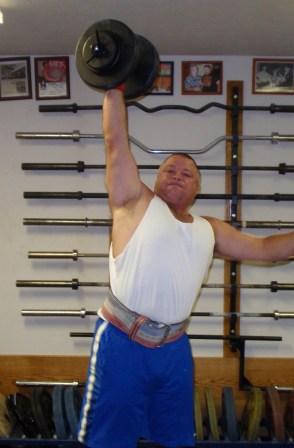
Al Myers with a 145 pound Dumbbell Swing.

There are two styles that are used the most when doing an One Arm Dumbbell Swing. I use the more traditional style of “swinging” the dumbbell between my legs once to gain momentum to propel it overhead. Chad uses a “snatch style” where he takes it from the floor overhead in one motion and drops under the dumbbell when he catches it overhead. This is difficult in the sense that the hand is turned different than a Dumbbell Snatch. The USAWA Rules allow the lifting arm to bend during the lift and the feet to move.

Top Ten All-Time USAWA One Arm Dumbbell Swings


1. 143 Pounds Chad Ullom
2.
140 Pounds Mike McBride
140 Pounds Frank Ciavattone
4. 121 Pounds Al Myers
5. 120 Pounds Ed Schock
120 Pounds Jim Goviannini
120 Pounds Abe Smith
120 Pounds Robert English
9. 115 Pounds Scott Schmidt
115 Pounds Jason Weigle

Coming SoonThe Top Ten One Arm Dumbbell Swings of All-Time.

Will any of these USAWA lifters make the list?

1 7 8 9