Category Archives: USAWA Lifts

New Lift – the Turkish Get-Up
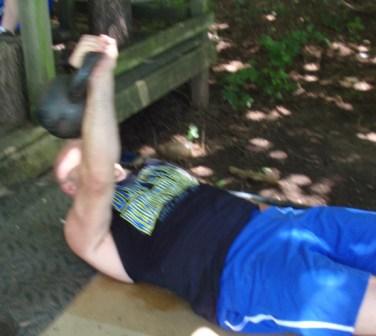
The starting position for the Turkish Get-Up.

by Al Myers

This is the only new USAWA lift approved at Nationals that I haven’t highlighted yet with a story.   It is a very unique lift in many ways.   The Turkish Get-Up  is NOT really a new lift as it was a favorite with old-time strongmen, and has been around forever.  It at times was called the “One Arm Get-Up”, and often trained by lifters that also specialized in wrestling, gymnastics or hand-balancing. Guys like Sig Klein loved it.  I first heard of the Turkish Get-Up several years ago when I read Brooks Kubik’s book Dinosaur Training.  In it he described the benefits of this exercise – how it strengthens the stabilizer muscles, improves flexibility, and  increases core strength.  The book mentions the old-time strongman Otto Arco and how he could do a Turkish Get-Up with MORE than his own bodyweight.  That is impressive!
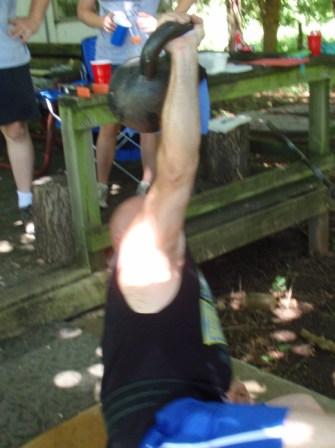
During the rise from the platform, the lifting arm must remain straight.

We have two similar USAWA lifts to the Turkish Get Up – the Half Gardner and Full Gardner.  However, the Turkish Get-Up is a different lift in a couple of ways.  The TGU starts on the floor – the Gardner lifts start standing.  The TGU requires the use of a dumbbell or kettlebell – the Gardner lifts require use of a bar.  It is the “missing link” to the Gardner Lifts. I have mentioned this before but I am going to repeat it again.  This formula “sums” up these three lifts:

Full Gardner = Half Gardner + Turkish Get-Up

Last weekend at the Ledaig Record Day, several of us got to be the first ones to put a Turkish Get-Up record in the USAWA Record List.  This included  Dave Glasgow, Amber Glasgow, Chad Ullom and myself.  The TGU is a very popular exercise for trainees outside of the All-Round crowd.  Just “goggle” Turkish Get-Up and you will see what I am talking about.  The Cross-Fit trainees love this exercise!  But now since the TGU is an official lift of the USAWA, we are the ONLY weightlifting organization that maintains records for it.
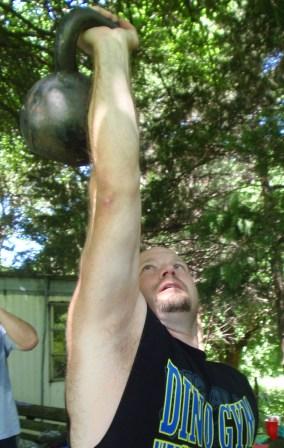
Chad Ullom demonstrating the steps of a Turkish Get-Up with a 70 pound kettlebell at the Ledaig Record Day.

The Rules for the Turkish Get-Up

A dumbbell or kettlebell is used for this lift. The lift begins with the lifter lying on his/her back on the platform holding the implement in one hand above the body with a straight arm perpendicular to the platform. Once in this position, an official will give the command to start the lift. The lifter must rise to a standing position, holding the implement overhead with a straight arm throughout. The lifting arm must stay perpendicular to the lifting platform. The lifter may use the free hand to brace against the body or the platform during the execution of the lift, but must not touch the implement or the lifting arm. The implement may rotate in any direction. Once standing with the implement overhead, the implement motionless and the lifter’s feet in line with the body, an official will give a command to end the lift.

The Turkish Get-Up will be included in the updated USAWA Rulebook coming the first of August!
A New Lift – The Foot Press

by Al Myers

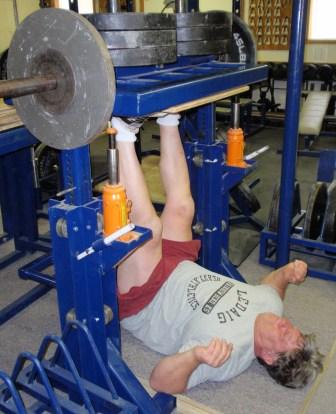
Dave Glasgow, Newcomer of the Year for the USAWA, performing a Foot Press with 1050 pounds at the 2010 Dino Gym Challenge.

Last January at the 2010 Dino Gym Challenge, I presented a meet in Arthur Saxon’s memory which I called the Arthur Saxon Pentathlon.  The meet contained five of Arthur’s favorite lifts.  Only one of the lifts in this meet was not an official lift of the USAWA – the Foot Press. This lift was popular with other Old Time Strongmen such as Hermann Goerner, Warren Lincoln Travis, and Milo Steinborn.  It was often performed in their Strongman Shows, usually with people from the crowd sitting on a plank resting on their feet to provide the weight needed to complete the stage act.  The USAWA does not have a lift similar to it.  I would consider  the Foot Press as the “Heavy Lift” version of the Leg Press.  This lift can be done in pretty much any gym that has a Vertical Leg Press or Back Lift Apparatus.  It was a “big hit” at the Dino Challenge as an Exhibition Lift, and because of that I presented it to the USAWA to be approved as a new official  lift. I was glad the membership approved it at the National Meeting.

Our mission statement states, “The USAWA was formed to continue the long standing tradition of old-time weightlifters like Eugen Sandow, Louis Cyr, Arthur Saxon, Hermann Goerner, Warren Lincoln Travis, and many others. We strive to preserve the history of the original forms of weightlifting, which in the past has been referred to as “odd lifting”. Many of the lifts we perform are based on stage acts or challenge lifts of old-time strongmen.”  The Foot Press is an excellent example of a lift that fits our mission statement!!

Rules for the Foot Press

An apparatus is used in which weight is loaded onto the feet only while the lifter is laying on his/her back on the floor/platform with the legs vertical and perpendicular to the floor. The apparatus used must allow the weight to rise without providing any leverage to the lift, but may be guided in a tract. It is also acceptable to use a plank resting on support platforms. The lift starts at the lifter’s discretion. Hands may be placed on the legs or any part of the apparatus, but must not be used to push directly against the weight being lifted. The hands may remain on the legs throughout the lift, and upon the finish of it. The weight lifted must clear the supports and be held motionless, at which time an official will give a command to end the lift.

The Foot Press will be included in the 4th Edition of the USAWA Rulebook that will become effective August 1st, 2010.

Trivia on the Foot Press: Arthur Saxon best reported Foot Press was 3200 pounds.

New Lift – Bent Over Row

by Al Myers

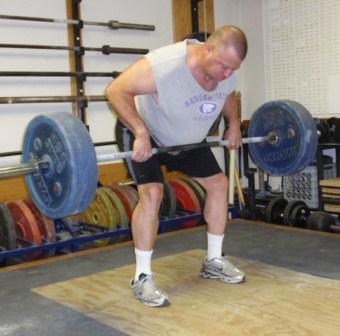
Al Myers training the Bent Over Row.

Another new lift that was approved at the 2010 National Meeting by the membership was the Bent Over Row.  This lift was proposed by John McKean of the Ambridge VFW Barbell Club.  The Bent Over Row  is an ole’ fashioned training exercise that has been part of training programs for years – but NOW is an official USAWA lift so it can now be done in competition and contested for records.  I was glad to see John propose rules for it that are consistent with how the lift is usually done in training.  The Bent Over Row is a tremendous upper back exercise.  John had this to say about the Bent Over Row when he proposed it as a lift to the USAWA, “This lift uses a combination of legs, hips and back.  It is a true all-round movement! This is an absolutely GREAT exercise certainly deserving its due as a very heavy weight, total body, competition lift.”

We do not have a lift even similar to the Bent Over Row in our extensive list of Official Lifts. I like to see lifts like this get approved – lifts which are basic movements and not just some “trick lift”, “gimmick lift”,  or a lift with a slight deviation of another official  lift (which isn’t really anything new).

The Rules for the Bent Over Row

The lift will start at the lifter’s discretion with the bar placed on the platform in front of the lifter. The lifter will grip the bar with an overhand grip with the palms of the hands facing the lifter. The width of grip spacing and feet placement is of the lifter’s choosing, but the feet must be in line with the bar. The body must be in a bent over position at the waist. The upper body must not straighten past 45 degrees parallel to the platform at any time during the lift or it is a disqualification. The legs may be bent during the lift and upon the completion of the lift. The bar is lifted to touch the abdomen or torso by bending the arms. The bar must touch the abdomen higher than the belt, or the navel if a belt is not worn. It is a disqualification if the belt supports the bar at the abdomen upon the finish of the lift. The lift ends by an official’s command when the bar is held motionless at the abdomen or chest.

I will definitely be doing the Bent Over Row at the Ledaig Record Day this weekend, and hope to be the FIRST one to set an official USAWA Record with it.  The Bent Over Row will be included in the updated USAWA Rulebook which will be available the first of August.

New Lifts – The Chin Up and Pull Up

by Al Myers

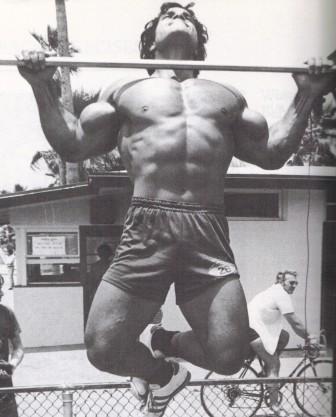
Pull Ups have always been a popular training exercise, as illustrated by this picture of Franco Columbo in Arnold's book Encyclopedia of Modern Bodybuilding.

Last spring, Dave Glasgow asked me why the Chin Up and Pull Up were not All-Round Lifts.  I didn’t have an answer for him.  It would seem logical that two of the oldest exercises known to man should be included amongst our All-Round  lifts.  We have over 200 lifts and I can’t  imagine why these two had been left out.  Early day All-Rounders often performed exercises involving body weight movements, and the Chin Up and Pull Up  were usually part of their training program.  So I told Dave to propose them for new lift approval, write the rules for them and hopefully, the membership would vote to accept them. I was glad to see this happen at the National Meeting, as they were accepted. These two common exercises can now be listed in the USAWA Rulebook and Record List alongside other more obscure lifts like the Zeigler Clean and the Scott Lift.  Now records can be established officially in the Chin Up and Pull Up. Bill Clark once told me that one of the purposes of the USAWA is to provide an official competition for a lifter to perform a lift in which he/she specializes in that is not available in other organizations.  Well, I can tell you this  – the Chin Up and Pull Up have been contested from the playgrounds to the prisons for decades.  It is about time an organization wants to oversee them as “official lifts”.

Practically ever gym has a Chin Up bar, and most lifters have trained these two lifts at least at some point in their life.  Dave had these words to say about these two lifts in drumming up support for their approval, “The Pull Up/Chin Up has long been a staple of the strength community and is a valid test of upper body strength.  The basic Pull Up is an exercise that involves multiple muscles of the upper back and arms to work in coordination with one another in order for the exercise to be executed.”

The Rules for the Pull Up

The crossbar used shall be a straight bar with a diameter between 1 inches and 2 inches. The width of hand placement on the crossbar shall be at the discretion of the lifter. The lifter may use any platform necessary to reach the crossbar. The bar is to be grasped with the palms facing away from the body. The weight shall be affixed to the lifter by way of hanging the weight on a belt attached to the waist of the lifter. The lift will begin on command from an official when the lifter is hanging at arms’ length from the crossbar, motionless, and with feet completely off the floor or any support. The lifter must then pull the body to the crossbar to a position where the point of the chin is above the crossbar. Once motionless, the lifter will receive a command that ends the lift. No “kipping” (the motion of excessive kicking of the legs to obtain a mechanical advantage) is allowed. The weight of the lifter is NOT to be included in the total weight lifted.

The Rules for the Chin Up

The rules of the Pull Up apply, with the exception that the palms of the hands must be facing toward the body of lifter.

Both of these lifts will be added to the 4th Edition of  the USAWA Rulebook, which will be available August 1st.

Chin Up Trivia: John Davis, at a body weight of 177 pounds, did a Chin Up with 171 pounds of extra weight attached to him in 1938!

The Cheat Curl: Part 1

by Thom Van Vleck

The first part of this article will deal with the Rules of the Cheat Curl and some technique advice. Later, I will do a “part 2” on how to use this exercise effectively for training. I am profiling this lift as it is part of the JWC Straight Weight Challenge.

The USAWA Rule book says:

D6. Curl – Cheat

The bar begins on the platform, and at the lifter’s discretion, is picked up with a grip that has the palms of the hands facing up or away from the lifter. Feet placement and hand spacing is optional, but must remain the same throughout the lift. Heels and toes must not rise during the lift. Once the lifter is upright in a standing position with the arms and legs straight, the bar on the thighs hanging at arms’ length, an official will give a command to curl. The knees must remain locked and the legs straight during the lift. The lifter is permitted to bend at the waist, sway the body, or drop the shoulders to gain momentum of the bar. The bar may be lowered prior to the beginning of the curl. The bar must be curled from arms’ length to touching the upper chest or neck in one motion. Any downward movement of the bar during the curl is a disqualification. Once the bar is motionless, and the lifter is upright, an official will give a command to lower the bar. The lift ends when the bar returns to the platform under control by the lifter.

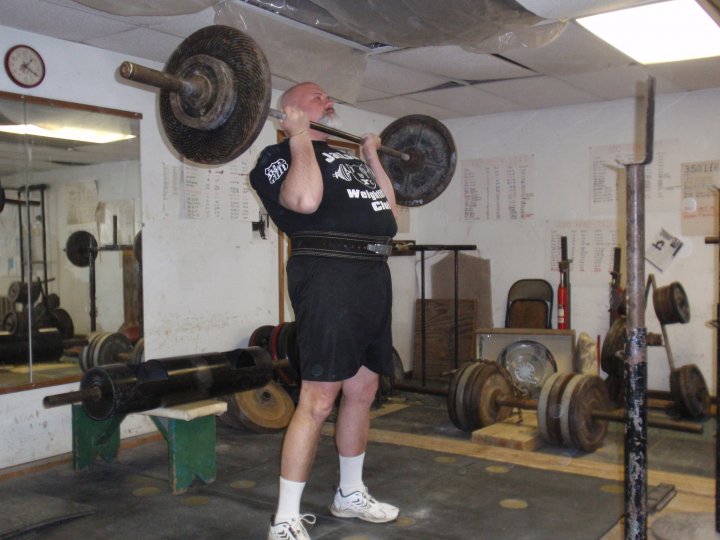
Thom hitting a 195# Cheat Curl in a meet at Clark's Championship Gym.

I have seen this lift done in a couple of different ways. The first way, which is the way I prefer, is to lift the bar to the start of the curl position. I then bend forward at the waist KEEPING the bar at the SAME spot on my thighs and then drive my hips forward while lifting the shoulders and pulling back. An example can be seen on the video list on this website. I have always been a “hip” puller and this technique favors me. However, Al Myers does a different style that may better suit others. Al will bend at the waist and drop the bar BELOW THE KNEES and then attempt to pull straight up. He keeps the bar tight to the body, much like he was doing a reverse grip clean from the floor. Al told me that one of the reasons he favors this style is the fact that he’s torn both biceps and wants to minimize the stress on them as much as possible.

Experiment around with both styles and try to find which one suits you best. I have never been satisfied doing something the same way, I’m always trying to tinker with my technique for greater gains and lifts. Next time I’ll talk about using the Cheat Curl to help your overhand pulling.

1 3 4 5 6 7 9