Category Archives: USAWA Lifts

World Wide Row

John McKean
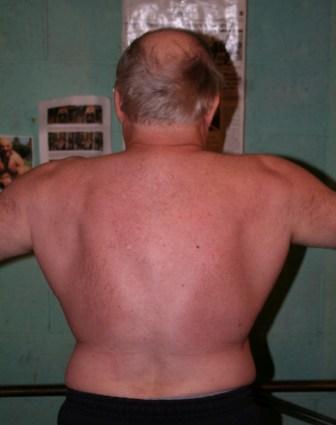
Recent work on the bent over row shows good effects on the 65-year-old upper back of that chubby little rascal in front who we know as John McKean!

John Grimek, our FIRST USAWA Hall-of-Famer (I was there when Howard Prechtel nominated him!) once wrote that the bent over row is a lift where huge poundages are possible, because the movement employs the arms, shoulders, lats, lower back, hips, and thighs. Big John also stated that the row is the absolute best heavy exercise for building the biceps, as well as the upper back. I once met a young super-heavyweight at a power meet who took Grimek’s advice seriously – the lad ONLY trained the heaving row for biceps, and a few bench presses for the triceps. Without exaggeration, his well formed upper arms had to have measured 23 inches!!

Famed writer/lifter Terry Todd did a photo filled article of his deadlift training for winning one of the first National powerlifting contests – yep, the huge poundage-heaving ROW was given prominent mention as his major assistance exercise. Terry was rowing with over 450, as I recall; those pictures left a lasting impression on my young mind! Even today the row is king in building other ALL-ROUND lifts!

We in the USAWA have instituted the bent over row as an official lift during the past season. First to “test” it was Al Myers’ crew, who raved about the dynamic feeling to pull big weight and the genuine enthusiasm for officially performing this grand old exercise! As Al mentioned, it is a natural, basic exercise that we ALL started our weight training with, and requires a unique direction of pull that no other lift fulfills! Later, big Ernie Beath (who really was the one instrumental in pushing for the inception of this barbell keystone as official) and I rowed for records at Art’s Birthday Bash (I think one END of Ernie’s bar was more than I managed!!). At this point in time, world-wide, the IAWA has adopted a “wait-and-see” attitude, but I think our more carefully conceived, clearer version of the rules should tell how simple and direct the bent over row is as a lift.

USAWA Rule for the Bent Over Row

The lift will start at the lifter’s discretion with the bar placed on the platform in front of the lifter. The lifter will grip the bar with an overhand grip with the palms of the hands facing the lifter. The width of grip spacing and feet placement is of the lifter’s choosing, but the feet must be in line with the bar. The body must be in a bent over position at the waist. The upper body must not straighten past 45 degrees parallel to the platform at any time during the lift or it is a disqualification. The legs may be bent during the lift and upon the completion of the lift. The bar is lifted to touch the abdomen or torso by bending the arms. The bar must touch the abdomen higher than the belt, or the navel if a belt is not worn. It is a disqualification if the belt supports the bar at the abdomen upon the finish of the lift. The lift ends by an official’s command when the bar is held motionless at the abdomen or chest.

Not only can our All-rounders benefit by direct effort applied to rows, but many who would come to us for weight training programs will make huge strides in OVERALL strength by utilizing the row as a LIFT.  As such, of course, we can draw these athletes into our fold to display prideful gains on a weightlifting platform!!  But these big bent over pulls can certainly serve wrestlers, martial artists, track and field athletes, football players, etc. I, for one, would love to see some of these new guys at our record day meets! Of course, it won’t hurt our image, either, to start associating IAWA lifters with that huge, old time “V” taper derived from concentrated, high-powered rows!
Quiz of the Week

by Al Myers

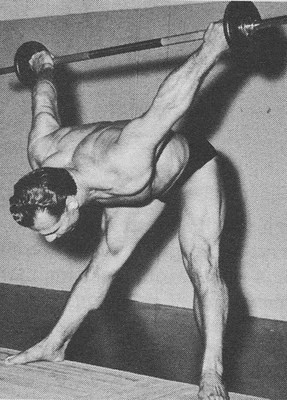
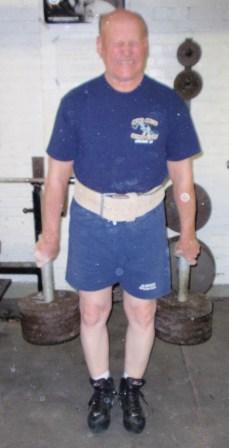
Who is this lifter and which USAWA lift is he performing?

It’s time for another Quiz of the Week!!  This one is going to be a little harder than previous ones, and it requires TWO ANSWERS.

Who is this lifter and which USAWA lift is he performing?

You must provide the answers to BOTH questions!  The rules are the same as before – only 1 answer per day, and the person with the first correct answer wins. Answer must be sent to my amyers@usawa.com email address.

Winner will receive a USAWA Patch

We have a WINNER!

Thom Van Vleck correctly identified this lifter as USAWA Hall of Famer, and the man of 1000 lifts –  John Grimek.  He is performing the Kelly Snatch (also known as the Reverse Swing)

The “Vert Bar” Deadlift

by Thom Van Vleck

Rudy Bletscher performing the 2 Bar Vertical Bar Deadlift at the Club Challenge last March.

Recently, I was talking to my Uncle Phil Jackson, the second generation leader of the Jackson Weightlifting Club and I told him about the “Straight Weight Challenge”.  Phil has been my coach and training guru since day one.  He once told me that it was no use to think I could ever know more than him about training because he had learned it all and he had “forgotten more than I would ever  know”.  I said there were 5 lifts involved and named them off.  When I got to the Vertical Bar Deadlift he paused and in his usual “old school coach” fashion said, “Well! I guess I’m gonna have to ask….what the he!! is a Vertical BAR!”.

Here’s the USAWA Rule book on the Vertical Bar Deadlift, more specifically, the 2 bar lift which is what we’ll be doing in the Straight Weight Challenge:

H24. Vertical Bar Deadlift – 2 Bars, 1”

The setup for this lift requires two Vertical Bars, which is a bar of one inch diameter with a maximum length of 18 inches. A collar or plate must be tightly fastened or welded to the bottom so plates may be added to the bars. No knurling is allowed on the bars. The lifter must start with the bars on each side of the lifter. Width of feet placement is optional, but the feet must be parallel and in line with the torso. Feet must not move during the lift, but the heels and toes may rise. Each bar may be gripped by any grip near the top of the Vertical Bars. The forearms are not allowed to touch the bars. The lifting hands or weight may accidentally touch the lifter’s body or legs during the lift, provided that it does not aid in the lift. The lift begins at the lifter’s discretion. The body must then straighten, lifting the Vertical Bars from the platform. The legs must be straight and knees locked and the body upright at the completion of the lift. Any rotation of the bars must be completely stopped. Once the weight is motionless, an official will give a command to end the lift.

Phil then asked me why I added the Vert Bar Deadlift to the contest.  I’m pretty sure he was asking because he has always been pretty critical of my grip strength (and my use of straps from time to time) and thinking, “If he isn’t good at it, why is he adding it”.  Well, to me, a good USAWA meet has to have at least one lift that tests grip in some way and, to be honest, the vert bar is one of my better gripping events.  It helps that my other two team members that have phenomenal grip!

I know that the Dino Gym has answered the challenge for the Straight Weight Challenge, I hope another club will step up!  After seeing the picture of Tully hitting that very impressive 330 Push Press….this will be a close contest!

The Push Press – From Rack

by Al Myers

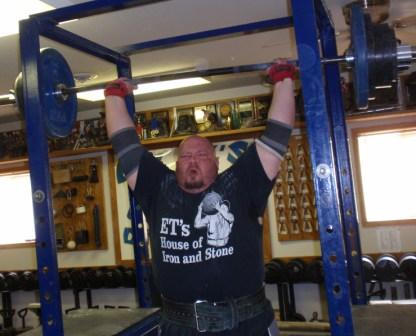
Scott Tully, of the Dino Gym, training the Push Press from Rack with 330 pounds in preparation for the Straight Weight Postal Challenge.

One of the lifts that will be “tested” at the Straight Weight Postal Challenge hosted this month by Thom Van Vleck is the Push Press from a Rack.  I want to “highlight” some of the rules for this lift.  The USAWA Rule book defines the rules for this lift as:

The rules of the Press – From Rack apply with these exceptions. The heels and toes may rise during the press. However, the feet must not move. The legs may bend during the press to initiate upward movement, but the legs must straighten simultaneously with the completion of the press.

The USAWA rules for the Press from the rack are as follows:

The lifter may take the bar from a rack, stands, or supports. The bar must be positioned on the chest as defined by the rules of the Clean prior to the start of the lift. The lifter must step back from the rack at least 2 steps. Once the bar and lifter are motionless, an official will give a command to press. The press is done according to the rules of the Press as defined in the rules of the Clean and Press. An official will give a command to lower the bar. Upon completion, spotters may assist the lifter in returning the bar to the rack.

As you can see, the rules are pretty straight forward for this lift.  One rule that I want to point out is “the legs must straighten simultaneously with the completion of the press”.   You can not  “catch” the weight overhead with your arms straight and  legs bent. That is not allowed.  This is a Push Press – not a Push Jerk.  Also, unlike a strict press, the heels are allowed to rise when doing a Push Press.  This DOES NOT mean the feet can move from their original position!  The bar MUST be held overhead until a down command is given by an official.

Thom has proposed this postal meet to find the STRONGEST team, not the best formula adjusted team.   There will be NO formulas used (bodyweight adjustments or age adjustments) in determining the best 3 person team.  Just the “total weight” lifted!!  This is the time, and opportunity,  for those supporting this idea to enter a USAWA competition where formulas can not be used as an excuse not to enter all-round weightlifting meets!   Results must be sent to Thom by the end of August to participate.

Definition of a Clean

by Al Myers

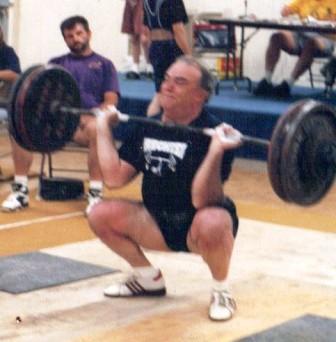
Longtime USAWA veteran Jim Malloy properly demonstrates how to "catch" a Clean.

The Clean is a lift that is not contested by itself in the USAWA as an Official Lift, but is a big part of several other lifts.  Lifts like the Clean and Press, Clean and Seated Press, Clean and Push Press, and the Clean and Press – 2 Dumbbells are very common lifts contested in the USAWA.  We (the USAWA) define a Clean differently than what is commonly referred to as a  “Clean” in gyms all over the country.   The USAWA Rulebook clearly outlines the Rules for the Clean:

The bar will be placed on the platform, in front of the lifter’s feet. The lifter will grip the bar with the palms of the hands facing the lifter, and then in one single and continuous movement lift the bar to the chest. The lifter may choose any width of hand spacing. The lift begins at the lifter’s discretion. The lifter may drop under the bar as it goes to the chest, using a squat-style catch in which the legs are bent, or a split-style catch in which the legs split. The lifter may also choose to drop only slightly, using a power-style catch. The bar may touch the lifter’s thighs and body during the lift. The bar must come to rest on the clavicles or on the chest above the pectoral muscle in a smooth continuous movement with arms bent. The feet may move during the lift. The elbows and the upper arms must not touch the knees or legs during the lift or it will be a disqualification. No other part of the body other than the feet may touch the platform during the lift. The lifter will recover and stand when ready, from the squat or split position, to an upright standing position. The legs must be straight with the feet parallel and in line with the torso. Once in this position with the bar motionless and under control, the clean portion of the lift is finished.

As you can see from this Rule Description  the bar must go from “the floor to the chest” in one motion.  Also,  you can not support the bar on the body during a Clean as that is a violation, as outlined in the General Rules of the Lifts in the USAWA Rulebook. Section IX.3 states, “Neither the body nor the equipment may support a weight in any manner during a lift.” Of course if the Individual Rules of a Lift state exceptions then they over-ride General Rules.  This is the case with this lift, The Continental to Chest, which in some ways is similar to a Clean.  The beginning and end of the Clean and the  Continental to Chest is the same – it is just what happens in between that is different!   This is where the confusion arises.  Continental is even defined in the USAWA Rulebook in the Glossary.  It states, “Continental – This means that the lift may be done in any manner, with minimal restrictions.  The bar may stop, be lowered, be supported by the body, or be lifted unevenly. The hands do not need to stay on the bar and any grip may be used.” In other words – ANYTHING GOES!!

So, a lift from the platform can be called either a Clean or a Continental.  It can not be called BOTH!  And please don’t use the terminology “Continental Clean” to describe a lift  – that is a misnomer due to  being a conflict of description between  both words. The USAWA has adopted the “modern day” rules of the Clean.  Look back in history and you will see the Rules of the Clean were more difficult than what we use now.  The word Clean, was first used because it applied to the bar being taken to the shoulders clean, or clear, of the body.  In other words – no touching of the legs on the way up!!  How many proficient Olympic Lifters do you see keeping the bar “away” from the body?  NONE!! Our Rules of the Clean allow the bar to touch the legs or body without it being a rules infraction.

When the USAWA Rulebook was updated last year, several of the lift names changed to better reflect how the lifts were performed.  In example, the “Two Hands Standing Press” was changed to the “Clean and Press”.  The new updated Rulebook (the 4th Edition which will be released  the first of August) will have some added rule descriptions as it applies to a Dumbbell Clean.  This will be added, “Both dumbbells must be cleaned at the same time and in one motion from the platform to the shoulders. It is an infraction to clean the dumbbells from the hang position”.  THAT is the way it has always SUPPOSED to have been but I wonder how many times, because it wasn’t laid out clearly in the Rulebook, this rule of the clean has been  violated.  I’m willing to bet that several records have been recorded in the USAWA Record List where the dumbbell/or dumbbells were taken to the shoulders using a Hang Clean.  Here is an example that I am sure even some “seasoned officials” have been confused on.  Both are one arm dumbbell lifts in which the dumbbell needs to be taken to the shoulder first in order to perform the lift.  What is the difference in taking the dumbbell to the shoulder between the “Clean and Jerk – Dumbbell, One Arm” and the “Press – Dumbbell, One Arm”?  You should now know this if you have been reading and following what I have described above.  In the first lift the dumbbell needs to be Cleaned correctly, while in the second lift the dumbbell can be taken to the shoulder in any manner, even using BOTH HANDS. Our previous Rulebooks called these two lifts the “One Hand Clean and Jerk with Dumbbell” and the “One Hand Dumbbell Press”.  It would be easy to see how the name “One Hand Dumbbell Press” could imply that ONLY ONE  HAND must be used throughout, which is not the case.

Our Rulebook is far from being perfect.  However, it is far better written now than before.  If we continue to update and correct it every year with issues like this  brought up during the year, it will only get better.

1 2 3 4 5 6 9