Category Archives: USAWA Lifts

Rules for the Anderson Squat

by Thom Van Vleck

The Anderson Squat: Old Time Strongman lift

Let’s take a look at one of the new lifts for the Old Time Strongman Nationals to be held Oct. 16 at the JWC Training Hall in Kirksville, Missouri.  First, let’s review what the “Old Time Strongman” is before we talk about this brand new lift.  Old Time Strongman in the USAWA will included lifts popularized or used by strongmen of years past.  The lifts must be loadable (So the bar can be loaded to any weight so any skill level can make the lift and not just have a heavy apparatus with a set weight).    The idea is that you will have a strongman contest that can be contested by a wide variety of skill levels and ages.

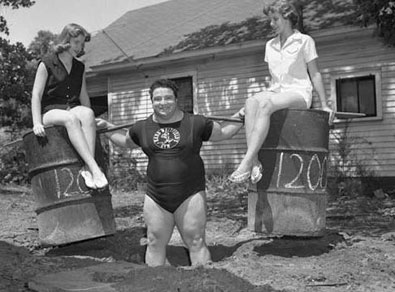
Today’s focus is on the “Anderson Squat”.  Paul Anderson, one of the greatest strongmen of all time, was famous for his leg strength.  Ol’ Paul had a lot of unorthodox training techniques often born out of necessity (in other words, “he didn’t have the proper equipment so he just rigged something up and lifted it!”).  One of the more famous lifts he employed was squatting barrels filled with junk from a hole in the ground.  The story goes Paul loaded it and dug a hole deep enough he could get under it and do a partial squat.  He would then throw some dirt in the hole, slowly filling it up, so that he would have to get a little lower each time to complete the lift.  I found a great photo of Paul doing the lift and evidently that day he was short on iron so a couple of pretty girls volunteered!  Don’t worry, if we run low on weights at the meet, I’ll be happy to climb on top for extra weight!

USAWA Rules for the Anderson Squat

 A squat (with a standard Olympic bar) done from a dead stop from a height not over two thirds the height of the lifter.  Squat is completed when the knees are locked and the lifter is standing erect.  Time limit of 1 minute is given for each attempt meaning the lifter may reset as many times as necessary to complete the lift.  Knee wraps or knee sleeves will be allowed.  An official will give a command to end the lift.

The uniqueness of this event is doing a squat from a dead stop.  It is also the challenge of it!  It will be interesting to see what kind of numbers we can put up in this event….and I don’t think Paul will have anything to worry about in regards to anyone coming close to breaking his records in this style of lifting.

Rules for the Anderson Press

by Thom Van Vleck

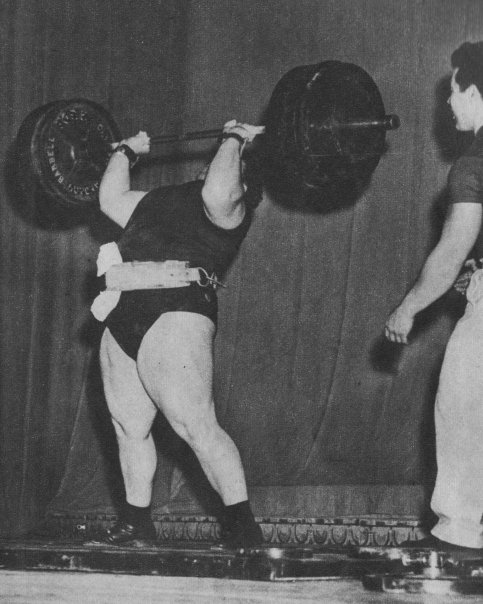
Paul Anderson with a 450lb Continental Clean & Press. This photo approximates the starting point of the "Anderson Press" event at the Old Time Strongman Nationals.

The first ever USAWA Old Time Strongman National Championship will be held at the JWC Training Hall on October 16, 2011.  One of the new lifts to be contested will be the “Anderson Press”.  Big Paul Anderson, arguably the strongest man that ever lived, used to do some pretty unique training lifts and often rigged things up to work on what he felt were his weaknesses. One lift he came up with was to hang a barbell from a tree with a chain and do partial lockout presses.  This lift was the inspiration for the lift to be contested in October!

USAWA Rules for the Anderson Press

Press (with a standard Olympic bar) will be done from a dead stop position in the power rack from a height no greater than the height of the lifter when standing erect.  Lifter may “bow” back to press the weight but must keep knees locked.  The lift ends when the lifter is upright, arms locked, and demonstrates control of the weight. The lifter may press in an uneven manner and unlock unevenly. It is not a disqualification if the bar is lowered during the press, and afterwards the press resumes. The feet are not allowed to move. However, the lifter may raise the heels or toes during the press.  Time limit of 1 minute is given for each attempt meaning the lifter may reset as many times as necessary to complete the lift.  An official will give a command to end the lift.

You will notice the rules are a lot more relaxed compared to other USAWA lifts.  The idea is that the lifter will be able to handle big weights and it will be pretty evident to any spectators if they get the lift or not.  I know that when I’ve attended meets I have spent a lot of time explaining to spectators that are not familiar with lifting why a completed lift did not count.  While this could still happen, it’s a lot less likely and I think that’s part of the appeal of the the “Old Time Strongman” concept.  It’s more spectator friendly and forgiving to the lifter!   As a result, this type of meet may attract a whole new type of strength athlete to the USAWA that will then try the traditional meets as well.  At least that’s my opinion.  Hope you can make it in October!

Continental Clean and Jerk

by Al Myers

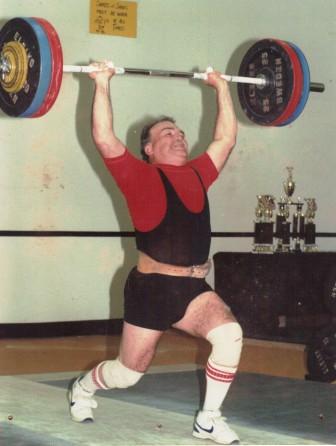
USAWA Hall of Famer Jim Malloy performing a Continental to Chest and Jerk. Or is he doing a Continental Clean and Jerk?

One of the lifts that is going to be contested next November at the 2011  IAWA World Championships in Perth, Australia is the Continental Clean and Jerk.  Or is it the Continental to Chest and Jerk, as described in the USAWA Rulebook??    At first glance, one would think these are the same lift, just with different names.  I know I did.  But in comparing the IAWA(UK)  rules for the Continental Clean and Jerk and the USAWA rules for the Continental to Chest and Jerk I found SEVERAL DIFFERENCES.  The Continental Clean and Jerk is NOT an USAWA Lift and the Continental to Chest and Jerk is NOT an IAWA lift.  I know – that’s confusing!!

The USAWA Rule for the Continental to Chest and Jerk:

A23. Continental to Chest

The lifter starts with the bar on the platform in front of the lifter and raises it by any method of the lifter’s choosing onto the lifter’s chest above the pectoral muscle. The bar may be raised in one or a series of movements and may come to rest, be lowered, or make contact with any part of the legs and body during the lift. However, the bar must not be upended into any position on the body. Hand spacing and grip are of the lifter’s choosing and may be altered on the bar during the lift. The hands may be removed from the bar during the lift. The bar may come to rest on the lifter’s belt. A towel may be placed in the belt for the bar to rest on. Touching the platform with a knee or the buttocks is permissible. It is a disqualification for the bar or plates to touch the platform before the finish of the lift. Once the lifter’s legs are straightened, the lifter’s body erect, the feet parallel and in line with the torso, the bar motionless, an official will give a command to lower the bar. The lift ends when the bar is placed on the platform under control by the lifter.

A24. Continental to Chest and Jerk

The rules of the Continental to Chest apply for the first part of this lift. Once the bar is in the proper position on the chest, a jerk or behind the neck jerk is performed. The rules of the Jerk or Jerk-Behind Neck apply.

The IAWA(UK)  Rule for the Continental Clean and Jerk:

B28.  CONTINENTAL CLEAN

The bar will be lifted from the floor, coming to rest in the finish position for the clean. The difference between the continental and the regular clean is the fact that it can be raised by any method of the lifters choice, other than upending the bar into position. The bar may be raised in one or a series of movements, it may come to rest, be re-lowered, and make contact with any part of the legs or body during the lift. Touching the lifting surface with any part of the knees or buttocks is permissible. The grip is optional and may be altered during the lift. The signal to replace the bar will be given when the lifter is motionless in the finished clean position, the bar gripped with both hands, body erect, legs braced and feet parallel and in line with the torso. A supportive belt with a folded towel or similar material placed inside it and at the front, may be used to assist the lifter, who may choose to clean the bar from the belt.

Causes for Failure:

1 Allowing the bar to make contact with the lifting surface during the lift.

2 Failure to maintain the finish position, bar on upper chest, legs braced and feet parallel and in line with the torso.

3 Lowering or replacing the bar before the referees signal.

B30.   CONTINENTAL CLEAN AND JERK

The rules of performance for the continental clean apply to the clean part of the lift, and the rules of performance for the jerk apply to the jerk part of the lift, except that the jerk can be done from a position in front or behind the neck, it is the lifters choice. There is no limit to the number of attempts made to clean or jerk the bar, once it is lifted from the floor. The lift may also finish with a press out.

Causes for Failure:

1 The causes for failure are the same as for the continental clean, and the jerk, except that it is the lifters choice to jerk from a front or behind the neck position.

After reading these two rule descriptions it is pretty easy to see the differences.  The USAWA only applies the use of “continental” to getting the bar to the chest, whereas the IAWA rule allows even the Jerk to be “continentaled”.   Taking  multiple attempts at the Jerk and allowing a press out (which is a direct rules violation of a Jerk,  but then again the use of the term continental to describe a clean is also a direct violation of the definition of  a clean) definitely makes the IAWA version of this lift  a much easier method than the USAWA version.  I might add that the IAWA version definitely will make the judging easier on interpreting the lockout!!!

I’m not interested in debating which is the “correct” rule for this lift.  But I will say that these are two distinct different lifts.  I just want everyone from the USAWA who plans to compete in next years IAWA Championships to be aware of this before they get there.  It seems every year at the World Championships I am presented with a different IAWA  rule for a lift that I was not aware of beforehand, because we (the USAWA) have slightly different rules on several lifts.  This frustrates me because  I consider myself  “in the know” on the rulebook.   Why do these differences persist?  After all, all the rules for the lifts started with ONE WRITTEN RULE in the original rulebook from 1987.  The IAWA(UK) developed their rulebook from these rules and the USAWA developed our rulebook from these original rules.  As of now, there IS NOT a specific IAWA Rulebook, rather we use the IAWA(UK) Rulebook for the IAWA Rules.  Unlike us (the USAWA), the IAWA(UK) have only made changes (besides editing and clarifications) based on membership votes at the IAWA Annual General Meetings, which contains representation of all countries involved in IAWA.  We have made changes in the USAWA Rulebook based on membership votes at the USAWA Annual Meetings.  The IAWA(UK) have maintained their rulebook this way so ONLY IAWA rules and lifts will be in play in the UK.  This is the reason we have lifts in the USAWA that the English do not, as we have approved them at USAWA meetings and these same lifts were turned down (or not presented) at IAWA meetings by membership vote.  The IAWA(UK) only accepts new lifts and rule changes into their rulebook that are accepted at the world meetings.

I won’t go into my opinion on these matters, but I hope in the future we will work better together in at least having consistent rules in the individual lifts.  I know it will take time to identify and resolve all issues, but at least I feel we are taking steps in the right direction.
The Dumbbell Walk

by Al Myers

Darren Barnhart, of the Dino Gym, performing the Dumbbell Walk last Saturday at the Dino Gym.

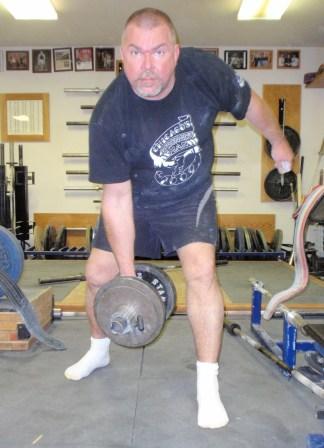
Often in the Dino Gym when the workouts are over, different odd training toys get pulled out for impromptu challenges.  This happened the other day in the gym with an official USAWA lift, the Dumbbell Walk.  The Dumbbell Walk is one of the most unique and strange lifts in the USAWA Rulebook.  Years ago when I first read the rules on it, I thought “now there’s an odd one”.  This lift is surrounded with mystery.  How did it come about?  I took a little time and looked through all my collection of back Strength Journals, books, and other mostly irrelevant strength information.  I could not find one single bit of research on it!  Who came up with it?   It was one of the original lifts in the USAWA, meaning it was part of the group of lifts that got “adopted” with the first rules were adopted.  It is an official IAWA lift as well as is included in the IAWA(UK) Rulebook.

The rules for the Dumbbell Walk are as follows from the USAWA Rulebook:

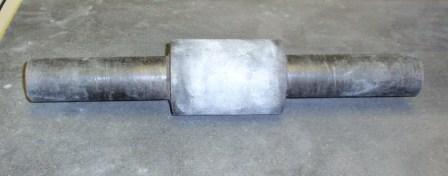
A distance of 10 feet will be marked out on a surface before the walk. The dumbbell and lifter must be behind the line at the start. The handle of the dumbbell must be 3 ½ inches in diameter. The lifter must hold the dumbbell with one hand only. The lift begins at the lifter’s discretion. It is recommended to straddle the dumbbell during the walk, however, the lifter may carry it to the side. Once the lifter lifts the dumbbell and begins the walk, the dumbbell must not touch the walking surface before the finish line or it will be a disqualification. The dumbbell may be lifted to any height during the walk, but it must always be hanging at arm’s length downwards. The lifter must put the dumbbell down under control completely past the finish line for the walk to be complete. The non-lifting hand must not touch the dumbbell or lifting hand and arm during the walk. The non-lifting hand may be placed on other parts of the body. It is acceptable for the dumbbell to accidentally touch the legs or body during the walk, provided it does not aid in the walk.

This is the 3.5" dumbbell handle that must be used for the Dumbbell Walk.

This is one of only two USAWA lifts where a distance must be covered in the execution of the lift (can you name the other?).   It has been contested only once in USAWA competition – at the 2010 Dino Gym Record Day.  Only myself and training partner Darren Barnhart have a USAWA Record in the Dumbbell Walk.  At this record day a Challenge ensued between us and Darren edged me out, 100 pounds to 95 pounds.  I’m pretty sure the reason the Dumbbell Walk has not been contested more often in competition is due to the special dumbbell required, with the 3.5″ diameter.

This is an outstanding grip exercise.  I think I might even put it in next year’s Grip Challenge at the Dino Gym.  It is also one of those grip exercises where when you add just a little bit more, say only 5 pounds, and the exercise goes from easy to impossible!

This is a YouTube Video of Darren performing the Dumbbell Walk with 100 pounds at the 2010 Dino Gym Record Day.

One Hand Snatch

by Arthur Saxon

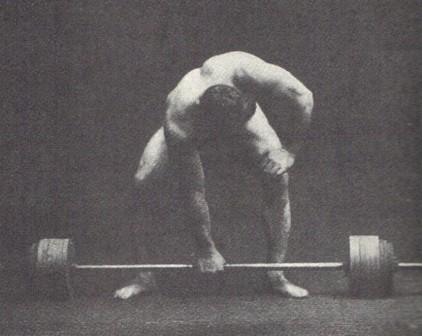
Position 1 - One Hand Snatch

Place yourself in position 1 (see illustration), and as you pull strongly with the right hand and shoulder, press as hard as you can with the left hand on the left knee.  Then when the weight has reached a fair height, dip beneath same, the eyes to be all the time on the weight.  The secret of this lift is to use as many muscles as possible at the same time, that is, you press with your legs, pull with your arm, and push with the disengaged one, also pull with the shoulder and jerk with the back, suddenly, when the weight is over your head, dipping beneath same, and throwing it a little to the back.  There are two positions possible in snatching the weight, either of which are good, and both of which I will describe.

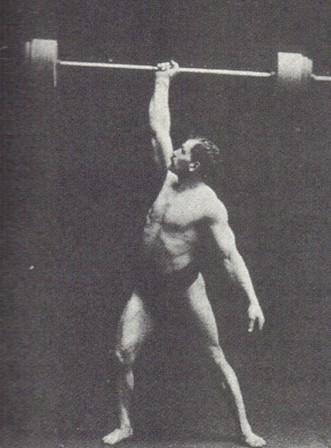
Position 2 - One Hand Snatch

One is to keep the body perpendicular and dip cleanly beneath the weight, the other is to suddenly fall to one side as in the bent press, when the bar is about the height of your head, and so place a straight arm beneath the weight, after which you recover to an erect position.  The benefit and advantage in this latter position being, given a a man who is enormously strong and a good side presser, if his arm should not go in the first attempt quite straight, then he may finish up the last inch or two by the body press, that is if no objection be made by referee or opponents in competition.  A variation of this is to snatch the bell overhead with two hands instead on one, the hands being held the same distance apart as in the double-handed barbell lift.  Those anxious to practice the single-handed lift all the way, as in the English Amateur Championship Competition, will find my instructions as to the snatch are, in reversed, directly applicable to the initial pull-in to the shoulder.  All that you have to do is place your hand on the bar with the palm to the front instead of to the back, then pull the bell up to the chest, stepping back with the left leg if pulling in with the right hand, and exerting as many muscles as possible as described.

NOTE:  – In all these positions where the weight is lifted to the shoulder from off the ground, the arm must NOT be bent at the first portion of the pull.

CREDIT:  The Development of Physical Power by Arthur Saxon

1 2 3 4 9