Category Archives: USAWA Daily News

Abe Smith-Newest Level 1 certified official

By Eric Todd

Abe Smith completing the clean and press-heels at Nationals in Al's Dino Gym

I have been notified by our Officials Director, Joe Garcia, that Abe Smith, former Official in training, has completed the 3 practical training sessions needed to qualify him to be a level one certified official.  This is under the designation of “Test Qualified.”  So, Abe has passed his test, and has completed his practical training sessions.  He now just needs to document having officiated in at least 25 contests to become a level 2 certified official, which is a lifetime certification.  Abe becomes our 9th current level 1 official, and our 27th certified official.  Congrats Abe, and thank you for taking the leap to serve your organization.

Newcomer of the Year-Runner Up

By Eric Todd

Newcomer of the year-runner-up-Everett Todd

Newcomer of the year-runner-up-Everett Todd

The designation for newcomer of the year reads as such “This award goes to an individual who in new to the USAWA or has become involved again. It doesn’t have to go to someone in their first year of being involved in the USAWA.”

My son, Everett is in his first year of competing.  He has competed at all of the postal meets since he has been involved, the “Lift for Leroy” record day, and the Old Time Strongman Championship.  It was most likely his participation rate as well as his performance in the Old Time Strongman meet that got him the votes needed for his runner-up status.  He placed third in that meet, outperforming 2 former champions including his old pop.  Well deserved, and a huge congrats to Everett Todd!

Bench Press rule

By Eric Todd

I would assume that by now most of our readers have read Dan Wagman’s article about the absurdity of the wording change for the bench press rule.  While I do take exception with the use of the word absurd, as it seems condescending to those individuals whose only purpose at that time was to do right by the rule, Dan is on to something.   The new wording maintaining that the hamstrings must stay in contact with the bench makes the lift undoable for some, which was no one’s intention.  As soon as I read the article, I headed to the basement to see if I could complete the lift as it was written, and alas, I could not even come close.

So, how do we go about making this right?  We did not want to go a full year with a faulty rule in our rulebook.  According to Dan, if we do not amend this “one of two things will happen: 1) meet refs will see that adhering to this rule is impossible for many lifters and will ignore it; 2) lifters like me will simply not perform the bench press and its variations.”  Neither of those results is desirable.  In looking at our bylaws, Article 6a reads as follows: “The Annual Meeting of the USAWA will be held in conjunction with the National Championships, unless the executive board, by majority vote, decides otherwise.”  So, this executive board decided by unanimous vote to reconvene the national meeting virtually with all of the voting members who were present at the meeting in June.  These members voted unanimously to correct the wording of this rule.

The corrected rule will read as follows:

The lifter will take a position on the bench with both upper back and buttocks in contact with the bench. The lifter will grip the bar with the palms of both hands facing away from the lifter’s face. The width of the grip must not be more than 32 inches (81 centimeters) between the index fingers. No open grip or thumbless grip is allowed. The bar may be handed to the lifter by a spotter from the support stands, but it must be held motionless momentarily at arm’s length prior to being lowered by the lifter to a motionless position on the chest. The feet must be flat on the floor and not braced against the bench during the lift.   The use of plates, blocks, or any similar device under the lifter’s feet is permitted in an effort to achieve firm footing.  Any width of feet placement is allowed. No heel or toe rising is allowed during the lift. Once the bar is motionless and under control on the chest, the lifter will receive a command from an official to press. The bar must not be any lower than the base of the pectoral muscle when on the chest. The bar will then be pressed to a position in which the arms are fully extended. During the ascent, the bar may be pressed unevenly, but must not be lowered in any manner. However, the final straightening of the arms must be completely simultaneous. During the ascent, the position of the body on the bench must not change. This includes keeping the buttocks and the head in contact with the bench, and not having any change in hand position on the bar. Once the bar is fully pressed and motionless, the lifter will receive a command from an official to end the lift. The lifter may have assistance by spotters in returning the bar to the support stands.

The only change to the original rule is the addition of the underlined sentence. As you can see, the part requiring hamstrings has been omitted.  You can also see that we not only added that plates are allowable, but that anything else used for a similar purpose is allowable.  Hopefully that way we don’t hear from members as to how ludicrous it is that we did not include pallets, shoeboxes, or stacks of old vinyl records into the rule, as not everyone has blocks, or plates enough to lift and place their feet on.  Since that part of the rule is just in an effort to level the playing field for shorter lifters, the spirit of the rule would dictate whatever article available to allow for that would be acceptable, whether it is blocks, plates, or old, rusty frying pans.

I realize that this procedure was rather unorthodox, but within the rules, and merely done as a way to correct a mistake made by your secretary.  I am going to use my inexperience as my excuse here and can only promise to do a better job of having my ducks in a row in the future.

Leadership of the Year Award

By Eric M. Todd, Esq

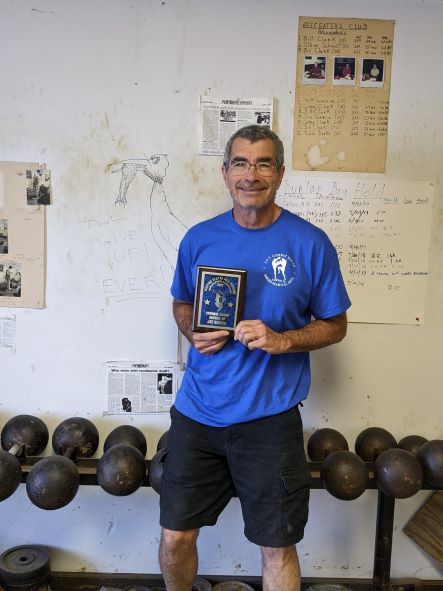
Executive Board member, Beth Skwarecki presents the Leadership of the year award to Denny Habecker.

Executive Board member, Beth Skwarecki presents the Leadership of the year award to Denny Habecker.

According to the section of our website called “Past USAWA Awards,” Each year the USAWA nominates and selects individuals for special awards.  These awards are given on behalf of the USAWA for outstanding merit in several categories.”  One of these categories is the Leadership award.  One of the great things about these awards is that they are voted on by our membership.

This year’s leadership award goes to our president Denny Habecker.  Denny is an absolute stalwart in all-round at the national and international level.  He has served as our president for about 15 years.  Denny has been at every national meet since 1995 as a competitor and/or official, having won the overall national championship twice.  He frequently competes on the international stage as well.  Denny promoted our World championship in 2021.  He hosted the presidential cup, and served as our postal chairman, running all four quarterly postals. I cannot tell you how many times he has driven from Pennsylvania to God’s country to support my meets.  Well deserved, and a huge congrats to our leadership award winner, Denny Habecker!

The runner up in the leadership goes to your humble author, and Secretary/Treasurer.

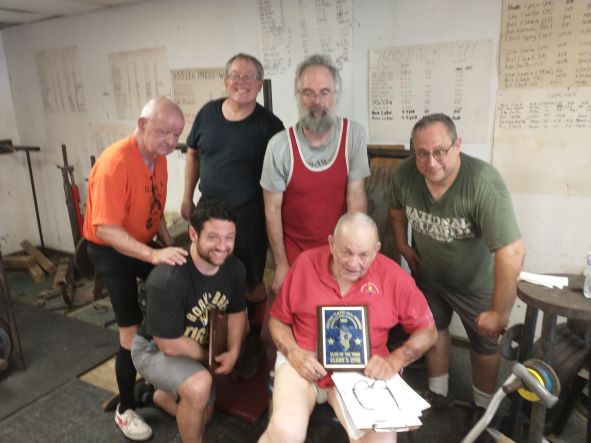
Executive Board member, Beth Skwarecki presents the leadership-runner up award to Eric Todd

Executive Board member, Beth Skwarecki presents the leadership-runner up award to Eric Todd

NEW BENCH PRESS RULE IS ABSURD

By Dan Wagman, Ph.D., C.S.C.S.

IPF World Bench Press Champions and world record setters Dan Gaudreau (l) and Dan Wagman (r) would receive red lights for the new USAWA hamstring violation.

IPF World Bench Press Champions and world record setters Dan Gaudreau (l) and Dan Wagman (r) would receive red lights for the new USAWA hamstring violation.

When I submitted an edit to USAWA’s bench press rule for consideration at the most recent yearly National Meeting, my sole objective was to provide lifters with the legal means to place plates or blocks under their feet if needed. That edit would conform with internationally accepted powerlifting norms as stated in the International Powerlifting Federation (IPF) technical rules. I even submitted the wording that would most easily and directly address this—just one brief sentence. Who could have predicted that such basic wording would end up garbled to the point of rendering the rule edit absurd?
According to the Minutes, some members felt that language should be added “to make clear what the lift should look like” in an effort to avoid “distorting the lift.” As a result, the language added does exactly that—distort the lift. First, it only allows a lifter to use blocks and not plates if that’s all that’s needed. But second, it most ludicrously requires the hamstrings to remain “in contact with the bench.”
That requirement is absurd because for many lifters it’s nearly impossible to have the hamstrings remain in contact with the bench while performing a technically proficient bench press.
To be clear, the internationally accepted standards and USAWA’s original rule only call for the head, shoulders, and buttocks to be in contact with the bench. For USAWA to now require the hamstrings to also remain in contact with the bench represents a fundamental departure of decades old standards. That requirement is absurd because for many lifters it’s nearly impossible to have the hamstrings remain in contact with the bench while performing a technically proficient bench press. First, it must be understood that the hamstrings constitute a group of three different muscles at the back of the thigh. How does a lifter get muscles at the back of the thigh to maintain contact with the bench? Well, the lifter could lay at least a portion of the back of the thighs on top of the bench or perhaps squeeze the outer edges of the bench with some back That requirement is absurd because for many lifters it’s nearly impossible to have the hamstrings remain in contact with the bench while performing a technically proficient bench press. portion of the thighs. Of course if you did the former and your legs are not long enough, foot contact with the ground would be compromised. Use of a wide stance foot placement that provides optimal transfer of forces from the floor to the barbell via a solid anchor and back arch is also out because doing so rotates the back of the thighs off/away from the bench. In addition, if you consider each lifter’s unique thigh-to-leg ratios in combination with the different bench length and width dimensions you can run in to at all-round meets, a nearly infinite number

For lifters with long legs, or a bench with less height, loaders would have to place the bench on blocks…

of different block heights would be required to accommodate this new rule. Also, what if the bench length is such that a tall lifter can only place his/her head or hamstrings on the bench at the same time? Of course, for lifters with long legs, or a bench with less height, loaders would have to place the bench on blocks to accommodate the hamstring-bench-contact requirement. Frankly, “absurd” is an understatement. So, what started out as a very simple edit to the existing bench press rule ended up diverting from international norms and has turned one of the most basic tests of maximal strength into a nightmare for many lifters. How does something like this happen? With the exception of omitting the plates and blocks allowance the original USAWA rule was perfectly aligned with international standards. So perhaps the more important question is: how does the organization correct this atrocity and do so before the next meet that will contest a version of the bench press which could be any Record Day and specifically the Postal Series National Championship at the end of the year? If the organization does not make corrections, one of two things will happen: 1) meet refs will see that adhering to this rule is impossible for many lifters and will ignore it; 2) lifters like me will simply not perform the bench press and its variations. Neither choice enhances USAWA’s credibility as a strength sport.

Turning perfect bench presses into red lights. Different views of the same hamstring violation.

Turning perfect bench presses into red lights. Different views of the same hamstring violation.

1 73 74 75 76 77 493