The Habecker’s host a fantastic
National Championships
by Al Myers
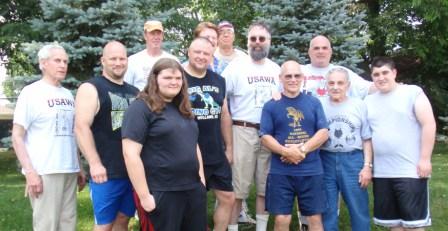
Group picture of lifters in the 2010 USAWA National Championships.
Denny and Judy Habecker were the hosts for this year’s USAWA National Championships, and they went way beyond what is expected from meet directors. Due to the small turnout of lifters entered for this year’s Nationals, they decided to have the meet in their backyard instead of renting a venue site. Denny had a large tent set up in his yard and built a platform on the grass. This provided shade for both the competitors and the spectators. While Denny was attending to the lifting needs of the lifters, Judy made sure that no one was going hungry! The night before the meet Judy provided the lifters with an unbelievable Italian meal of lasagna and pasta, followed with several desserts. She made breakfast for all of us both days, along with having plenty of food after the meet on both days. I just barely made my weight class on Saturday due to all the great food she made! Denny and Judy’s hospitality at this meet went far beyond anything I have ever seen at a competition. I felt like I was at a family reunion. Denny and Judy are without a doubt the “parents” of the USAWA, and this meet is one I will never forget. Everyone had a great time and despite the low turnout of participants, this meet was an invigorating experience and proved that the USAWA is very much alive and flourishing! Someday when our membership is much larger, those of us present this past weekend will look back upon this as the “good ole days” when the USAWA was a family. The meet atmosphere was filled with camaraderie with everyone cheering each other on and helping each other make “a big lift”.
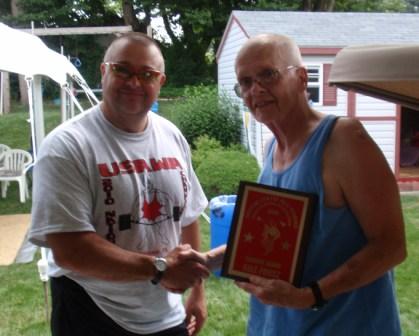
USAWA Awards Director Al Myers presenting the 2009 Courage Award to Dale Friesz.
Now back to the meet itself. The first person I want to talk about is Dale Friesz. I have never met anyone like Dale and his commitment to weightlifting. It would take a book to detail all the things Dale has had to overcome in his life in his quest to continue lifting weights. Recently Dale has been battling infection and circulatory problems with one of his legs, but he STILL lifted in this meet. He is scheduled to have surgery this week in which the leg will be amputated below the knee. I know he had to be in excruciating pain during the meet, and even though he was giving himself IV”s during the day, the heat had to be hard on him (it was in the 90’s and fairly humid). I was so glad to see Dale receive the COURAGE AWARD for this past year, as it should be named after Dale “the Miracle Man” Friesz. Before the meet Dale set a couple of records in the fingers deadlift (both Index and Little), which have always been a favorite of his. I know Dale will be back competing again soon after his surgery, as this is the type of person Dale is. “Mr. Courage” Dale Friesz is an inspiration to everyone who has had to comeback from an injury by showing that NOTHING can stop you from enjoying the IRON. We need to keep Dale in our prayers this week.
The next person I want to mention is Barry Bryan. Barry made his return to the USAWA platform after many years of being away from it. This was the first time I got to really visit with Barry. For those of you who are “new” to the USAWA, Barry was the Overall Best Lifter of the 1990 National Championships. He has records in the record list that are almost unbeatable and have stood for over 20 years. He is an ICON in the USAWA and it was great to see him back in competitive action. Welcome back Barry!
It was great to see Frank Ciavattone again. Frank brought along his son Frankie, who isn’t a newcomer to National Competition. I first met Frankie at the 2005 National Championships, in which he was competing at the age of 11. Now Frankie is 16, and it won’t be long before he starts putting up the big numbers. He seemed to really enjoy himself as he had a smile on his face the entire weekend. He was a big help to me, as he took pictures for me during the second session in which I was competing in. Frank is still coming back from his hip replacement, but still showed he can put up big weights. Frank pulled an easy 353 pounds in the One Arm Deadlift (and appeared he could have lifted much more – and it was obvious he still has the grip to hold onto over 500 pounds). I talked Frank into lifting in the second session in the One Arm Deadlift (which made him wait a long time) so Chad and I could have the honor of lifting with him. I know this wait probably didn’t help his lifting, but Frank’s presence sure helped Chad and me. I ended up with a 375# One Arm Deadlift (my competition best) and Chad had the top One Arm Deadlift of the meet at 408#’s. So even in this small meet, there were three lifters over 350 pounds in the One Arm Deadlift, which hasn’t happened in very many meets in the past. Frank lifting with us shows you the type of person Frank is – always helping others even if it is at his own expense. Despite this, Frank is the most accomplished heavyweight lifter of All-Time in the USAWA, and has won over 20 Championships to back it up.
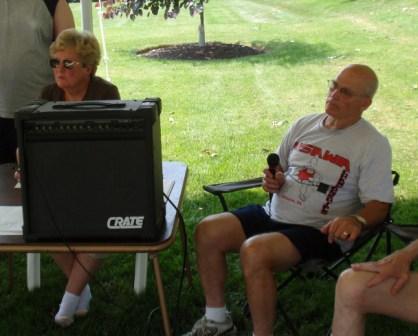
2010 National Championship meet directors Denny and Judy Habecker.
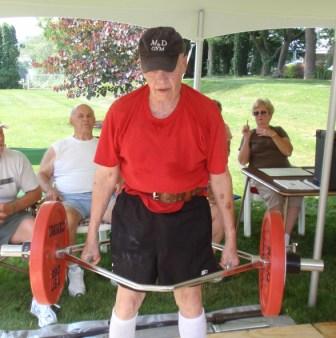
Randy Smith made the trip from his home in Michigan to take fourth overall at this year’s Championships, which moved him up a spot from his overall placing of fifth at last year’s Championships. Randy is a joy to be around, and when he is not entertaining us with a joke, he is inspiring us with an all-out effort on the platform. He even entertained us by performing a “Zercher Walk”! This happened when he missed a Zercher Lift at the top by moving his foot, and in response, locked out the lift and walked to the front of the platform holding the bar in the crooks of his arms!! The Head Judge, Art Montini, had to wonder if Randy was going to deposit the bar in his lap!! Speaking of Art, Art continued to amaze us with his unbelievable lifting at the age of 82. Art did a 242 pound Trap Bar Deadlift – how many 80 plus year old men can do THAT??? I can tell you – NOT MANY! Scott Schmidt came into the meet in great form – and put up the top Clean and Press of the meet at 100 kilograms. Saturday night at the National Meeting, Scott was inducted into the USAWA Hall of Fame. Scott is more than deserving of this prestigious award, and has been for several years. Chad Ullom ended the meet with the TOP Zercher Lift of the meet at 200 kilograms. With this effort, it gave him the BEST LIFTER in the OPEN DIVISION, which he very much deserved. Most of you know that Chad is my training partner, and I can tell you that he has the most positive attitude towards lifting, more so than anyone else I know. He has “pushed” me in training, and made me a better lifter. I also get to travel with him to meets which makes the whole experience much more enjoyable. We have accumulated 1000’s of stories together from our travels (some of which I’ll keep a secret!). The “Young Samson” Kohl Hess continues to improve under the expert coaching of Denny Habecker and SURPRISED everyone with his 518 pound Trap Bar Deadlift and his 353 pound Zercher Lift. Kohl is ONLY 15, and weighing in at 290 pounds, is built like an Offensive Lineman. He is amazingly flexible for his size, which is very important in All-Round Weightlifting. I have seen his rapid improvement since Worlds last October, and with a little more time he will be one of the top lifters in the USAWA. The last person I want to mention is Dennis Mitchell. This weekend marked the 22nd CONSECUTIVE National Championships that Dennis has competed in. That is a record that probably won’t be broke by anyone EVER. At the age of 78, Dennis doesn’t appear to be slowing down. He always performs his lifts with perfection, making his last attempts look like opening attempts.
This year’s Championships was a HUGE success. I want to mention the three men who lifted the most weight over the weekend – the loaders. A big THANK YOU goes to these guys – Terry Barlet, Don Brandt, and John Horn. Again, THANKS to Denny and Judy for welcoming the USAWA into their home and treating all of us to a time we will never forget.
FULL MEET RESULTS
2010 USAWA National Championships
Lebanon, Pennsylvania
June 26 & 27, 2010
Meet Director: Denny Habecker
Lifts on day 1: Vertical Bar Deadlift – 1 bar, 2″, one hand, Pullover and Push, Clean and Jerk -One Arm, Trap Bar Deadlift
Lifts on day 2: Snatch – From Hang, Deadlift – One Arm, Clean and Press, Zercher Lift
Officials (3 official system used): Chad Ullom, Scott Schmidt, Barry Bryan, Randy Smith, Dennis Mitchell, Art Montini, Frank Ciavattone
Scorekeeper: Judy Habecker
Loaders: Terry Barlet, Don Brandt, John Horn
Announcers: Denny Habecker, Judy Habecker, and Aidan Habecker
Day 1 Results:
| Lifter |
Age |
BWT |
VB-IArm |
P&P |
C&J-1arm |
Trap DL |
| Al Myers |
43 |
114.7 |
70-L |
170 |
67.5-R |
295 |
| Chad Ullom |
38 |
108.4 |
80-R |
145 |
55-R |
235 |
| Denny Habecker |
67 |
83.5 |
60-R |
110 |
35-R |
155 |
| Randy Smith |
55 |
89.1 |
80-R |
92.5 |
40-R |
165 |
| Scott Schmidt |
57 |
119.7 |
90-R |
102.5 |
45-R |
202.5 |
| Art Montini |
82 |
80.7 |
41.25-R |
65 |
20-L |
110 |
| Kohl Hess |
15 |
131.5 |
80-R |
107.5 |
47.5-R |
235 |
| Dennis Mitchell |
78 |
70.7 |
41.25-L |
37.5 |
17.5-R |
100 |
| Dale Friesz |
69 |
76.6 |
40-R |
45 |
10-R |
100 |
| Barry Bryan |
52 |
88.0 |
57.5-R |
90 |
35-R |
105 |
| Frank Ciavattone Jr. |
55 |
129.2 |
90-R |
—— |
—— |
202 |
| Frank Ciavattone III |
16 |
107.4 |
57.5-R |
50 |
20-R |
105 |
Day 2 Results:
| Lifter |
BWT Cls. |
Snatch |
DL-1arm |
C&P |
Zercher |
Total |
Points |
| Al Myers |
120 |
87.5 |
170-R |
90 |
195 |
1145 |
939.53 |
| Chad Ullom |
110 |
87.5 |
185-R |
90 |
200 |
1077.5 |
874.93 |
| Denny Habecker |
85 |
50 |
115-R |
70 |
110 |
705 |
858.84 |
| Randy Smith |
90 |
60 |
110-R |
62.5 |
150 |
760 |
795.81 |
| Scott Schmidt |
120 |
70 |
115-R |
100 |
107.5 |
832.5 |
758.66 |
| Art Montini |
85 |
30 |
90-L |
32.5 |
70 |
458.75 |
701.80 |
| Kohl Hess |
125+ |
60 |
100-R |
65 |
160 |
855 |
663.01 |
| Dennis Mitchell |
70 |
20 |
80-L |
20 |
80 |
396.25 |
625.36 |
| Dale Friesz |
80 |
12.5 |
92.5-R |
12.5 |
70 |
382.5 |
505.88 |
| Barry Bryan |
90 |
35 |
60-R |
50 |
50 |
482.5 |
495.66 |
| Frank Ciavattone Jr. |
125+ |
—– |
160-R |
—– |
115 |
567 |
489.63 |
| Frank Ciavattone III |
110 |
20 |
65-R |
37.5 |
50 |
405 |
343.65 |
BWT is bodyweight in kilograms on day 1 weigh-ins. BWT Cls. is the bodyweight class on day 2 weigh-ins for records only. All lifts are recorded in kilograms. R and L designate right and left hands. Total is the total weight lifted over two days. Points is the adjusted points amended for bodyweight and age correction.
EXTRA ATTEMPTS FOR RECORDS ON DAY 1:
Dale Friesz – Deadlift, Little Fingers 100.6 pounds
Dale Friesz – Deadlift, Index Fingers 151.8 pounds
BEST LIFTER AWARDS:
Best Lifter Overall – Al Myers
Best Lifter Master – Al Myers
Best Lifter Open – Chad Ullom
Best Lifter Teen – Kohl Hess
Best Lifter 40-44 Age Group – Al Myers
Best Lifter 50-54 Age Group – Barry Bryan
Best Lifter 55-59 Age Group – Randy Smith
Best Lifter 65-69 Age Group – Denny Habecker
Best Lifter 75-79 Age Group – Dennis Mitchell
Best Lifter 80-84 Age Group – Art Montini