Category Archives: USAWA Daily News

Being a Coach…. Also Known as A Mentor.

By Christopher Lestan

As lifters, athletes, and even as individuals we all go through different types of coaches. Some coaches we never want to talk to again. Some we consider as parents. Some even as role models. Now, in my opinion, a mentor is someone who instills values through activities they demonstrate or organize. They are the people who can inspire a person who just hit rock bottom to come out on top within a few weeks. They make the effort to make a connection that will aide them to instill morals and lessons. I find coaches as the best mentors in my personal opinion. In a generation where social media dominates the landscape of popularity, and perception of life it’s often difficult to find genuine coaches who are able to be mentors. People who actually care for the athletes or individuals they coach, and often give life advice to them whenever they are down. That is when it matters. The ability to create a connection that will last years after even when the sport they participated in ended.

My first experience of bad mentors was through hockey. Now I completely understand that hockey is a tough sport were coaches often scream at their kids until they respond and commit to the action that the coach wanted. I will never understand the action of crushing a kid’s dream. Often at these “power skating” sessions is where little kids would learn the basic foundations of a perfect stride in hockey. It was there I got the taste of horrible mentorship. I loved hockey and wanted to play college after high school. However, the coaches there always said that I never would because I never played select hockey ( the private league for youth hockey players). So I decided to try it. When I got there the coaches still instilled I would never play college due to the inability to be part of a select hockey team sooner than now. It was no surprise that I quit hockey soon after.

The next experience was all the same when I played football, and the coaches told me I couldn’t play college or even start varsity unless I was 6 foot and 300 pounds. Now, this was a 5’8″ stout 230-pound kid who was done growing they were telling this too. So safe to say football didn’t last long for me. They also didn’t inspire and when kids failed the coaches often told them that it was “their fault and their choices that brought them this failure”. Now, this may connect with a few kids, but often most kids do not want to aid that coach that called them a failure.

Lacrosse (Yes I did play lacrosse at my size believe it or not) was when I experienced my first mentor. I was a freshmen goalie in high school with not high expectations for sports since hockey and football never panned out as I wanted too. My father told me to walk on the varsity team but due to the previous experiences, I had no desire to really try at lacrosse. Two months later my freshmen coach tells me to head to the varsity practice. In my head I was saying “why!” but of course I responded with “yes no problem”. On a hot summer day in June, and out of shape, chubby, 240 pounds 5’8″ lacrosse goalie shows up to varsity practice. Immediately a man who looked like he could run 4 marathons and not be tired still sprints to me and says “Hey, my name is Coach Z, and I heard awesome things about you” shakes my hand and before I could respond yells at the whole team “TIME FOR CONDITIONING”. My heart skipped a beat, due to the word conditioning, and what seemed like in 10 seconds I was doing bleacher sprints. After what seemed like 2 hours (it was really 20 mins I soon found out) we were in full gear getting ready to scrimmage each other.

Soon I was taking shots that were between 80-90 mph to the face, body, legs, and arms. I felt shell shocked partly due to the fact on the freshmen team no one shot above 75 mph and now that was chump change. I remember making a few great saves that I wouldn’t expect myself to save, and my team actually won the scrimmage. After the dust settled and everyone started to unpack their equipment Coach Z came up to me and looked me in the eyes and said: “Great job kid you were really impressive”. He was saying this to the same 5’8″, 240 pounds, stout, chubby, out of shape kid that walked into practice in the beginning. I ended up staying with the varsity and even played a game for them.

Two years later I was in the rotation for Varsity as a goalie. He would text me in the off-season to make sure I was working hard, and practicing for the next season. Even if I was the backup on varsity I still knew I had a role to play. I knew I needed to bring my A-game to make sure the starting Goalie we had practiced harder to ensure his starting position. My senior year was when I got the nod to start. We had a very good season, came in 4th in the state, made All-State, and I even broke a couple of school records.

Now besides the accomplishments of myself, none of it would have happened if it wasn’t for Coach Z. He always had a saying before big games in which he would look us in the eyes and say “Be great… Only you can control that”. That stuck with me all 4 years in high school after I met him. He wasn’t a coach that told you were good even when you weren’t. He wasn’t going to yell at a mistake you made in a game. He wasn’t going to put blame on a player in front of kids or even tell us we suck. He wanted us to understand that we are great, but only if we wanted to be. If we made a mistake he told us to get back up and get back out there in a stern voice. We didn’t fear mistakes, for we understood we had to make them to be great. We as players have the option to be terrible, good, okay, or great. We controlled our destinies. It was him telling us he had full faith in what we can do as a team, and how much control we had in a making a season a great one. It worked. Throughout the season we would simply dominate teams that were way more talented than us on the simple fact we wanted to win more, and we wanted to make him proud.

He was also put in an effort to be close to his players. Often he would say on senior year of lacrosse to not drink and drive from a party, don’t make stupid decisions that would affect other people, and if all else to call him and he would help you in any situation. He wanted his players to be safe, and make intelligent decisions as grown men. He wouldn’t baby us and cradle us, but again expect us to be smart with our actions. He loved us as players and as people and would help anyone that needed help. In turn, his players would do the same.

Now, that’s what I call a coach who knows how to mentor. He allowed us to control our fate’s senior year. He also made us push ourselves in drills to the limits simply because we wanted to win. Also, the ability to develop relationships with players that evoke us to care for him because he cared for us. I remember we would scrimmage till the sun was setting and we refused to stop the practice. I wouldn’t be that good of a Goalie if didn’t believe in myself. He instilled values and morals that we didn’t even know he placed within us. The best part about this is that we still meet up every couple of months to get a beer and talk about our lives! That’s a mentor.

The impact that these people have can last forever. This is what makes kids into great people. These are the people who learn life lessons from sports, and morals are soon developed. Never crush a kid’s dream. Always have them push. Life is never easy and thus learning this will instill great pride within themselves! They can use what they learned through failure, and success to the real world where they can become great leaders.

Therefore, as the title of the article states great coaches are mentors. They allow the people they coach to start believing in themselves. The ability to inspire a young group of kids is a true talent. When the belief becomes a reality that is when the person is a force to be reckoned with. I’m sure we can all relate to a point in our lives when in training we started to believe in our ability to lift a certain weight. That’s when we become unstoppable. The ability to walk up to something and then say to yourself ” I will do it” is the most powerful tool known to mankind. For coaches who stress this into their players, and athletes who in return use this tool… that is when that coach has become a mentor. The mental state is fragile but once it is harnessed to its full capability there is only progress. In return, I feel like I would do anything for Coach Z. If he was in a situation and needed help he can rely on his players to be there for him.

Coach Z was my first mentor in my athletic career and I can’t thank him enough for what he has taught me. Make sure you say thank you to your mentors whenever you have a chance.

And of course…. be a coach….but also a mentor.
 

Cold Weather Training

by Thom Van Vleck

It's cold outside!

It’s cold outside!

I have always enjoyed cold weather training….up to a point.  Fall is my favorite time of year and I do my best lifting in the 50 to 65 degree range.  When I built my new house I even put in a heavy duty air conditioner so that I could keep my gym at 68 degrees even on the hottest day.  I’m a big guy and hot weather is NOT your friend.

I started out lifting in the old Jackson Weightlifting Club.  AKA my Grandparents barn.  The club had kind of fallen apart after a good 20 year run that saw membership approach 30 lifters, a couple of team state championships in Olympic lifting, and numerous state Champions, as well as my Uncle Wayne winning the teenage Nationals.  Now only a handful of members remained and it was often just me and my Uncle Wayne.  Just as often it was just me!

That barn was old.  It was wood with no insulation and had tin roof.  That tin roof would turn it into an oven in the summer.  In the winter there were single incandescent bulbs that hung from the rafters and a small space heater that didn’t even begin to touch the temperature in that barn.  All it was good for was warming your hands. I remember warming my hands in front of it one time next to a bucket full of frozen water!

Most of the time I enjoyed it being in the 50s, 40s, and even the 30s and 20s.  While I can’t say I enjoyed it being colder than that I did look at it as a challenge.  I had a routine and I was sticking to it regardless of the weather. A day off was unacceptable.  No matter what the weather.

One time I was working out at 2am.  I was working at a pizza place and when I got off at closing time it was workout day and I wasn’t missing it!  It was a back workout and I was doing power cleans.  I had three layers of sweats as it was literally below zero.  Nobody was out so it was extremely quiet except for the weight hitting the platform after every rep.  I remember my breath turning to ice crystals and floating to the floor.

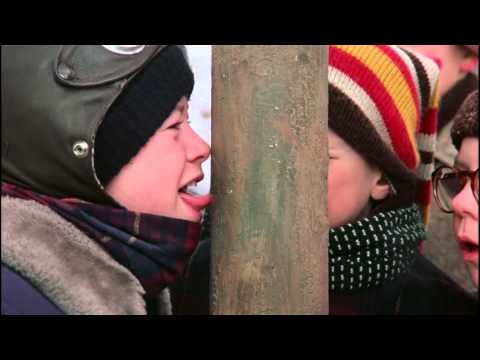
At one point I was actually getting a bit of a sweat going.  I addressed the bar, pulled, and racked the weight. It was then I realized my neck was wet and as the bar pushed down the collar of my layers of sweats it made contact with the bare, wet skin.  It was like the kid from “A Christmas Story” that stuck his tongue to the frozen, metal lamp post!  I stood there for a moment, contemplating my fate.  Finally, I dropped the weight along with the top layer of skin on my neck!

Another time I had been working out at a nice, heated gym for a time and traveled home for Christmas.  I was in the Marines at the time and took a couple weeks leave.  Of course, I didn’t want to miss a workout so I went to the old barn.  My cousin had started working out and had also been working out in a nice, heated gym.  He had really been training hard and showing progress.  I thought he was really serious and hooked.

We went to the cold, cold gym.  It was about 10 degrees out.  I went to work and about 15 minutes in my cousin was shivering and said, “I can’t take this. It’s too cold, you can’t get in a decent workout in this weather. I’m going home. See you later”.  I finished my workout and I remember thinking, “He may be right about a decent workout but it’s more than building muscle sometimes.  It’s about building a work ethic and dedication.”  I also remember thinking, “He won’t last”.  A couple of months later he quit weight training and took up bowling. Nothing wrong with that….wait….yes there is.

I once read where the perfect temperature for weight training is between 68 and 72 degrees.  Ideally, I would train between 60 and 65 degrees.  But sometimes you can’t.  I think training in extremes can still be good.  Maybe not for purely building strength, but for building perseverance.  Right now the thermometer is reading 2 degrees here.  Time to work out….in my heated gym where it’s currently 65 degrees!

Grip Strength and Suicide

By Dan Wagman, PhD, CSCS

No, no, no, my fellow meatheads, this ain’t about your grip strength being so superior, that I’m worried about some of you strangling yourselves to death, but February is around the corner–Grip Month for all-rounders…Because I always keep an eye out for new exercise physiology and sport psychology research that will improve my maximal strength, when serendipity brought me to a study looking at the link between grip strength and suicidal thoughts in the U.S., I thought I’d share the basic findings because they’re interesting.

In 2016 the U.S. suicide mortality rate was 15.3 per 100,000, well above the global rate of 10.6. Since suicide has been, and continues to be, deeply researched it’s interesting that about six studies have found a connection between lower physical quality of life and suicide along with a hint that weaker grip strength could be an indicator for suicidal thoughts. Therefore, a group of scientists lead by Chao Cao from the Washington University School of Medicine sought to explore this potential link more closely. They investigated 8,903 adults aged 20 years and older and grouped them into age categories of 20-39, 40-64, and 65 and older. Suicidal thoughts were assessed via survey and grip strength with the Takei Digital Grip Strength Dynamometer. Many variables already linked to suicide were controlled for such as diabetes, cancer, arthritis, etc., to include sociodemopraphic variables and leisure-time physical activity rates.

Complex and detailed statistical analyses revealed that a handgrip strength increase by 5 kg was associated with 16% reduced odds of having suicidal thoughts in men. No such association was found in women. When broken down by age groups, in men, a significant association between handgrip strength and suicidal thoughts were observed between the ages of 20-39 and 40-64; in males over 65 no link was found.

The main finding of this work is that males younger than 65 with low grip strength are significantly more likely to have suicidal thoughts. Of course all credible researchers mention the limitations of their work. In this particular study, the scientists point out that “this study makes it impossible to determine a causal association.” That means you cannot draw any conclusions as to whether lower grip strength causes suicidal thoughts or whether suicidal thoughts might be the cause for losses in grip strength. The researchers do point out, however, that “the association is likely bidirectional.”

To me, the pursuit of physical strength represents life itself. I find it rewarding to learn that with a scientific approach to training, the benefits can stretch far beyond the pounds lifted. Since effective and longterm strength gains depend upon credible and science-based information, should you run across someone who might appear suicidal, seek out evidence-based help.

Suicide Hotlines

Military Veterans: 800-273-8255/option1

National Suicide Prevention Lifeline: 800-273-TALK [8255]

Reference

Cao, C., et al. Handgrip strength is associated with suicidal thoughts in men: Cross‐sectional analyses from NHANES. Scandinavian Journal of Medicine, Science, and Sports. 2020;30:92–99.

Winter Lifting….

By Christopher Lestan

Its that time of year again when the snow falls, and the winter breeze gently brushes our skin and the holiday spirit is in the air. We often take time off and begin to spend time with our loved ones. We eat till our bellies are full, and tell stories of the past and plans of the future. This is why it’s one of the most beautiful times of the year.

However, training must continue as always. Yet there is something I enjoy about the winter lifting sessions that I come to appreciate and enjoy. Something about working out in my home gym, in December, in sub-freezing weather with snow covering the ground really makes me feel like a warrior. The basement is never really warm, and often a basic warm-up includes my training partners and I performing just light reps in sweat pants, sweatshirts, and a beanie. Sometimes I don’t sweat during a session. We then start to warm up the barbell by placing our hands on it using the warmth from Then we stack the plates on and perform heavy compound movements followed by long rest periods and talks about year and what we have accomplished. The main movements being comprised of squats, bench, and deadlifts each one of them being the center of attention and intensity.

The talks are what makes winter lifting my favorite. This is when the planning of the next year comes to play. When we will discuss on how to improve ourselves as people, competitors, employers, and what goals we want to achieve. My best memories are from me walking to my basement gym early in the morning when its 45 degrees in the house and soon to find my closest friends training with me on what they want to accomplish for the next year. Mine personally is to save money for the Gold Cup and to bring my closest friends and family with me so they can see my hard work on display. I have achieved my goals this year of 2019 by competing at Nationals, Worlds, and making new friends and achieving personal goals in life a well. My proudest being I got through the toughest semester of my academic career.

Another aspect of winter lifting is its intense sessions. The thought of working hard when it’s snowing outside. The heavy lifting sessions that come with breaking mental and physical barriers that have stood all year. Grinding out reps in the cold, feeling strong, but the best part is eating warm food after the workout until we are full and soon taking naps by the fire.  There shouldn’t be stress about making weight. Everyone should be eating, and growing.

Recently my training partner and I have decided that I would focus this year solely on All-Around Nationals. In deciding to do this gives me to the end of winter to get strong. Also, it allows us to train in our favorite gym…. Franks Barbell Club. The reps will be between 3-6 and accessories will be limited as working sets will be high in the hope of rest and strength will be the priority. Since we have a long time to train we can use this winter lifting mentality and push the limits and boundaries.

Enjoy the winter. Enjoy the lifting. And of course…. ENJOY THE GAINZ

2020 Postal Series

By Al Myers

The entire 2020 Postal Series Meets has been announced.  The USAWA has had a long history of promoting postal meets, and for the last several years have hosted a Postal Series, consisting of 4 quarterly Postal Meets with the last one being the USAWA Postal Championships.

The promotion of these meets are done by the USAWA, under the direction of the Postal Meet Director Denny Habecker.  All scoresheets are to be sent to Denny as he does the formula calculations for the final meet standings. There is no entry fee to enter the USAWA Postal Meets. The Postal series is sponsored by the USAWA.  However, you must be a current member of the USAWA to participate.

Postal Meets are a great way to get introduced to All Round Weightlifting. Denny picks a variety of different lifts for each meet.  Rules for the lifts are found in the USAWA Rule Book, which is available for free download from the website.

Now for the lifts of this years Postal Series!

1st Quarter Postal Meet – January 1st to March 31st
Swing – Dumbbell, One Arm
Deadlift – No Thumb, One Arm
Deadlift – 2 Bars

2nd Quarter Postal Meet – April 1st to June 30th
Curl – Cheat, Reverse Grip
Snatch – Dumbbell, One Arm
Clean and Push Press

3rd Quarter Postal Meet – July 1st to September 30th
Lateral Raise – Lying
Deadlift – Ciavattone Grip, One Arm
Continental to Belt

Postal Championships – October 1st to December 31st
Snatch – From Hang
Deadlift – Dumbbell, One Arm
Pullover and Push

All entry forms for the USAWA Postal Meets are found in upcoming events in the right column of the website homepage.

1 103 104 105 106 107 487