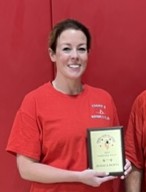
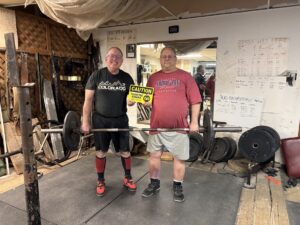
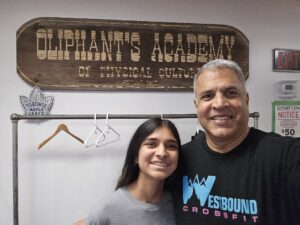
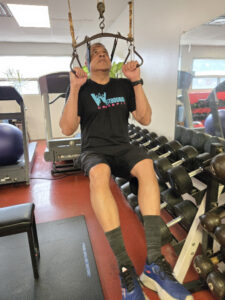
March featured Tony & Allison’s 60th Birthday Party. Riley Wenzel earned lifter of the month with an incredible 1314-pound total across a broad mix of lifts. The 1367 Lynch Points was good enough for the overall top men’s performance. His 170-pound Anderson Press was also good for the ALL-age class 75kg record. He also holds the ALL-age class record at 70kg.
Riley has been competing for just over a year and holds 67 records in the 60, 65, 70 and 75 kg weight classes.
Does the body need to be upright? Can Sumo stance be used?
I have been involved with All-Round Weightlifting for four years and have officiated in 48 USAWA competitions, but the rules of the deadlift variations always require careful study of the rulebook. I think a careful study of the rulebook is essential for every athlete, but especially those who choose to support the organization by officiating.
The question that most often comes up is does the body need to be upright? The second question that comes up is hand position and whether the hands can be inside the legs?
My understanding of the traditional deadlift is that the body needs to be fully erect (knees locked, hips open, shoulder erect). However, with one arm deadlifts, the shoulders do not need to be pulled erect. This was likely due to limb length variation which may not allow the shoulders to be erect without interference with the groin if the bar were being straddled.
My understanding of the traditional deadlift is that the arms should be outside the legs. However, arms inside the legs is often more comfortable for athletes based on limb length variation. Given this variation and the opportunity for a very wide stance, the rule book typically states that the bar needs to be above the knees when the lift is completed.
As follows are the references in the rulebook.
The Rules of the Basic Movements – Deadlift (XII.A) states that legs are straight, shoulders erect and bar motionless. It also mentions that any hand spacing may be used.
Deadlift – One Arm (B13) Bar must be raised to a point where both ends of the bar are above the knees, but the shoulders do not need to be pulled erect or the body straight as long as the legs are straight.
Deadlift – Stiff Legged (B16) This is the first mention that arms are allowed to be inside the legs.
Deadlift – Dumbbell, One Arm (E13) refers back to Deadlift – One Arm (legs straight, shoulders not erect)
Bavarian Deadlift (H4) – lifter has to use Sumo stance
Deadlift – 3” Bar (I4) – Rules of Deadlift (legs straight, shoulders erect)
Deadlift – Fulton Dumbbell One Arm (I7) refers back to Deadlift – Dumbbell, One Arm refers back to Deadlift One – Arm (legs straight, shoulder not erect)
Deadlift – Inch Dumbbell One Arm (I8) refers back to Deadlift – Dumbbell, One Arm refers back to Deadlift One – Arm (legs straight, shoulder not erect)
Pinch Grip Deadlift (I15) legs straight and body erect
Travis Lift (I24) shoulders and torso do not need to be upright
Vertical Bar Deadlift – 1 Bar, 1”, One Hand (I26) legs straight and knees locked, but shoulders and body do not need to be erect. Lifting hand must be above mid-thigh.
Did this article miss anything or are corrections required?
Do you have an idea for a USAWA website article? Consider submitting some content for the website.
The annual meeting is now only two months away. The annual meeting is confirmed for Friday, June 26. It will be held at D. Rowe’s Restaurant and Bar at 1005 Club Village Drive. Doors open at 4 PM and the evening will start at 5 PM.
New Lifts
None have been proposed and approved by the Executive Board
New lifts proposals must be sent to usawasec@gmail.com by May 28th to be considered by the Executive Board. Historically the Executive Board has considered (1) is it a new lift, (2) does it represent an all-round movement, (3) can it be performed properly by the majority of members as described in this article by Al Myers.
Officer Reports
Officers and Special Assignment Directors should consider submitting their reports in writing to usawasec@gmail.com prior to the meeting. This is not a requirement and during the past few annual meetings, reports have been given ad hoc during the annual meeting.
Treasurer Report – Bill Clark
Website Director Report – [by acting Secretary – Sanjiv Gupta] The website continues to be produced in WordPress with content being published by a handful of trusted servants. The domain is registered with Network Solutions. Curtis Cooper continues as the consultant that maintains the website and resolves issues. The website was down earlier this year due to high volume access from overseas. The website is now only accessible from the United States, UK, Australia and New Zealand. No changes are planned for the upcoming year.
Awards Director – Tony Lupo
Record Director – Tony Lupo
Drug Enforcement Director – [vacant] – Two drug tests were performed at the 2025 National Championship. One was positive, one was negative. Once a new Director is appointed, they can establish an MRO account.
Officials Director – Joe Garcia
Postal Meet Director – Denny Habecker
Social media Director – [vacant] – Facebook continues to be the primary social media platform. It is a private group with 497 members. Aside from USAWA business and announcement, some content is generated by non-USAWA members regarding historic all-round weightlifting and general odd lifting. Reddit is active with minimal content. The Instagram pages have been archived.
Override Executive Board Decisions
Sanjiv Gupta intends to motion to delete Rule “Meet directors reserve the right to remove any athlete due to disruptive behavior.” This rule was created on July 27, 2025 unanimously by the three-person board of Clint Poore, Tony Lupo and Kyle Frappier. I don’t think it is necessary and can be used to by meet directors to discriminate against athletes.
Sanjiv Gupta intends to motion to delete addendum to Section IX sub-section 4 “at the meet director’s discretion, including all USAWA national events.” This addendum was created July 27, 2025 unanimously by the three-person board of Clint Poore, Tony Lupo and Kyle Frappier. Official scoring is required per the National Championship guidelines Section X subsection 9 and this addendum creates a conflicting rule. The 33% gender allowance was unanimously passed at the 2024 Annual Meeting to align the USAWA with the IAWA and allow for women to be part of a larger competitive field and should not be overridden by three male board members.
New Business
Sanjiv intends to motion to delete Rule VI. Equipment 27. “A certified scale is required for weigh-ins in competitions or events where records are set. It may weigh in either pounds or kilograms. A scale certificate must be present with the scales and must not be older than 1 year.” Rationale – Modern digital bathroom scales are very accurate and I have not seen a scale certification in any of the events I have competed in.
Sanjiv intends to motion to remove “Level 1 – Experienced Qualified Officials” VII.9 and VII.15. Experienced qualified officials gain Level 1 status by sitting in the chair next to a certified official for 25 competitions. This has not been utilized since I have been in the organization and is unlikely to be documented and tracked well. There is an argument for keeping it if an aspiring official does not have English language proficiency.
Sanjiv intends to motion to change the rules on the Habecker Lift. The new rule for height is consistent with the other OTSM lifts and removes the potential mobility challenge of taking the bar directly from the supports.
Current Rule: “The bar will be placed at a height of one third the lifters height, measured to the bottom of the bar. The lift begins at the lifters discretion. The lifter will take the bar in the inside of the elbows between the upper arms and lower arms as in the Zercher Lift. The bar is lifted to a position where the lifter is standing fully upright with legs straight and shoulders erect. The feet must not move position during the lift, but the heels and toes may rise. It is an infraction if the bar is supported by the lifters belt. Once upright and motionless, an official will give the down command. A one minute time limit is allowed for the lifter to make a legal lift, during which time a lifter may make multiple tries. No padding of any kind is allowed on the bar or on the lifters arms. The bar must be returned to the supports under control.”
New Rule: “The bar will be placed at a height no greater than one third the lifters height, measured to the bottom of the bar. The lift begins at the lifters discretion. The lifter will secure the bar in the inside of the elbows between the upper arms and lower arms as in the Zercher Lift either directly from the supports or after deadlifting and lowering the bar to the thighs. The bar is lifted to a position where the lifter is standing fully upright with legs straight and shoulders erect. The feet must not move position during the lift, but the heels and toes may rise. It is an infraction if the bar is supported by the lifters belt. Once upright and motionless, an official will give the down command. A one minute time limit is allowed for the lifter to make a legal lift, during which time a lifter may make multiple tries. No padding of any kind is allowed on the bar or on the lifters arms. The bar must be returned to the supports under control.”
New business should be specific with references to the appropriate section of the Rulebook or By-Laws for which the change is being proposed.
Some members have expressed concerns with non-United States based athletes being full members and able to set and hold United States records, but no specific agenda item has been brought forward.
The Heavy Lift Championships have the longest history aside from the National Championships. The first event was promoted October 30, 1994, by Bill Clark and won by John Carter and Kerry Clark. Eight records still stand from that event including Bill Clark’s 1200-pound Back Lift and Kerry Clark’s 1460-pound Back Lift. The meet included at least the Harness Lift, Hip Lift and Neck Lift as well.
An article by Dale Friesz in 2010 lists all the Heavy Lift Competitions which have included Heavy Lift Championships, Schmidt’s Backbreaker Pentathlon (since 1987), and the Strongman Pentathlon (1986 & 1988). In recent years, The New England Heavy Lift Classic (2024 & 2025) could be added to that list.
Historically, five lifts were contested as part of the Heavy Lift Championship. The website has a great write up on the 2011 event which was cut down to three lifts due to venue time constraints at York Barbell. I assume, the Back Lift was removed due to needing a dedicated apparatus for a Back Lift which is not always easy to fabricate or move around. Similarly, the Harness Lift requires hand supports to achieve a true max effort.
HIP LIFT – Men’s records in the range of 2000-2500 pounds; women’s records in the range of 800-1200 pounds
Men’s Hip Lift Records
Women’s Hip Lift Records
NECK LIFT – Men’s records in the range of 500 to 800 pounds with some extreme outliers. Women’s records are lighter, but I do need to highlight Kerry Clark’s 555-pound Neck Lift in 1995. The next highest women’s record is 400-pounds by Jacqueline Caron in 1992. In the last decade, the heaviest women’s neck lift was 325 pounds by Cassie Morrison in 2016.
Men’s Neck Lift Records
Women’s Neck Lift Records
HAND & THIGH – Men’s records are around 1500 pounds. Women’s records are around 800 pounds.
Men’s Hand & Thigh Records
Women’s Hand & Thigh Records
In recent years, the top lifts at the heavy lift contests have been lower. The athletes are lifting amazing numbers, but they are a fraction of the weights lifted by athletes in the first decades of the organization.
This year’s Grip Championship was an all-Colorado event. Nisha and Kim lifted in flight 1 and Sanjiv, Jarrod and Joshua lifted in flight 2. Weigh-ins and rules briefings were conducted and the meet was contested using the one official system.
We started with Pinch Grip, Deadlift, One Hand. This is the first time the lift was contested at the Grip Championship and mistakes were made. Flight 1 set the plates up vertical to the platform and had top lifts under 30 pounds. Essentially, they did a Pinch Grip Strict, One Hand. Jarrod correctly pointed out the error and Flight 2 set up the plates horizontal to the platform. Flight 2 all had good lifts at 100 pounds or more. Kim and Nisha declined the option to repeat their lifts. For record purposes, they should be recorded as Pinch Grip Strict, One Hand.
Next was the Deadlift, Fulton Dumbbell, One Hand. This was the fifth time this lift has been contested at the Grip Championship, and some big numbers were put up. The women’s field accounted for Age Class and ALL age records in their weight classes.
Next was another favorite, the Vertical Bar, 1”, One Hand. This was the third time this lift has been contested in the Grip Championship and athletes who competed in Tony & Allison’s Birthday Bash got to test their max lifts recently. At 86 pounds on a fourth attempt for a record, Nisha was the only athlete to set a record in this lift.
The last competition lift was the Deadlift, 3” Bar. Records were set across the board. Everybody was feeling the effects of the first three lifts, but everybody also knew what they needed to hit the overall field. Jarrod narrowly missed his third attempt at 355 pounds, securing Sanjiv’s position atop the men’s field. Joshua followed suit attempting 355 pounds on his third attempt.
The Pinch Grip Clean & Press, One Hand was offered as an exhibition lift. This is an IAWA lift and the IAWA rules were followed.
The lifter will grip the weight, either in front or to the side, as in the one hand pinch lift. The lifter will clean the weight to the shoulder and stand ready for the signal to press. The lifter will be standing erect with the weight held at the side of or just above the deltoid muscle, or even resting on the shoulder muscle (if desired). The stance is as for the start of any pressing movement, foot spacing is optional, but the feet will be parallel to the lifters front. On the referees signal the weight will be pressed out to arm’s length, as in the one hand dumbbell press. On completion the referee signals to replace the bar.
All athletes were able to complete the lift. However, maintaining a plate width spacing on the lighter loads required the use of foam spacers to achieve an outside spacing of 2.25-2.50 inches. The other challenge with lighter lifts was incremental plate loading. We utilized magnetic weight attachments so that athletes could still get a full grip on the plates.
Nisha – 15, 17.5, 20 pounds
Kim – 20, 22.5, 24 pounds
Sanjiv – 25, 28 pounds
Joshua – 28, 35 pounds
Jarrod – 25, 28 pounds
The consensus was that it was not a fun lift. As the weights approached maximum efforts, missing a lift resulted in an explosion of weight and collars as the plates came crashing down. The width of the rod was also a concern as the rod was coming dangerously close to the lifter’s ear. When I watched a video of Matt Jones’ 30-kg lift, it appear he used two 10kg plates, a 12-18 inch metal rod and 2.5 kg and 1.25 kg change plates along with collars. Our best lift was 35 pounds (16kg). Joshua attempted 50 pounds (23kg), but the weight slipped and went crashing to the floor.
Complete Results:
USAWA Grip Championship High Country Vigour Lakewood, Colorado April 4, 2026 Meet Director: Sanjiv Gupta Scorekeeper: Sanjiv Gupta
Officials: (1-official system) Sanjiv Gupta, Jarrod Fobes, Kim Van Wagner, Nisha Gupta
The Lifts: Pinch Grip Deadlift, One Hand; Deadlift, Fulton Dumbbell, One Hand; Vertical Bar, 1 Bar 1”, One Hand, Deadlift, 3” Bar
Bodyweight and Lifts in Pounds
WOMENS DIVISION
Lifter
Age
BW
Strict Pinch
Fulton
V-Bar
3” Bar
Total
Points
Kim
58
127.6
27.5 (R)
81 (L)
86 (L)
154
348.5
661.3
Nisha
17
87.3
22.5 (R)
61 (R)
76 (R)
88
247.5
610.7
MENS DIVISION
Lifter
Age
BW
Pinch
Fulton
V-Bar
3” Bar
Total
Points
Sanjiv
54
208.5
120 (L)
126 (L)
156 (L)
315
717
719.2
Jarrod
48
206.5
100 (R)
141 (L)
161 (R)
305
707
675.8
Joshua
41
257.1
120 (R)
136 (R)
161 (R)
305
722
575.7
Pinch Grip Clean & Press, One Hand [Exhibition]
Lifter
Age
BW
OH Pinch C&P
Lynch
Kim
58
127.6
24 (R)
45.5
Nisha
17
87.3
17.5 (R)
43.1
Sanjiv
54
208.5
28 (R)
28.1
Joshua
41
257.1
35 (R)
27.9
Jarrod
48
206.5
28 (R)
26.7
4th Attempts for Records
Kim Van Wagner Pinch Grip Strict, One Arm, Right – 30 pounds Vertical Bar, 1”, 1 Bar, One Arm, Left – 91 pounds Deadlift, 3″ Bar – 164 pounds
Nisha Gupta Vertical Bar, 1”, 1 Bar, One Arm, Right – 86 pounds
To determine the overall winner, the meet director decided to take the Age-Weight-Gender Lynch Totals of the three lifts performed to the same rule set:
Kim Van Wagner – 321 total pounds – 609 Lynch points
Sanjiv Gupta – 597 total pounds – 599 Lynch points
Jarrod Fobes – 607 total pounds – 580 Lynch points