Lift Programming
I would like to share the programming style I used for USAWA meets.
With the number of meets and lifts in the USAWA, programming efficiency is key not to over train while still competing competitively in several lifts.
The simple strategy I used was;
Combine the “main” weight of one lift to be the “warmup” weight of another.
For example, if you are training for a split jerk, push press the lighter warmup weights. While you are doing warmup weights for push press, strict press them.
Obviously if your form needs work, you need the reps but if your skill and strength are adequate, squeeze in an extra lift or two.
My deadlift strategy for the longest time is to use thumbless until grip starts to fail, then double over, and finally alternate grip. It allowed me to train 3 styles of deadlift without one impacting another. Train for 3 types of lift without any programming changes off the bat.
Once the weights are programmed, the goal is to hit the prescribed reps for each deadlift type but if the grip starts to fail, the barbell is floored, and the next grip is taken to finish out the reps and the workout carries on.
When training for meets, specific changes are made. This could be adding a lift or replacing a lift plus equipment changes e.g. Fulton deadlifts. Also singles for the meet lift will be added.
If finger deadlifts are on the horizon, they would be added first, becoming the warmup to the thumbless deadlift.
If there’s a Peoples deadlift, the no thumb deadlift may be removed to save strength and to start at a higher poundage. The Peoples deadlift would continue after the alternate grip deadlift.
If you are going for a thumbless record, this is going to be pushed followed by a few extra singles before the full grip deadlift. You’ll then perform the rest of the deadlifts in the series to “keep the wheel greased” but you won’t push them.
I used my PR’s from 2020 for the example below. Using the 531 method by Jim Wendler, I took 90% of these PR’s to calculate an individual workout for each.
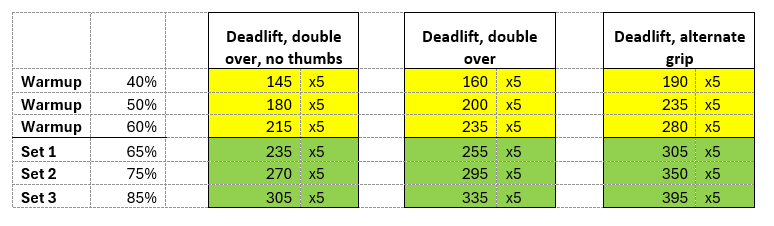
So instead of 3 workouts with 3 separate warm-ups, they will be combined into one workout;
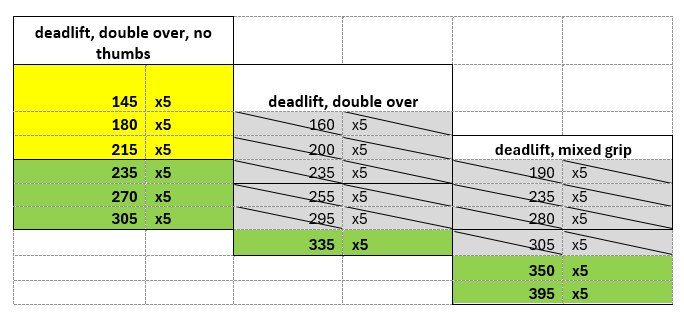
The greyed out poundage is made redundant by the previous lift. You’ll need to decide where one lift ends, and another begins based on the poundages. Since “no thumbs” ends at 305, the closest weight to that (and lower) will be ignored, thus “double over” will start on its last set of 335. Then “mixed grip” will finish its last two sets. If you feel you need more work on x lift, just repeat the last lift weight with the new lift. E.g. after “no thumbs” 305×5, do “double over” 305×5, then 335×5.
Meet manipulation example 1
Say the next meet has a no thumb one arm deadlift, since they are the lightest, they are placed at the start and will replace part of the “no thumbs” warmup. Since both hands will be trained, I drop the reps to 3 and do each arm per set. Also since these are “no thumb” you may want to only do a few sets of “double over, no thumb” and jump early to “double over” as to not stress the thumbless grip.
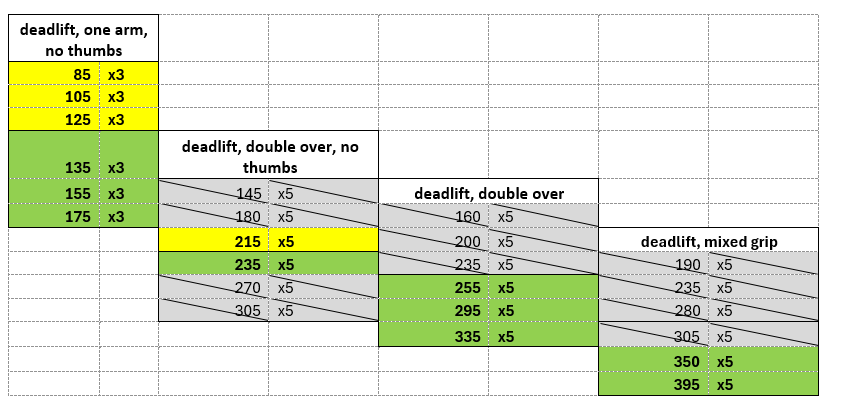
Meet manipulation example 2
Maybe there’s a meet with the “peoples deadlift” and a Postal the following week with “double overhand”. Since “Peoples” is a heavy lift, you may want to strip down the sets, so “no thumbs” is reduce to a couple of warmup sets to still get some training in, then the lift is switched to “double overhand” for the rest of the warmup and main lift. Some singles are added to train strength before a set of “mixed grip” as a filler to warm up for the “peoples deadlift”.

While these all use the same bar, there is no reason dumbbell lifts like one hand/two hand, Fulton, Inch etc can be used early as well as a Fulton barbell lifts.
The same process can be used as a dumbbell workout, regular > to fulton > to inch.
There are many USAWA lifts that can be “cheated” into another lift’s progression. Even just combining two that fit well will make a difference.
Hope this was helpful to anyone struggling to program many lifts into their routine.