Masters Benching Secrets

by Roger LaPointe

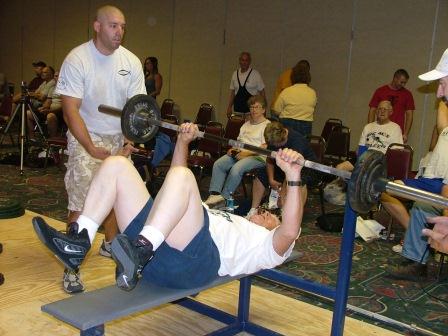
Rudy Bletscher, at 70 years of age, performing a Feet in the Air Bench Press at the 2006 USAWA National Championships.

How much do you bench?

How many times have you been asked that question?

To me, the bench press is an exercise. To other people, I know it can be a way of life. For the Masters Age lifter, it can be an enigma..

I have recently been doing more bench pressing, because of my focus on the Crucifix Hold records. Thanks to a torn rotator cuff twelve years ago, I quit doing regular bench pressing. Now, thanks to the Indian Clubs, I am not so hesitant to bench. It used to put that shoulder out of commission for a week, or two, if I pushed it at all.

5 Training Lifts for the Master Bencher

  1. Crucifix Hold – I deal with a lot of Masters Age lifters and we all seem to have our particular collection of injuries, big or small. The Crucifix Hold is a funny lift. I have definitely found the classic flat bench press to be a helpful training lift to help with the crucifix 1RM, and vise versa.
  2. Olympic Power Clean and Press – Don’t use a super arched lay back, like the Russians of the early 1970s, instead press like Schemansky. Jim Bradford told me that Norb (Schemansky) told him he needed to “massage the bar”. My buddy Dave Pohlzin has been teaching me to do it. It’s pretty cool. One day I hope to Clean & Press more than I can bench.
  3. Incline Dumbbell Bench Pressing – Man, you need to crush it like Casey. I have an old Meet poster from Dr. Ken’s Iron Island Gym with a photo of Pat Casey doing incline dumbbell benches with some dumbbells that look to weigh around 220 pounds. Awesome. Most guys over do it with the flat benching and develop tendonitis and other problems at the point where the pecs, front delts and biceps meet at the front of the arm pit. This helps to avoid that problem.
  4. Side Lateral Raises – I know you have heard it a million times before but you really do need to avoid muscle imbalance in the delts. On some of these things, the bodybuilders have it right. If you hate this classic bodybuilder movement, try a one arm barbell snatch high pull. I won’t beat a dead horse on this concept. Just try it.
  5. Dumbbell Bent Over Rows – This will solidify the shoulder girdle like nothing else you can do.

Round out these movements with Indian Club work. Masters lifters all seem to have rotator cuff and biceps problems. In many cases, the Indian Clubs seem to solve that problem. They will help you bench more weight. Follow up the Indian Club work with the 5 exercises listed above and you might be benching more than when you were in your 20’s.

Roger LaPointe
“Today is a good day to lift.”

RULE CHANGE – Feet in Air Bench Press

by Al Myers

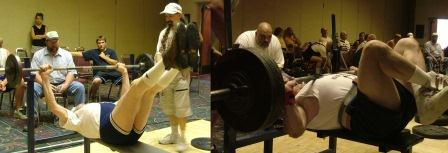
These are the two ways the Feet in the Air Bench Press must be performed - legs straight off the bench (left) or with legs crossed (right). No longer is a support bench allowed to rest the lower legs on. These pictures were taken at the 2006 USAWA National Championships. Dennis Mitchell is lifting in the picture to the left, with head official Bob Burtzloff seated behind him. Al Myers is lifting in the picture on the right, with head official Thom Van Vleck looking on (and intently I might add!)

One of the IAWA rule changes that happened at the 2011 IAWA World Meeting involved the rule for the Bench Press – Feet in Air.   This proposed change was presented by the IAWA Technical Committee at the meeting, chaired by IAWA Technical Committee Chairman Dennis Mitchell.  The “issue” involved disallowing a support bench during the lift, which has been allowed under previous IAWA rules.  The USAWA rules have NEVER allowed the legs to rest on another (a totally separate) support bench.  This issue was discussed at this past years USAWA meeting as well.  These past couple of years rule changes have been presented to the USAWA   membership to bring our rules (the USAWA rules) into compliance with IAWA rules.  You would be surprised how many differences there are.  All of the other changes were passed at this meeting, but the USAWA membership voted NOT to allow a support bench to rest the legs on.  This decision led to this being presented to the IAWA Tech Committee to see how the IAWA membership felt on it.  There was some opposition, but the majority in attendance felt that a support bench was not within “the intent” of the feet in the air bench press.  Thus the IAWA rule is now changed, and the USAWA rule and the IAWA rule is the same on this now. The bottom line – NO SUPPORT BENCH!

As I’ve said before, there are many subtle (and some not so subtle!) rules differences between the USAWA Rules and the IAWA Rules. These rules differences can make some lifts harder or easier, depending on which rules you follow.  I would say DEFINITELY having a support bench to rest the lower legs on is an advantage as it would provide more balance to the lifter resting on the bench during the press.  That is one of the biggest difficulties in the feet in the air bench press, maintaining proper body position as you press the weight up.  The interesting thing is that this difference between the IAWA rules and the USAWA rules came about because of how the original rule was interpreted.  The original rule stated that the “ankles and heels” must not be supported or resting on the floor.  This was interpreted by IAWA as meaning the lower legs WERE allowed to be supported by a support bench, whereas the USAWA made the assumption that NO PARTS of the legs could be supported.  Again, I’ve said this before and I’ll say it again, THERE SHOULD BE NO INTERPRETATIONS WHEN IT COMES TO THE RULES, everything should be “spelled out” and very clear in what is allowed and not allowed! 

But this leads to an even bigger issue.  What about all the IAWA World Records that were set by lifters resting their feet/lower legs on a support bench?  Should these records still count?  And how would you go about identifying these cases? It will definitely take a much better effort to break one of these records in the IAWA World Record List from now on.  Also, what about all of the other differences between the IAWA rules and the USAWA rules where rule differences might give an “added advantage” to set World records?   These are issues that need to be worked out in my opinion.